

Key Takeaways
Our Verdict
Therapy, counseling, and psychiatry are complementary rather than competing options. Choosing between them depends on the nature and severity of your concerns - whether you need structured talk-based support, short-term guidance, or medication management. Many people find the most benefit from a coordinated care approach involving more than one provider type.
| Best for | Recommended |
|---|---|
| Those seeking long-term talk-based treatment for emotional or behavioral patterns | Therapy (Psychotherapy) |
| Those navigating a specific life challenge or transition | Counseling |
| Those whose symptoms may have a biological component or who need medication evaluation | Psychiatry |
| Those with complex or treatment-resistant conditions | Combined therapy and psychiatry |
Why the Distinctions Matter
When you decide to seek mental health support, the first question you'll likely face is: who should I see? The terms therapist, counselor, and psychiatrist are often used interchangeably in everyday conversation, but they describe meaningfully different professionals with different training, tools, and areas of focus.
Understanding these differences isn't just an academic exercise - it helps you advocate for yourself, set realistic expectations, and connect with the right kind of care sooner. If you're newer to mental health terminology, our plain-language mental health glossary is a helpful place to build your foundation before diving deeper.
This article is for general informational purposes only and is not a substitute for personalized medical or mental health advice. Always consult a qualified professional about your individual situation.
Therapy, Counseling, and Psychiatry: A Side-by-Side Look
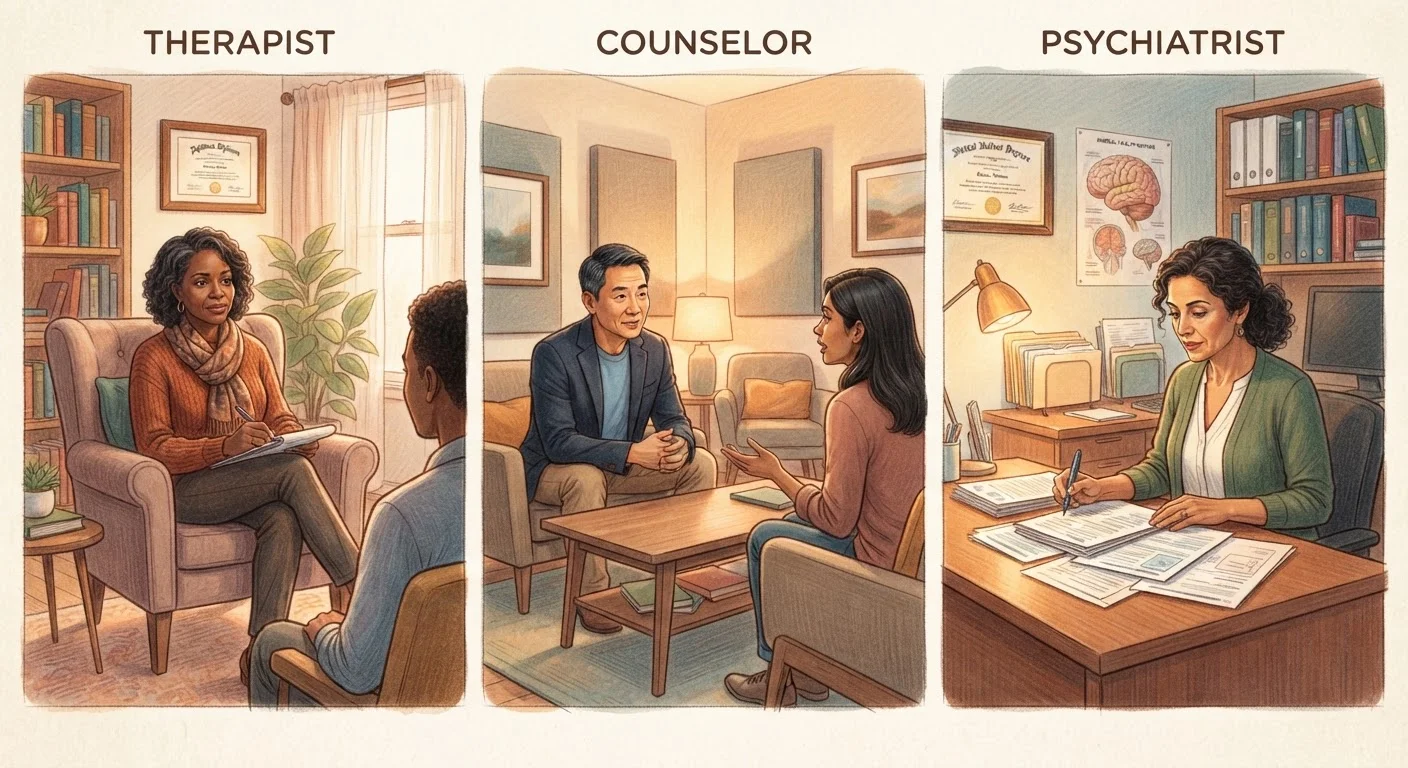
Each discipline approaches mental health from a different angle. Here's how they compare across key dimensions that matter to most people seeking care.
| Therapist | Counselor | Psychiatrist | |
|---|---|---|---|
| Typical degree | Master's or doctoral (psychology, social work) | Master's (counseling, education, social work) | Medical degree (M.D. or D.O.) + residency |
| Can prescribe medication | Generally no | No | Yes |
| Primary treatment method | Psychotherapy (talk-based) | Talk-based, often goal-focused | Medication management, sometimes therapy |
| Typical session focus | Patterns, emotions, behavior change | Specific challenges or transitions | Diagnosis, medication, symptom monitoring |
| Treatment duration | Often long-term | Often short- to medium-term | Ongoing as needed for medication |
| Best suited for | Emotional and behavioral concerns | Life challenges, specific issues | Complex or biologically-rooted conditions |
It's worth noting that licensing and titles vary by state. For example, a Licensed Clinical Social Worker (LCSW) or Licensed Professional Counselor (LPC) can provide therapy in most states. Always verify a provider's credentials and licensure with your state's regulatory board.
What Therapists and Counselors Actually Do
Psychotherapy - commonly called "therapy" - involves structured, evidence-based conversations designed to help people understand and change thought patterns, emotional responses, and behaviors. Therapists typically hold a master's or doctoral degree in psychology, social work, or a related field and are trained in modalities like Cognitive Behavioral Therapy (CBT), Dialectical Behavior Therapy (DBT), or psychodynamic therapy.
Counseling is closely related but often more focused. A counselor may work on a specific concern - grief, career transitions, relationship conflict, or substance use recovery - over a shorter timeframe. School counselors, addiction counselors, and marriage and family therapists all fall under this broader umbrella.
Not Sure Which Type of Provider to See?
Starting with your primary care physician is a practical first step. They can conduct a general mental health screening, rule out physical causes for symptoms, and provide a referral tailored to your situation. Many people find this removes much of the guesswork from the process.
Both therapists and counselors use talk-based approaches and generally cannot prescribe medication in most U.S. states (with a few exceptions for specially licensed psychologists in certain states). Their power lies in helping clients build insight, coping strategies, and behavioral skills. You can also explore how digital formats compare to in-person sessions in our look at therapy apps versus in-person counseling.
What Psychiatrists Bring to the Table
Psychiatrists are medical doctors (M.D. or D.O.) who completed medical school, a general residency, and then specialized in psychiatry. This medical background distinguishes them in one key way: they can prescribe and manage psychiatric medications, such as antidepressants, mood stabilizers, or antipsychotics.
Psychiatrists are especially important when symptoms are severe, have a biological or neurological component, or haven't responded to therapy alone. Conditions such as bipolar disorder, schizophrenia, or major depressive disorder with significant functional impairment often warrant psychiatric evaluation.
1 in 5
U.S. adults experiencing mental illness annually
According to the National Institute of Mental Health, roughly one in five U.S. adults lives with a mental illness in any given year.
~50%
Adults with mental illness who receive treatment
The Substance Abuse and Mental Health Services Administration (SAMHSA) estimates that fewer than half of adults with mental illness receive treatment in a given year.
Many psychiatrists today focus primarily on medication management and work collaboratively with a therapist who handles ongoing talk-based care. This coordinated model - sometimes called "split treatment" - can be highly effective. It's one reason that seeking multiple types of support isn't a sign of severity but often of thoughtful, comprehensive care.
It's worth challenging the notion that needing medication signals weakness or that therapy is only for people in crisis. Our related piece on mental health myths that still mislead people addresses these and other common misconceptions directly.
How to Choose Your Starting Point
There's no single right entry point into mental health care. A useful general framework:
- Start with your primary care provider if you're unsure - they can conduct an initial screening and refer you appropriately.
- Consider a therapist or counselor if your concerns center on stress, relationships, anxiety, grief, or day-to-day coping.
- Consider a psychiatrist if you're experiencing symptoms that significantly impair your ability to function, if previous therapy hasn't helped, or if your doctor suspects a biological component.
- Consider both if you're already in therapy and finding it insufficient, or if a psychiatrist recommends therapy alongside medication.
Complementary self-directed practices - like mindfulness and meditation - can support, but not replace, professional care. See how those two practices compare in our overview of mindfulness vs. meditation. For a broader look at everyday mental wellness strategies, the comprehensive everyday mental wellbeing guide is a thorough resource.
This article is for general informational and educational purposes only. It is not medical or mental health advice, and it does not substitute for the guidance of a licensed healthcare professional. If you are experiencing a mental health crisis or emergency, please contact emergency services or a crisis line immediately.