

Key Takeaways
Nutrition Facts Label
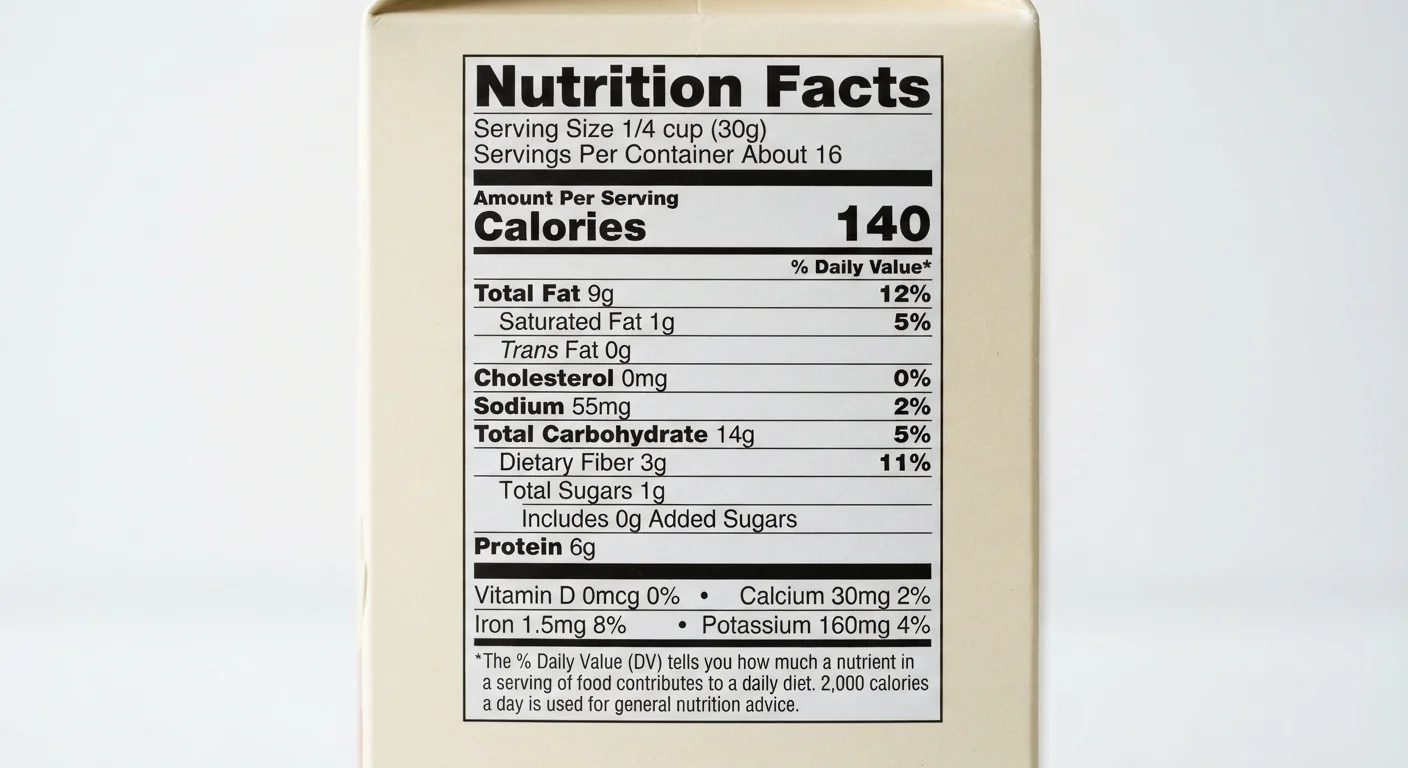
The Nutrition Facts label is the standardized panel required by the FDA on most packaged foods sold in the United States. It lists serving size, calorie count, and the amounts of key nutrients per serving. The label is designed to help consumers understand what they're eating and compare foods more easily.
The current label format, updated by the FDA in 2016 and phased in through 2020, reflects newer scientific understanding of nutrition - including added sugars as a distinct line item and updated Daily Values based on more recent dietary research.
Start Here: Serving Size Is the Foundation
Every number on the Nutrition Facts label refers to a single serving - not necessarily the whole package. This is the most commonly overlooked detail, and it changes everything. If a bag of chips lists 150 calories per serving but contains three servings, eating the whole bag means consuming 450 calories.
Serving sizes are standardized by the FDA based on typical consumption amounts. They're reference points for comparison, not portion recommendations. A "serving" of ice cream may be listed as two-thirds of a cup - a reasonable reference, but not always what ends up in the bowl.
Once you know the serving size, every other line on the label makes sense relative to that amount. This is the first and most essential step to reading any food label accurately.
Check Servings Per Container First
Before reading any other number on the label, look at "servings per container" at the very top. A small package that appears to be one serving may actually contain two or three. Multiplying all nutrient values by the number of servings you actually eat gives you a far more accurate picture of what you're consuming.
Calories, Macronutrients, and What They Signal
Below serving size, the label displays calories - the total energy one serving provides. This counts energy from all three macronutrients: carbohydrates, fat, and protein. For a deeper look at what each of these does in your body, see our plain-English introduction to macronutrients.
The label then breaks down each macronutrient in grams:
- Total Fat - broken into saturated fat and trans fat as sub-lines. Saturated fat has a %DV; artificial trans fat intake is broadly advised to be as low as possible.
- Total Carbohydrate - includes dietary fiber and total sugars, with added sugars listed separately beneath total sugars.
- Protein - listed in grams. A %DV for protein only appears in certain contexts, such as products marketed for children under four.
These figures give you a picture of a food's nutritional composition - not a verdict on whether it's "good" or "bad."
2,000
Calories used as the %DV reference benchmark
The FDA bases all % Daily Value figures on a standard 2,000-calorie daily diet, which serves as a general reference for adults.
5% or less
% DV considered low for any nutrient
According to FDA guidance, a %DV of 5% or less per serving indicates a food is a low source of that nutrient.
20% or more
% DV considered high for any nutrient
The FDA's label reading guide identifies 20% DV or more per serving as a high amount - useful for spotting both beneficial nutrients and those to limit.
Decoding % Daily Value
The right-hand column of the Nutrition Facts label shows % Daily Value (%DV) for most nutrients. This figure tells you what percentage of the recommended daily intake for that nutrient one serving provides, based on a standard 2,000-calorie daily diet.
The FDA offers a practical shorthand: 5% DV or less is considered low for a nutrient; 20% DV or more is considered high. This makes it easy to quickly assess whether a food is a meaningful source of fiber or calcium, or whether its sodium content warrants attention.
Keep in mind that %DV is a general reference tool. Individual calorie needs vary based on age, sex, activity level, and health status. A 2,000-calorie benchmark is a reasonable average for many adults, but not a universal prescription. If you have specific health goals, a registered dietitian can help you interpret these numbers in context.
Not Every Food Requires a Nutrition Facts Label
Fresh produce, raw meat, and most restaurant foods are not required to carry a Nutrition Facts panel under FDA rules. Certain very small businesses and some specialty foods may also be exempt. When a label isn't available, nutrition databases maintained by the USDA can serve as a reference for general nutrient information.
Nutrients to Encourage - and Nutrients to Watch
The label groups nutrients into two broad categories based on public health guidance:
Nutrients many Americans tend to get enough of or over-consume - including saturated fat, sodium, and added sugars - appear toward the top of the nutrient list. High %DV figures for these are a cue to take note.
Nutrients many Americans tend to under-consume - including dietary fiber, vitamin D, calcium, iron, and potassium - appear lower on the label. For these, a higher %DV per serving is generally a positive sign.
Added sugars deserve special attention: they're listed separately from naturally occurring sugars so you can distinguish between sugar inherent to a food (like the lactose in yogurt) and sugar added during manufacturing. Current dietary guidance broadly recommends limiting added sugars, making this line item one worth checking regularly.
For context on how marketing language on the front of the package relates to what's on the back, see our article on reading between the lines on food marketing claims.
This article is for general informational and educational purposes only and is not a substitute for personalized nutrition or medical advice. Consult a registered dietitian or qualified healthcare professional for guidance tailored to your individual health needs.