

Key Takeaways
Why Review Literacy Matters More Than Ever
Online reviews have become one of the primary ways American consumers evaluate purchases, from a $15 phone case to a $1,500 appliance. But the ecosystem around reviews has grown complicated. Sellers have financial incentives to manipulate ratings, platforms vary widely in how aggressively they police abuse, and the sheer volume of feedback available can create an illusion of trustworthiness where none exists.
This isn't a reason to ignore reviews - it's a reason to read them differently. The same critical instinct that helps you evaluate food marketing claims applies here: what looks like objective information often has a layer of commercial interest underneath it. With a structured approach, reviews become a genuinely useful research tool rather than a source of false confidence.
Fake Reviews Are a Known, Widespread Problem
The Federal Trade Commission has taken enforcement action against fake review practices, and major platforms have faced scrutiny over manipulated ratings. This means no single platform's star average should be treated as ground truth. Always verify across sources before making a significant purchase decision.
What You'll Need Before You Start
No special skills are required to evaluate reviews critically - just a willingness to slow down and look beyond the summary number. Having a few basic resources on hand makes the process faster and more reliable.
Multiple retail or review platforms
Cross-checking ratings across different sites helps identify patterns that suggest manipulation on any single platform.
Browser extension for review analysis
Third-party tools (widely available for major browsers) can flag suspicious review patterns on popular retail sites automatically.
Review sorting and filtering tools
Built-in platform filters let you sort by star rating, recency, or verified purchase status to surface the most useful feedback.
What you will need
Sort by Most Critical, Not Most Recent
Most platforms let you filter reviews by star rating. Reading the two- and three-star reviews first gives you a balanced picture faster than scrolling through five-star praise. These mid-range reviewers tend to describe real-world trade-offs with specifics that marketing copy never will.
How to Read Reviews Step by Step
Follow these steps in order when researching any significant purchase. You won't always need every step for a low-stakes item, but for anything involving meaningful cost or long-term use, working through the full process will serve you well.
Look past the overall star rating
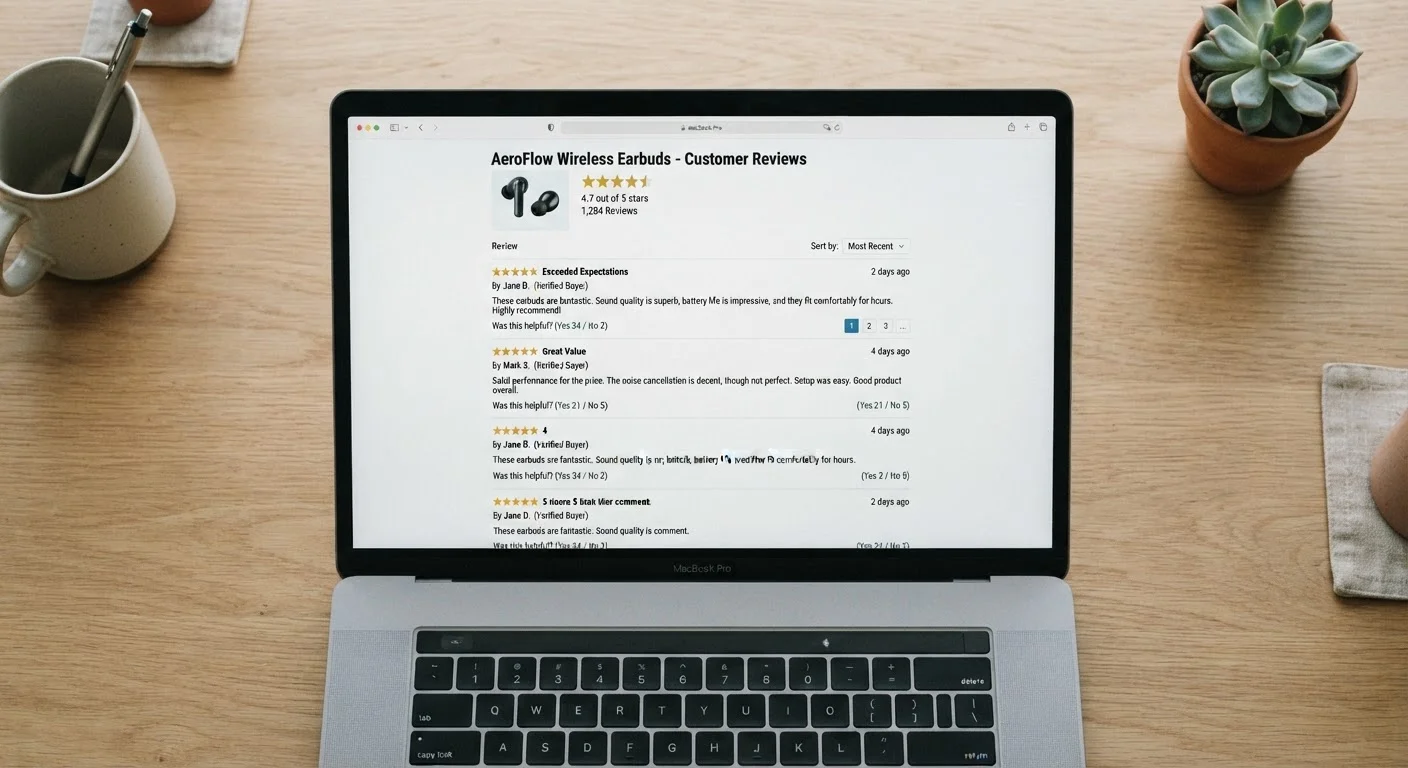
A 4.6-star average across 12 reviews means something very different from a 4.6-star average across 4,800 reviews. Start by noting the total review count alongside the rating. Small sample sizes swing dramatically with just a few reviews. Also check when the bulk of reviews were posted - a spike of activity over a short window, especially around a product launch, can indicate an organized effort rather than organic feedback.
Prioritize verified purchase reviews
Most major retail platforms flag whether a reviewer actually bought the product through that platform. Prioritize these verified purchase labels - they're not foolproof, but they raise the bar for manipulation. Unverified reviews, including those from brand websites only, carry less weight and deserve extra scrutiny before you rely on them.
Read for specific, verifiable details
Genuine reviewers tend to describe how they used the product, what problem it solved, and what fell short. Look for mentions of specific features, dimensions, materials, or use cases. Vague praise like "amazing product, love it!" with no supporting detail is a weak signal. A review that says "the zipper on the left pocket jammed after three weeks of daily use" is far more informative and harder to fabricate at scale.
Identify suspicious patterns in the rating distribution
Open the full rating breakdown - the bar chart showing how many reviews fall at each star level. A healthy distribution typically forms a rough J-curve or bell shape, with most reviews clustered at four and five stars, a smaller dip in the middle, and a modest number of one-star responses. Red flags include:
- A nearly empty middle - almost no two-, three-, or four-star reviews
- A sudden surge of five-star reviews concentrated within a few days
- One-star reviews that describe completely different products than the five-star reviews
That last pattern sometimes indicates the seller has changed the product listing after accumulating reviews for a different item - a known practice on some marketplaces.
Cross-reference across platforms
A product sold in multiple places - a retailer's website, a general marketplace, and the manufacturer's own site - will often have reviews on more than one platform. If ratings diverge sharply between platforms, that gap is worth investigating. Independent review aggregators and consumer forums can also surface experiences that never make it onto a seller's product page. This multi-source approach mirrors the kind of critical reading described in our electronics specs guide, where a single number rarely tells the whole story.
Apply your findings to the purchase decision
After gathering evidence across these steps, you should have a clearer picture of what a product genuinely delivers versus what its marketing claims. Weigh the specific recurring criticisms against your use case - a flaw that matters deeply to one buyer may be irrelevant to you, and vice versa. If you're still uncertain, check the return policy before committing. Our return policies guide explains what to look for beyond the basic refund window.
Watch Out for Review Gating
Some sellers ask customers for feedback privately and only direct satisfied shoppers to leave public reviews - a practice called review gating. This artificially inflates ratings. If a product has thousands of reviews but almost no three-star responses, that imbalance itself is a warning sign worth investigating.