

Key Takeaways
Our Verdict
Both the debt snowball and debt avalanche are proven frameworks for systematically eliminating debt. The avalanche is generally more cost-efficient over time, while the snowball tends to sustain motivation through early progress. The right choice depends on whether you are more driven by math or by momentum.
| Best for | Recommended |
|---|---|
| Those who need early wins to stay motivated | Debt Snowball |
| Those focused on minimizing total interest paid | Debt Avalanche |
| Those with several high-rate balances of similar size | Debt Avalanche |
| Those with many small balances creating mental clutter | Debt Snowball |
What the Two Methods Have in Common
Before comparing the approaches, it helps to understand their shared foundation. Both the debt snowball and the debt avalanche assume you will make minimum payments on every debt you carry, then direct any extra money toward one targeted debt at a time. When that target is paid off, the freed-up payment gets redirected to the next one — a practice often called a "payment rollover."
Neither strategy requires a large income or a perfect credit score. What they both require is a consistent monthly surplus — even a small one — above your minimum obligations. If your budget is already stretched thin, revisiting core budgeting strategies can help you identify room to apply either method.
Both approaches also work best when paired with a commitment to stop adding new debt. Eliminating balances while accumulating new ones can undermine progress regardless of which method you choose. For a broader look at how different debt types interact, see the complete picture of personal debt in America.
How the Debt Snowball Works
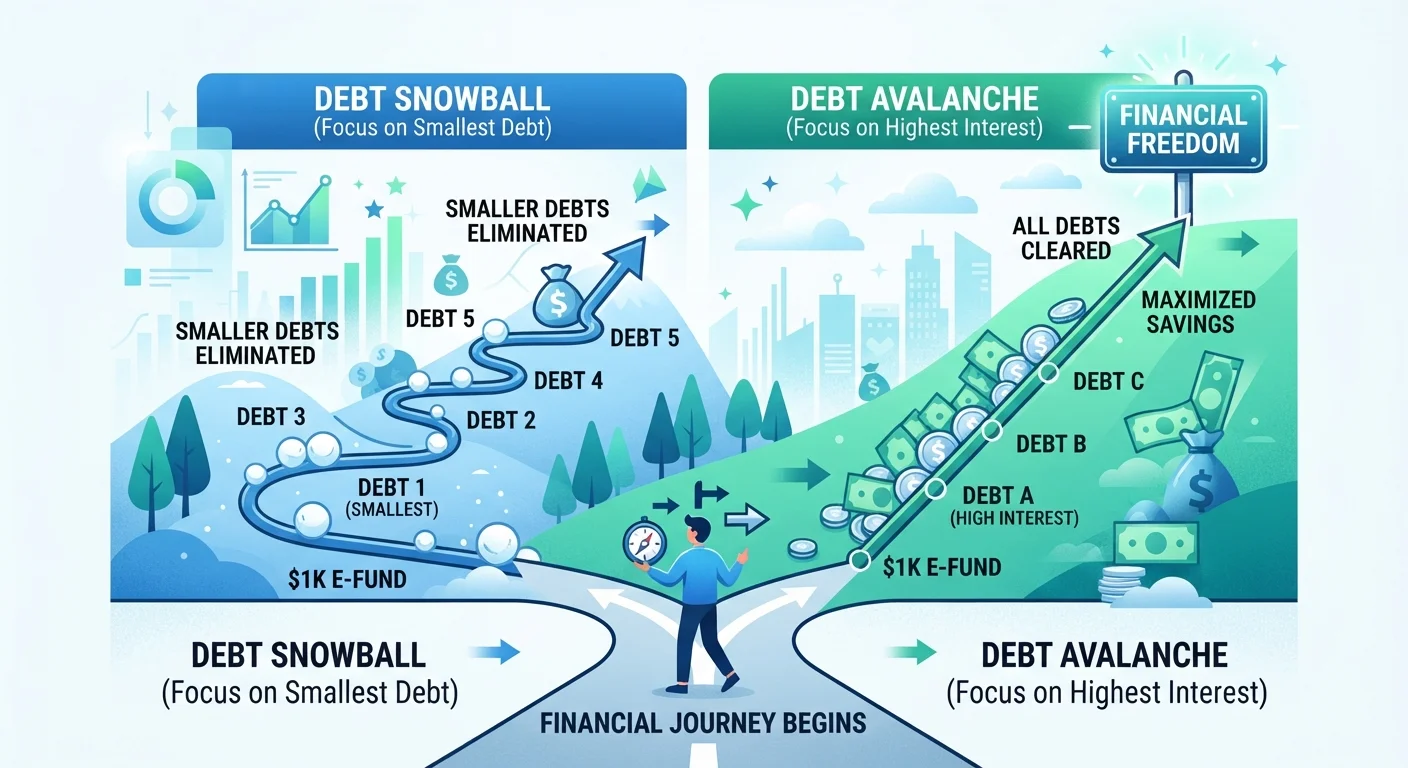
The snowball method, popularized by personal finance educator Dave Ramsey, organizes your debts from smallest balance to largest — regardless of interest rate. You put all extra money toward the smallest debt until it's gone, then roll that freed payment into the next-smallest balance.
The logic is psychological. Paying off a full account, even a modest one, delivers a concrete sense of accomplishment. Research in behavioral economics suggests that these small victories can reinforce the habit of paying down debt, making people more likely to stick with a repayment plan over time. The trade-off: because you're ignoring interest rates, you may end up paying more in total interest than you would with the avalanche.
Track Account Eliminations, Not Just Balances
Rather than focusing solely on the dollar amount you've paid down, mark each fully closed account as a milestone. Seeing a shorter list of debts each month is a concrete visual reminder of real progress — particularly helpful during longer repayment timelines. A simple spreadsheet or a debt-tracking app can make this easy to maintain.
The snowball is particularly effective for people managing a large number of separate accounts — for example, multiple store credit cards or medical bills — where account consolidation feels overwhelming.
How the Debt Avalanche Works
The avalanche method organizes debts by interest rate, from highest to lowest. You direct extra payments to the highest-rate balance first, regardless of its size, while maintaining minimums on all others. Once that debt is eliminated, the payment rolls down to the next-highest rate.
Mathematically, this approach minimizes the total interest you pay over the life of your repayment plan. If your highest-rate debt also happens to be a large balance, the payoff may take longer than the snowball's first milestone — which is why consistency and patience matter more with this method.
| Debt Snowball | Debt Avalanche | |
|---|---|---|
| Ordering principle | Smallest balance first | Highest interest rate first |
| Total interest paid | Typically higher | Typically lower |
| Time to first payoff | Usually faster | Can take longer initially |
| Psychological motivation | High — frequent early wins | Lower — progress less visible early |
| Best suited for | Many small accounts | Few high-rate balances |
| Complexity | Simple to implement | Requires rate comparison |
For those carrying high-interest credit card debt, the avalanche can pair well with the strategies outlined in keeping credit card debt from spiraling.
Choosing the Right Approach for Your Situation
There is no universally superior method. Factors to weigh include the interest rate gap between your debts, how many accounts you're managing, and honestly, your own track record with financial follow-through.
If your debts carry similar interest rates, the snowball and avalanche produce nearly identical financial outcomes — in that case, the psychological edge of the snowball may tip the decision. If one or two debts carry significantly higher rates than the rest, the avalanche's interest savings become more meaningful.
It's also worth knowing that the two methods aren't mutually exclusive. Some people start with the snowball to eliminate a few small accounts, then shift to the avalanche once they feel steady. Others tackle one high-rate account first, then switch to smallest-balance ordering. Flexibility matters more than rigid adherence to any single framework.
If you're weighing whether to restructure debt entirely before choosing a repayment method, debt consolidation has real trade-offs worth understanding first. And once debt is under control, the logical next step is redirecting that payment capacity toward building wealth — explored in the Saving & Growing hub.
This article is for general informational purposes only and does not constitute personalized financial advice. Consult a licensed financial professional for guidance tailored to your individual circumstances.