

Key Takeaways
Why Enrichment Is a Behavior Tool, Not Just Entertainment
When a dog chews the furniture or a cat yowls at 3 a.m., the instinct is often to look for a training fix. But many common behavior problems aren't training failures — they're boredom or under-stimulation in disguise. Enrichment addresses the underlying need rather than just the symptom.
The concept is straightforward: animals are built to do things. In the wild, they hunt, forage, explore, and solve problems. Domestic life removes most of those demands, and that cognitive surplus has to go somewhere. Enrichment channels it constructively. As part of a reward-based training approach, enrichment creates a calmer, more focused pet who is genuinely easier to work with.
The activities below cover the major enrichment categories, what each one targets, and how to adapt them for both dogs and cats. Think of them as a menu — variety across the week is more effective than relying on a single type.
Food Puzzles and Foraging Feeders
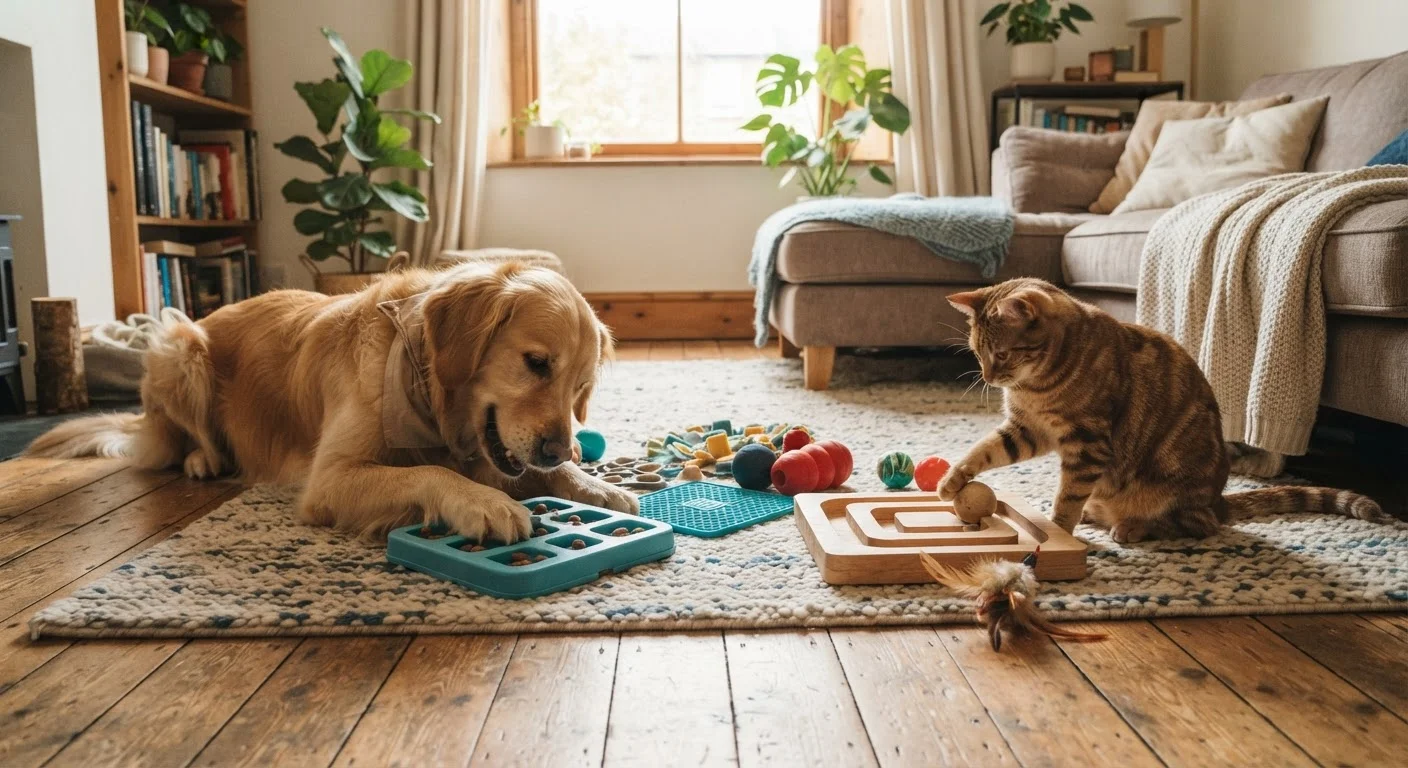
Swapping a standard food bowl for a puzzle feeder is one of the highest-impact, lowest-effort changes an owner can make. Dogs and cats are built to work for food — foraging and hunting can occupy hours in a natural setting. A puzzle or slow feeder compresses that instinct into a manageable daily activity.
For dogs, options range from simple rubber chew toys stuffed with wet food to multi-step sliding puzzles that require the dog to move compartments in sequence. For cats, small foraging mats, snuffle balls, or kibble scattered across a textured surface mimic hunting micro-behaviors. The key is to start easy — if a pet gives up in frustration, the difficulty level is too high and the activity becomes aversive rather than enriching.
Working for food satisfies foraging instinct and turns mealtime into a mentally tiring activity.
Scent Work and Nose Games
A dog's olfactory system processes smell at a level humans can barely conceptualize — estimates suggest their sense of smell is tens of thousands of times more sensitive than ours. Engaging that system is genuinely exhausting in the best way. A 15-minute nose game can tire a dog more effectively than a 30-minute walk.
The simplest version: hide small amounts of food or a favorite toy in different locations around the house and encourage your dog to find them. More structured scent work involves teaching a dog to identify a specific odor — an activity that translates well into competitive nose-work sports. Cats also benefit from scent enrichment; rotating novel scents like dried herbs, pet-safe botanicals, or used cardboard from different environments provides low-effort novelty that encourages investigative behavior.
Nose games tap into a dog's most powerful sense and deliver deep mental fatigue efficiently.
Training Sessions as Cognitive Exercise
Short, positive training sessions aren't just about teaching commands — they're enrichment. Learning a new behavior requires concentration, decision-making, and pattern recognition. For both dogs and cats, these are genuinely tiring cognitive tasks.
Five-minute sessions two or three times a day are more effective than one long session, and the subject matter doesn't have to be practical. Teaching a cat to high-five or a dog to identify toys by name are enriching precisely because they're challenging. The complete pet training reference covers learning theory in more detail, including how to read when a pet is engaged versus overwhelmed. Watching for those signals — covered in depth in our pet body language guide — keeps sessions productive and stress-free.
A five-minute training session demands real cognitive effort from a pet and counts as genuine enrichment.
Environmental Complexity and Vertical Space
For cats especially, the three-dimensional structure of their living environment is a major behavioral lever. Cats are climbers and perch-seekers by nature; a home with only floor-level furniture gives them limited opportunity to express that. Cat trees, wall-mounted shelves, window perches, and even cleared bookcase tops provide vantage points that reduce anxiety and territorial stress — particularly in multi-cat households.
Dogs also benefit from environmental variation. Rotating which rooms they have access to, adding a sniff-walk on a novel route, or simply rearranging furniture occasionally gives them new information to process. Novelty itself is enriching. A predictable, unchanging environment removes one of the main drivers of investigative behavior, which can redirect into less welcome outlets.
Vertical space and environmental novelty directly reduce stress-driven behaviors in both cats and dogs.
Social Play and Structured Interaction
Enrichment doesn't have to involve objects or gadgets. Intentional, structured play with an owner is one of the most powerful enrichment forms available — it simultaneously addresses physical, cognitive, and social needs. Wand toys for cats, tug games for dogs, and interactive fetch variations all count, provided the pet is setting the pace and genuinely engaged rather than just tolerating the interaction.
The distinction between structured play and simply being in the same room matters. A dog lying next to a distracted owner receives companionship but not active engagement. For the full behavioral benefit, the human needs to be present and responsive. This also builds the kind of attentive relationship that makes training skills like a reliable stay easier to achieve — a dog or cat who trusts their owner's engagement is more motivated to work with them.
Intentional play with an owner addresses physical, cognitive, and social needs all at once.
Chewing, Scratching, and Species-Appropriate Outlets
Chewing in dogs and scratching in cats are not problem behaviors — they're biological drives. The problem arises when owners don't provide appropriate outlets and the pet redirects to furniture, baseboards, or cables. The solution isn't suppression; it's substitution.
For dogs, providing a variety of chew textures (rubber, nylon, natural materials) allows them to self-regulate. Some dogs prefer softer chews; others need something more resistant. Offering a selection and observing preference is more effective than guessing. For cats, scratching posts need to be tall enough for a full-body stretch, stable enough not to wobble, and ideally placed near resting spots since scratching is partly territorial marking. Horizontal and vertical scratching surfaces serve different preferences — many cats benefit from both.
Appropriate chewing and scratching outlets prevent destructive behavior by satisfying biological drives directly.
Putting It All Together
No single activity does everything. A food puzzle satisfies foraging instinct but doesn't meet social or physical needs. Scent work tires a dog's mind but a high-energy breed still needs physical outlets. The goal is a weekly rhythm that mixes categories — something structured into your pet's daily routine rather than offered only when problems arise.
Rotate Activities to Maintain Novelty
Pets habituate to the same enrichment quickly — the puzzle that fascinated your dog in week one may get ignored by week three. Rotating activities every few days, or introducing slight variations, keeps the challenge level appropriate and sustains engagement. A simple system is to keep three or four options in active rotation rather than offering everything at once.
It's also worth remembering that enrichment needs shift across a pet's life. A kitten and a senior cat have very different energy levels and physical limitations. The life stage guide for pets covers how to adjust expectations and activities as your animal ages. When in doubt about the right type or intensity of enrichment for a pet with a health condition, a veterinarian or certified animal behaviorist is the right resource.
This article is for general informational purposes only and does not constitute veterinary or behavioral advice. Consult a qualified veterinarian or certified applied animal behaviorist for guidance specific to your pet's health and behavior needs.