

Key Takeaways
Option A
Fixed-Rate Mortgage (FRM)
The predictable, long-term stability choice.
Best for: Buyers planning to stay in their home long-term who want consistent monthly payments regardless of market conditions.
Option B
Adjustable-Rate Mortgage (ARM)
The lower initial cost, variable-future option.
Best for: Buyers with a defined shorter horizon or those expecting to refinance before the rate adjustment period begins.
If you plan to stay in the home for 10 or more years
Fixed-Rate Mortgage (FRM)
Long-term owners face the most exposure to rate volatility. Locking in a fixed rate eliminates that uncertainty and simplifies long-term budgeting.
If you expect to sell or refinance within 5–7 years
Adjustable-Rate Mortgage (ARM)
A 5/1 or 7/1 ARM lets you benefit from a lower introductory rate during the period you actually plan to hold the loan, potentially reducing total interest paid.
If your income is variable or your budget is tight
Fixed-Rate Mortgage (FRM)
Predictable payments make it easier to manage cash flow and avoid financial stress if income fluctuates month to month.
If rates are currently high and likely to fall
Adjustable-Rate Mortgage (ARM)
An ARM may position you to benefit from lower rates at adjustment time, though rate forecasts are inherently uncertain and should not be the sole basis for this decision.
If you are a first-time buyer prioritizing simplicity
Fixed-Rate Mortgage (FRM)
Fixed-rate loans are easier to understand and compare, reducing the risk of being caught off guard by payment changes during a period of financial adjustment.
How Each Mortgage Structure Works
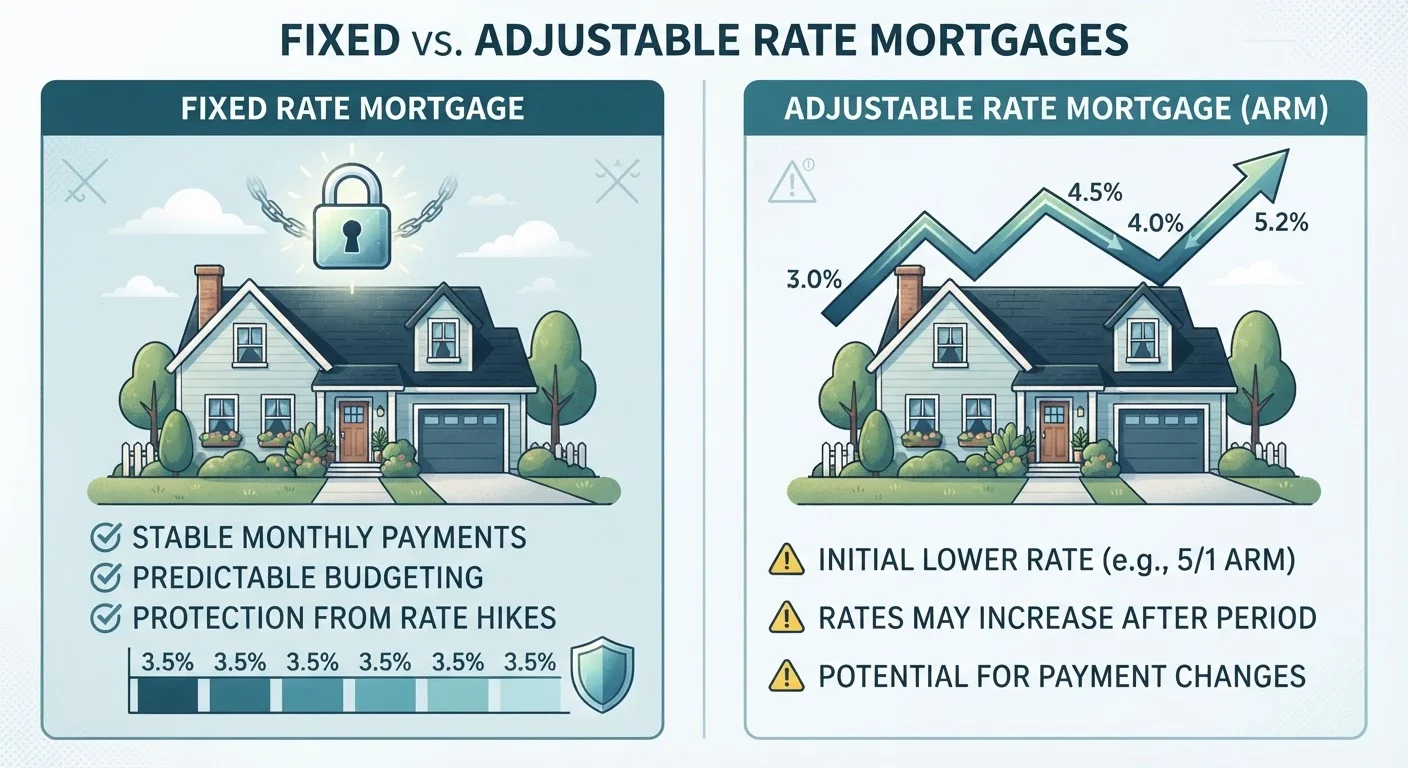
A fixed-rate mortgage (FRM) sets one interest rate at closing that applies for the entire loan term — typically 15 or 30 years. Your principal-and-interest payment never changes, regardless of what happens to broader interest rates. This makes budgeting straightforward and protects you if market rates climb after you close.
An adjustable-rate mortgage (ARM) starts with a fixed introductory period — commonly 5, 7, or 10 years — during which the rate is typically lower than prevailing fixed-rate offerings. After that initial period, the rate resets periodically (often every 6 or 12 months) based on a benchmark index, such as the Secured Overnight Financing Rate (SOFR), plus a fixed margin set by the lender. A 5/1 ARM, for example, carries a fixed rate for five years and then adjusts once per year thereafter.
ARMs include rate caps — limits on how much the rate can increase at each adjustment and over the life of the loan. A common cap structure is 2/2/5: the rate can rise no more than 2 percentage points at the first adjustment, 2 points at each subsequent adjustment, and 5 points above the initial rate over the loan's lifetime. Even so, a significant rate increase is possible, and borrowers should stress-test their budget against the maximum allowable rate before committing. For a deeper look at how ARM mechanics interact with your monthly budget, see how rate changes affect your payments.
| Criterion | Fixed-Rate Mortgage | Adjustable-Rate Mortgage |
|---|---|---|
| Interest rate | Locked for entire loan term | Fixed initially, then periodic adjustments |
| Initial rate level | Typically higher at origination | Typically lower during intro period |
| Payment predictability | Fully predictable | Uncertain after fixed period ends |
| Rate-change risk | None — borrower bears no rate risk | Borrower bears risk after intro period |
| Common term structures | 15-year, 30-year | 5/1, 7/1, 10/1 ARM |
| Rate cap protections | Not applicable | Periodic and lifetime caps apply |
| Best scenario | Long hold, stable budget | Short-to-medium hold, rate may fall |
The Trade-Offs That Matter Most
The core tension between these two structures is certainty versus cost. Fixed-rate loans offer complete payment predictability, but lenders price that guarantee into a higher rate. ARMs transfer some interest-rate risk to the borrower in exchange for a lower starting rate.
30-year FRM
Most common mortgage in the US
The 30-year fixed-rate mortgage has historically been the dominant loan product chosen by American homebuyers, according to Freddie Mac survey data.
2/2/5
Typical ARM rate cap structure
A 2/2/5 cap structure limits first-adjustment increases to 2 points, subsequent adjustments to 2 points, and lifetime increases to 5 points above the initial rate.
5–7 years
Median US homeowner tenure
According to the National Association of Realtors, the median tenure in a home has historically ranged between 5 and 13 years depending on buyer type and market conditions.
How long you plan to hold the loan is the most decisive factor. If you sell or refinance before an ARM's fixed period ends, you may never experience a rate adjustment — and you will have paid less interest in the meantime. If you stay beyond the fixed window, you're exposed to market movements that are genuinely difficult to predict.
Credit profile and loan program also shape the calculus. Borrowers with stronger credit histories and lower debt-to-income ratios may qualify for more competitive rates on both products. To understand what lenders evaluate during underwriting, review what lenders look at when you apply. For those weighing loan type alongside rate structure, comparing FHA, VA, USDA, and conventional loans provides a useful parallel framework.
One risk borrowers sometimes underestimate: the combination of rising payments and declining home equity during early ARM adjustment periods. Why borrowers end up paying more than expected examines how this and related missteps quietly raise the total cost of homeownership.
ARM Index Benchmark Has Changed
Most ARMs originated after mid-2023 use the Secured Overnight Financing Rate (SOFR) as their benchmark index, replacing the London Interbank Offered Rate (LIBOR), which was phased out. If you are reviewing an older ARM or refinancing an existing one, confirm which index applies to your loan documents, as this affects how your future rate adjustments are calculated.
Refinancing as a Long-Term Consideration
Choosing a mortgage structure today does not lock you in permanently. Borrowers who start with an ARM can refinance into a fixed-rate loan before the adjustment period ends — though doing so involves closing costs (typically 2%–5% of the loan balance), a new qualification process, and a reset of the loan's amortization schedule. Conversely, homeowners with fixed-rate loans in a declining-rate environment sometimes refinance into ARMs or lower fixed rates to reduce monthly payments.
The decision to refinance carries its own set of trade-offs. Mortgage refinancing: when it makes sense and what it involves breaks down the cost-benefit analysis in detail. The general principle is that refinancing makes financial sense only when the long-term savings outweigh the upfront costs — a calculation that depends on how long you plan to remain in the home after refinancing.
This article is for general informational and educational purposes only and does not constitute personalized financial, mortgage, or legal advice. Mortgage products, rates, and eligibility criteria vary by lender and individual circumstances. Consult a licensed mortgage professional or financial adviser before making any borrowing decision.