

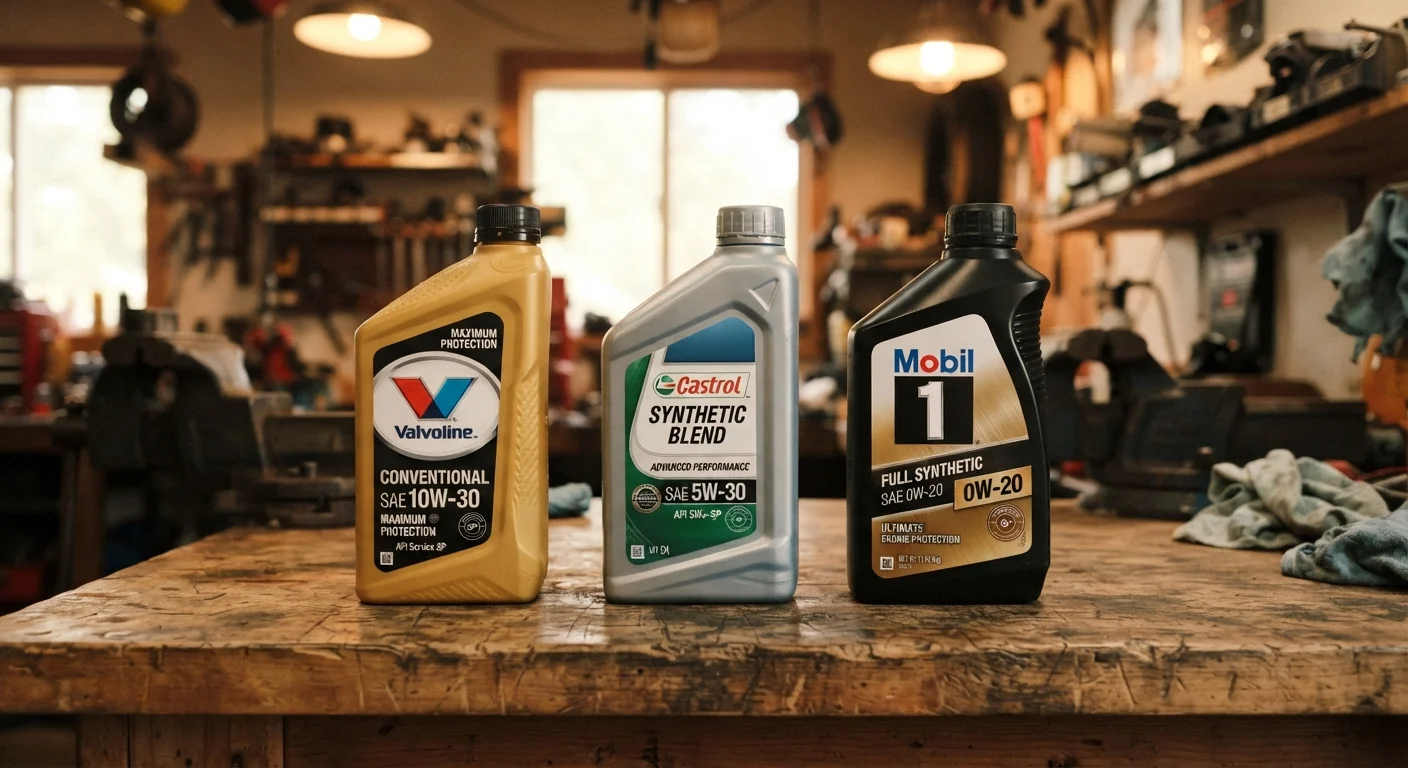
Key Takeaways
Option A
Conventional Motor Oil
The traditional, widely available baseline.
Best for: Older vehicles with simple engine designs and drivers who follow shorter change intervals in moderate driving conditions.
Option B
Synthetic & Synthetic Blend Oil
The engineered, higher-performance alternative.
Best for: Modern engines, high-mileage vehicles, drivers in extreme climates, or anyone seeking longer intervals between oil changes.
If you drive an older vehicle with low annual mileage in mild conditions
Conventional Motor Oil
Conventional oil meets the needs of simpler, older engine designs and remains cost-effective when change intervals are kept short.
If you drive a modern vehicle or want fewer oil changes per year
Synthetic & Synthetic Blend Oil
Full synthetic oil's engineered molecular consistency delivers superior protection over longer intervals, matching what most new engine warranties require.
If you want better protection than conventional without the full synthetic price
Synthetic & Synthetic Blend Oil
A synthetic blend provides improved performance over conventional oil at a moderate cost increase, making it a practical step up for many drivers.
If you frequently tow, haul, or drive in extreme heat or cold
Synthetic & Synthetic Blend Oil
Full synthetic oil maintains viscosity stability under thermal stress far better than conventional, reducing wear during demanding operation.
What Actually Separates These Oil Types
Motor oil does more than lubricate moving parts. It also reduces heat, carries away contaminants, and protects metal surfaces from corrosion. The formulation of that oil - how it was made and what it contains - determines how well it performs those jobs under real driving conditions.
Conventional motor oil is derived directly from crude petroleum through a refining process. That process removes many impurities, but the resulting base oil still contains naturally occurring molecules of varying shapes and sizes. That inconsistency limits how well the oil performs at temperature extremes and how long it holds up before breaking down.
Full synthetic motor oil is chemically engineered in a laboratory. Manufacturers start with highly refined base stocks - or synthesize the base compounds from scratch - then build uniform molecular chains designed for specific performance characteristics. The result is an oil with more predictable viscosity behavior, better resistance to thermal breakdown, and improved flow at cold temperatures.
Synthetic blend motor oil is exactly what it sounds like: a mixture of conventional base stock and synthetic base stock. It offers meaningfully better protection than straight conventional oil without reaching the price point of full synthetic. For many drivers, it represents a practical middle ground.
For a broader look at how oil change habits and intervals are often misunderstood, see our breakdown of common oil change myths.
| Criterion | Conventional Oil | Synthetic / Synthetic Blend |
|---|---|---|
| Base stock origin | Refined crude petroleum | Chemically engineered or highly refined |
| Molecular consistency | Variable - natural impurities remain | Uniform - engineered for predictability |
| Cold-weather flow | Slower to flow at startup | Flows more readily at low temperatures |
| Heat resistance | Breaks down faster under high heat | Maintains viscosity better under heat |
| Typical change interval | 3,000-5,000 miles (varies by vehicle) | 5,000-15,000 miles (varies by vehicle) |
| Cost per quart | Generally lower | Moderate (blend) to higher (full synthetic) |
| Suited for turbocharged engines | Usually not recommended | Typically required or strongly preferred |
| Availability | Universally available | Widely available at most retailers and shops |
How to Know Which Oil Your Engine Actually Needs
The single most authoritative source on this question is your vehicle's owner's manual. Manufacturers specify not only the oil type but also the viscosity grade (such as 5W-30 or 0W-20) based on how the engine was designed and tested. Following that specification is the baseline requirement - deviating from it can affect performance and, in some cases, affect your warranty coverage.
75,000+
Miles where high-mileage synthetic formulas are often recommended
Many oil manufacturers and mechanics suggest high-mileage-specific synthetic blends once odometer readings exceed this threshold.
0W-20
Viscosity grade increasingly specified by automakers
Thinner, low-viscosity synthetic oils like 0W-20 are now standard specifications in many modern fuel-efficient engine designs.
Up to 15,000
Miles between oil changes with some full synthetic oils
Actual intervals vary significantly by vehicle, oil brand, and driving conditions - always follow your owner's manual over general estimates.
Beyond the manual, several driving patterns and conditions point toward upgrading to synthetic:
- Extreme temperatures: Synthetic oil flows more readily at startup in cold weather and resists thinning better in intense heat.
- Towing or hauling: High load operation puts significant thermal stress on oil; synthetic maintains its protective film more reliably.
- Turbocharged engines: Turbo bearings spin at very high speeds and run hot - most manufacturers of turbocharged vehicles specify synthetic as standard.
- High mileage: Vehicles over roughly 75,000 miles may benefit from high-mileage-specific synthetic formulas designed to condition seals and address increased wear.
If you're unsure where to start, understanding your car's full maintenance schedule puts oil type in context alongside every other service interval your vehicle needs.
One common question is whether switching from conventional to synthetic is safe. For most vehicles built in the past two decades, the answer is yes - modern synthetic oils are compatible with the seals and materials used in contemporary engines. If your vehicle is significantly older or has a known oil consumption issue, it's worth discussing the switch with a qualified mechanic before making the change.
This article provides general educational information about motor oil types. Always consult your vehicle's owner's manual and a licensed mechanic for recommendations specific to your vehicle and driving conditions.