

Key Takeaways
Our Verdict
No single acquisition method wins outright - the right choice depends on how much capital you have available, how you use your vehicle, and how you prioritize monthly cash flow versus long-term ownership value. Financing suits most buyers who want ownership without depleting savings. Leasing works well for those who want predictable costs and drive modest miles. Cash purchasing makes the most financial sense for those with sufficient savings who plan to hold a vehicle long-term.
| Best for | Recommended |
|---|---|
| Drivers who want to own a vehicle and spread costs over time | Financing |
| Those who prefer lower monthly payments and like driving newer vehicles every few years | Leasing |
| Buyers with sufficient savings who want to minimize total long-term cost | Paying Cash |
| High-mileage drivers or those who frequently modify or customize their vehicle | Financing or Paying Cash |
The Three Paths: What Each One Actually Means
When you acquire a vehicle, you're not just choosing a car - you're choosing a financial structure that affects your monthly budget, your insurance obligations, and your equity position for years to come. Understanding how each option works mechanically is the starting point for a sound decision.
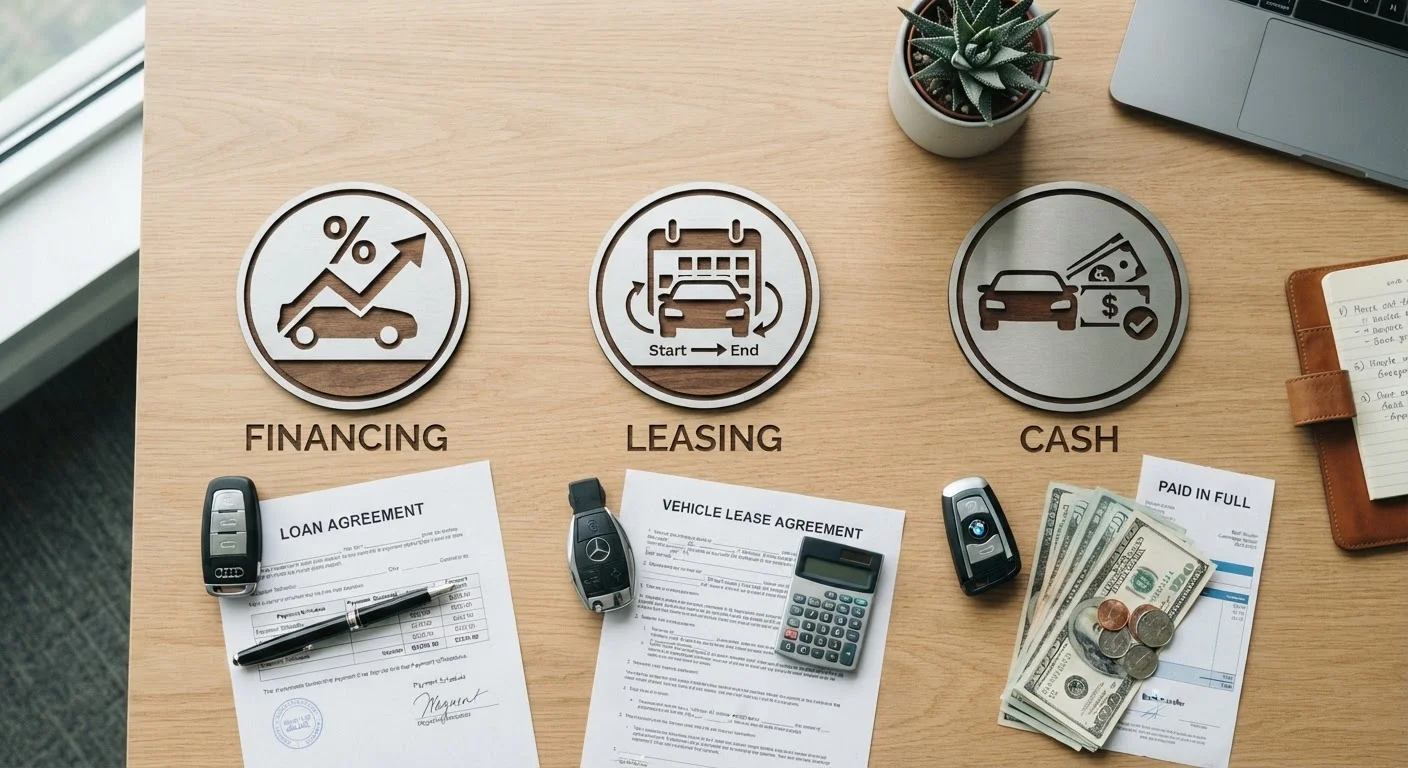
Financing means borrowing money - typically through a bank, credit union, or dealership-arranged lender - and repaying it with interest over a set term, usually 36 to 72 months. You take title to the vehicle (subject to the lender's lien) and build equity as you pay down the loan.
Leasing is essentially a long-term rental agreement. You pay for the portion of the vehicle's value you use during the lease term, plus fees and interest (expressed as a "money factor"). At the end of the lease - typically 24 to 36 months - you return the vehicle or, in some cases, purchase it at a predetermined residual price.
Paying cash means purchasing the vehicle outright with funds you already have. There's no lender involved, no monthly payment, and no interest. You own the car free and clear from day one.
For a broader look at what vehicle ownership costs beyond the purchase itself, see The True Cost of Owning a Car Beyond the Sticker Price.
Comparing the Key Trade-Offs
Each method comes with a distinct set of advantages and limitations. The comparison below breaks down the most decision-relevant factors across all three approaches.
| Financing | Leasing | Paying Cash | |
|---|---|---|---|
| Monthly payment | Moderate to high | Typically lowest | None |
| Ownership at end of term | Yes - full title | No - return or buyout | Yes - immediate title |
| Interest or finance cost | Yes - based on APR | Yes - built into money factor | None |
| Mileage restrictions | None | Strict annual limits | None |
| Upfront capital required | Low to moderate (down payment) | Low (first month + fees) | High (full purchase price) |
| Ability to modify vehicle | Yes, once paid off | Generally not permitted | Yes, at any time |
| Long-term cost (10+ years) | Moderate | Highest (continual payments) | Lowest |
| Credit required | Yes - affects rate | Yes - often stricter | No credit check needed |
One often-overlooked consideration: both financing and leasing require you to carry comprehensive and collision coverage throughout the term. If you'd prefer more flexibility over your insurance choices, ownership - whether financed or cash - eventually allows you to adjust coverage on an older vehicle. Learn more about how those coverages differ in our guide to comprehensive vs. collision coverage.
What Leasing Gets Wrong (and Right)
Leasing is frequently misunderstood. It's marketed around its lower monthly payments, but those lower payments reflect the fact that you're not paying for the full vehicle - only for the depreciation during the lease period plus finance charges.
Lease Terms Carry Hidden Costs
Exceeding your mileage allowance typically results in per-mile overage charges at lease end - fees that can run 15 to 25 cents per mile or more. Wear-and-tear beyond "normal" use is also billed separately. Early lease termination can be especially costly, often requiring you to pay the remaining lease balance in full. Read the full lease agreement carefully before signing.
On the upside, leasing offers genuine advantages in specific situations. If you drive fewer than 12,000-15,000 miles per year, prefer always having a vehicle under warranty, and value predictable monthly costs, leasing can be a rational choice. Business owners may also find lease payments easier to structure for tax purposes - though individual situations vary and consulting a tax professional is advisable.
The financial logic shifts significantly if you tend to keep vehicles for many years. Once a financed vehicle is paid off, you can drive it cost-effectively for years. A lease simply restarts the payment cycle. For perspective on long-term ownership economics, see Keeping a Car Long-Term: The Honest Trade-Offs.
Financing: Building Equity With Borrowed Money
A loan lets you acquire a vehicle without liquidating savings, but it comes at a cost: interest. Over a 60-month loan, the total interest paid can add thousands of dollars to the vehicle's effective purchase price. Your credit score is the primary factor lenders use to set your interest rate - a stronger credit profile translates directly into lower borrowing costs.
Get Pre-Approved Before You Shop
Securing a loan pre-approval from a bank or credit union before visiting a dealership gives you a known interest rate to compare against dealer-arranged financing. Even a fraction of a percentage point difference in APR can translate to hundreds of dollars over the loan term. Pre-approval also simplifies negotiations by separating the vehicle price discussion from the financing discussion.
Down payments matter here. A larger down payment reduces the amount financed, lowers monthly payments, and can reduce the risk of being "underwater" - owing more than the car is worth - as the vehicle depreciates. This is particularly relevant in the early years of a loan when depreciation is steepest.
For anyone managing other debt alongside a car loan, the Debt & Credit hub offers useful context on how auto loans interact with your overall credit profile.
Paying Cash: Maximum Simplicity, Real Opportunity Cost
Paying cash for a vehicle eliminates interest expense entirely and removes the lender from the transaction. There's no approval process, no monthly obligation, and no risk of default. For drivers who plan to keep a vehicle for many years, cash purchasing often results in the lowest total cost of ownership.
The honest trade-off is opportunity cost. The money used to buy a car outright is money that could have been invested, used to pay down higher-interest debt, or kept as a liquidity buffer. Whether this matters depends on your personal financial position, your access to credit, and the interest rate environment - all factors that vary by individual.
Cash purchasing is also not always negotiated the same way. Some sellers may offer financing incentives that aren't available to cash buyers. The full financial picture for vehicle ownership - including taxes, registration, depreciation, and ongoing costs - is covered in our complete car ownership cost guide.
This article is for general informational and educational purposes only and does not constitute personalized financial or legal advice. Consult a qualified financial adviser before making major financial decisions.