

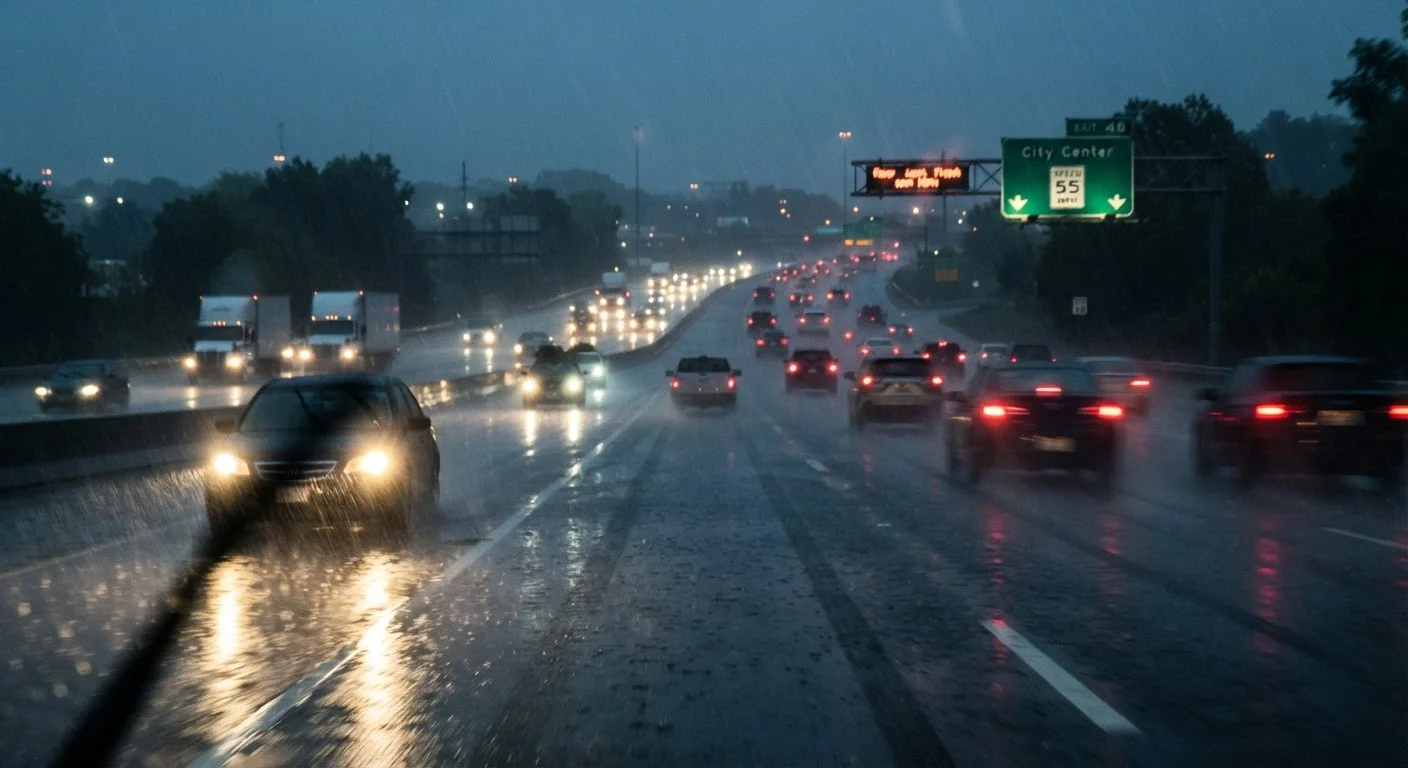
Key Takeaways
Why Rain Changes Everything on the Road
Rain doesn't just make roads wet - it fundamentally changes how your vehicle handles, stops, and steers. According to the Federal Highway Administration, wet pavement is a factor in roughly 70% of weather-related crashes in the United States. Yet many drivers don't adjust their habits to match the conditions.
The danger isn't uniform. Crashes cluster around predictable scenarios: the opening minutes of a rain shower, highway on-ramps, intersections, and curves. Understanding where risk concentrates helps you stay ahead of it.
This article is part of our broader guide on safe driving in America, which covers the full range of conditions and habits that separate cautious drivers from reactive ones.
~70%
Weather-related crashes on wet pavement
According to the Federal Highway Administration, wet pavement is a contributing factor in approximately 70% of all weather-related motor vehicle crashes in the U.S.
35 mph
Speed at which hydroplaning can begin
Traffic safety research indicates hydroplaning can occur at speeds as low as 35 mph when standing water is present and tire tread is worn.
The Most Dangerous Moment: The First Rain of the Day
Counter-intuitively, roads are often most slippery at the very start of rainfall. Over days of dry weather, motor oil, diesel residue, and tire rubber accumulate on the pavement surface. When the first rain hits, these materials dissolve into a thin, slick film before eventually washing away. This window - roughly the first 10 to 30 minutes of rainfall - produces conditions nearly as treacherous as black ice.
Experienced drivers treat the onset of rain like a yellow light: they ease off the accelerator, increase following distance, and avoid sudden braking. Good car maintenance also plays a role here - worn wiper blades and bald tires compound the hazard significantly.
Treat Fresh Rain Like a New Hazard
The first few minutes of rainfall can create road conditions nearly as slippery as ice. Build the habit of easing off the accelerator when rain begins - before you feel any loss of traction. This is also a good moment to verify your headlights are fully on and your following distance has increased.
Hydroplaning: What It Is and How to Respond
Hydroplaning occurs when a layer of water builds up between your tires and the road faster than the tire can disperse it. The result: your tires lose contact with the pavement and you lose steering control. It can happen at speeds as low as 35 mph on standing water, and the risk increases with speed and tire wear.
If you feel your vehicle hydroplane, the correct response is calm and deliberate: ease off the accelerator gradually, do not brake hard or jerk the wheel, and allow the car to slow naturally until traction returns. Hard braking or sharp steering inputs can cause a spin.
“The tire is the only part of the vehicle that actually contacts the road. Everything else - steering, braking, acceleration - is only as effective as that small patch of rubber allows.”
— National Highway Traffic Safety Administration, U.S. federal vehicle safety regulator
Maintaining proper tire inflation and tread depth is one of the most effective defenses against hydroplaning. A tire with 2/32" of tread remaining - the legal minimum - disperses water far less effectively than one with 6/32" or more. If your vehicle has anti-lock brakes, apply firm, steady pressure in an emergency - the system will modulate braking automatically.
Best Practices for Driving in Rain
Wet-weather driving rewards deliberate habits. The practices below reflect guidance from traffic safety organizations and experienced driving instructors. None of them are complicated - what they require is consistency.
Reduce speed well below the posted limit in wet conditions
Speed limits are set for ideal conditions. Wet pavement extends stopping distances dramatically, and higher speeds make hydroplaning far more likely. Slowing down gives you more time to react and more margin for error.
Disable cruise control on wet or slick roads
Cruise control is designed to maintain speed, which works against you if a tire hydroplanes. The system may accelerate into a skid rather than allowing natural deceleration. Manual throttle control lets you respond instinctively to changes in traction.
Increase your following distance to at least 4-6 seconds
Wet roads can more than double stopping distance compared to dry pavement. A gap that feels comfortable in sunshine may leave no room for emergency braking in rain. Extra space is the single most effective buffer against rear-end collisions.
Turn on headlights - not just daytime running lights - when visibility drops
In many states, law requires headlights when wipers are in use. More importantly, headlights make your vehicle visible to others, not just illuminate the road ahead. Daytime running lights often do not activate taillights, leaving you invisible from behind.
Avoid standing water and flooded roadways
It is impossible to judge water depth by sight, and just six inches of moving water can knock a person off their feet. A foot of water can float many vehicles. Driving into flooded roads is one of the leading causes of flood-related fatalities.
Following distance deserves particular emphasis. In dry conditions, a 2-3 second gap is a common standard. In rain, doubling that to 4-6 seconds is a reasonable baseline - and some safety professionals recommend even more. See our article on why tailgating is more dangerous than most drivers realize for the physics behind stopping distance.
When Pulling Over Is the Right Call
No driving technique substitutes for simply stopping when conditions become unsafe. Heavy downpours can reduce visibility to near zero within seconds. If you cannot see lane markings, road edges, or vehicles ahead, you should pull over - not to the shoulder of a highway if possible, but to a parking lot, rest area, or side street.
If you must stop on a highway shoulder, turn on your hazard lights, stay in your vehicle with your seatbelt fastened, and move as far from the travel lanes as possible. Shoulder stops carry their own risk, particularly in poor visibility conditions.
Rain also compounds fatigue. Reduced visibility demands sustained concentration, and the rhythmic sound of wipers and rain can accelerate drowsiness. If you find yourself struggling to stay alert, stopping is the only responsible option. Our article on driver fatigue explains why tired driving is more dangerous than most people assume. For related low-visibility challenges after dark, see night driving demands more than headlights.