

Key Takeaways
Option A
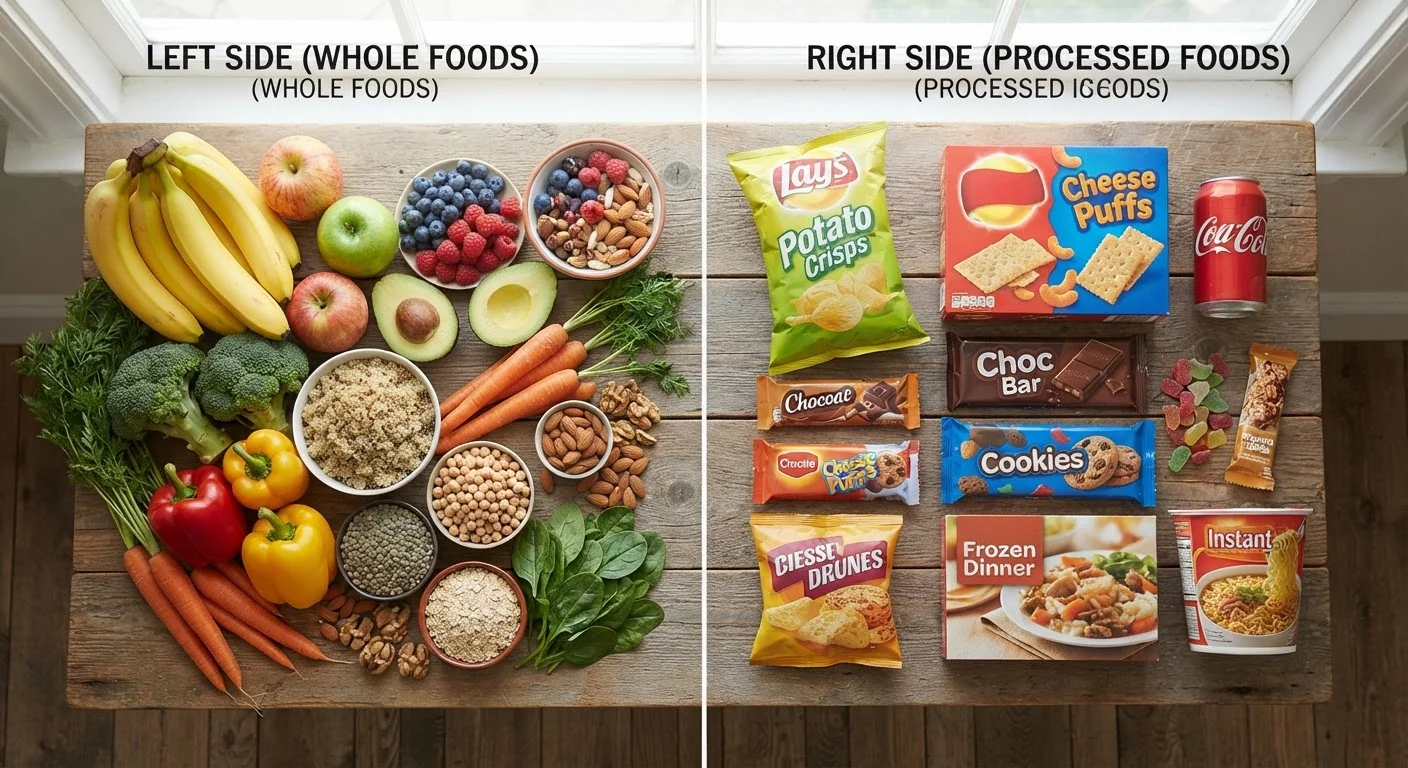
Whole Foods
The minimally altered, nutrient-dense foundation of most evidence-based diets.
Best for: People seeking to maximize fiber, vitamins, minerals, and phytonutrients with minimal additives.
Option B
Processed Foods
A broad and varied category spanning helpful convenience items to highly engineered products.
Best for: Understanding what 'processed' actually means before making blanket judgments about packaged foods.
If you want to maximize nutritional density in your daily diet
Whole Foods
Whole foods retain naturally occurring fiber, micronutrients, and phytonutrients that are often reduced or removed during heavy processing.
If convenience is essential and you need practical shortcuts
Processed Foods
Minimally processed options like canned legumes, frozen vegetables, and plain yogurt offer real nutritional value with significant time savings.
If you're trying to reduce sodium, added sugar, and artificial additives
Whole Foods
Ultra-processed foods are the primary source of excess sodium and added sugars in the average American diet, according to public health research.
If you're building a realistic, sustainable long-term eating pattern
Whole Foods
Diets centered on whole and minimally processed foods are consistently associated with better long-term health outcomes across diverse populations.
Defining the Terms: What 'Whole' and 'Processed' Actually Mean
The word "processed" has become shorthand for unhealthy, but that framing misses important nuance. By a technical definition, any food that has been altered from its raw state has undergone some form of processing - including pasteurized milk, washed bagged salad, and rolled oats. Whole foods, by contrast, are foods consumed in or very close to their natural state: fresh fruits, vegetables, legumes, whole grains, eggs, and unprocessed meats.
A more useful framework is the NOVA classification system, developed by researchers at the University of São Paulo. NOVA groups foods into four categories based on the extent and purpose of processing:
- Group 1 - Unprocessed or minimally processed: fresh produce, plain meat, eggs, milk, plain frozen vegetables, unsalted nuts.
- Group 2 - Processed culinary ingredients: oils, butter, flour, salt, sugar - used to prepare food rather than eaten alone.
- Group 3 - Processed foods: canned fish, cheese, cured meats, fermented foods - products made by adding salt, oil, sugar, or preservation techniques to Group 1 foods.
- Group 4 - Ultra-processed foods: soft drinks, packaged snack foods, instant noodles, reconstituted meat products - industrial formulations containing additives, flavor enhancers, emulsifiers, and colorings not found in home kitchens.
Understanding this spectrum is the starting point for more informed food choices. If you're newer to nutrition fundamentals, our introduction to macronutrients provides useful context for how these food categories fit into overall eating patterns.
Head-to-Head: How Whole and Ultra-Processed Foods Compare
The most meaningful nutritional contrast isn't between whole foods and all processed foods - it's between whole or minimally processed foods and ultra-processed foods. Here's how they stack up across the dimensions that matter most for health.
| Criterion | Whole / Minimally Processed | Ultra-Processed |
|---|---|---|
| Fiber content | Naturally high; intact | Often removed during manufacturing |
| Added sugars | None or minimal | Frequently high; multiple sugar types |
| Sodium levels | Low in natural form | Often very high for preservation/flavor |
| Micronutrients | Naturally occurring, diverse | Depleted; sometimes artificially added back |
| Additives & preservatives | Absent or limited | Industrial emulsifiers, colorings, flavors |
| Satiety per calorie | Generally high due to fiber and protein | Often lower; engineered for overconsumption |
| Shelf life | Short to moderate | Extended through processing |
It's worth noting that not all processing is detrimental. Fermentation, for instance, can enhance bioavailability of certain nutrients. Fortification of foods like breakfast cereals has helped address widespread micronutrient deficiencies. The problem arises when processing primarily serves to extend shelf life, enhance palatability beyond natural levels, and reduce cost at the expense of nutritional integrity.
57%
Share of U.S. calories from ultra-processed foods
Research published in BMJ Open estimated that ultra-processed foods account for approximately 57% of total caloric intake among American adults.
14%
Mortality risk increase per 10% rise in ultra-processed intake
A large prospective cohort study published in The BMJ (2019) found this association, though researchers caution that observational data cannot confirm direct causation.
~90%
Of U.S. added sugar intake comes from ultra-processed foods
Analysis of NHANES data suggests the vast majority of added sugar consumption in American diets originates from ultra-processed food and beverage products.
What the Research Suggests About Ultra-Processed Consumption
A substantial body of observational research has associated high consumption of ultra-processed foods with elevated risks of cardiovascular disease, type 2 diabetes, certain cancers, and all-cause mortality. A landmark 2019 study published in The BMJ found that each 10% increase in ultra-processed food consumption was associated with a 14% higher risk of all-cause mortality - though researchers note that association does not establish direct causation.
Mechanistically, researchers point to several plausible pathways: the displacement of fiber-rich whole foods, the high caloric density relative to satiety, the presence of additives that may affect the gut microbiome, and engineered palatability that can override natural hunger and fullness signals.
Populations with diets centered on whole and minimally processed foods tend to show more favorable long-term health markers. Our article on eating patterns associated with longevity explores what these dietary commonalities look like across different cultures.
NOVA Is a Research Tool, Not a Rigid Rulebook
The NOVA classification was developed for population-level nutritional research, not as a precise shopping checklist. Some researchers debate its boundaries - for example, where plain yogurt with added fruit falls. The framework is most useful as a general guide to thinking critically about industrial food formulation, not as an absolute dietary law. Individual nutritional needs, food access, and cultural food practices all matter when applying these concepts to real life.
This article provides general nutrition information and is not a substitute for personalized medical or dietary advice. Consult a registered dietitian or qualified healthcare provider for guidance specific to your health circumstances.
Practical Steps for Navigating the Spectrum
A realistic eating pattern doesn't require eliminating every packaged product. Instead, developing the skill to identify where foods sit on the processing spectrum puts the decision-making power in your hands.
Read the ingredient list first
A short ingredient list made up of recognizable whole-food components generally indicates minimal processing. A long list containing emulsifiers (like carrageenan or polysorbate 80), artificial flavors, and multiple forms of added sugar is a reliable signal of ultra-processing. Our guide to food marketing claims can help you cut through label language that obscures a product's true nutritional character.
Anchor meals in Group 1 and Group 3 foods
Building meals around unprocessed staples - vegetables, legumes, whole grains, plain proteins - leaves room for some processed convenience items without tipping dietary balance toward the ultra-processed end. For more on protein choices, see our comparison of animal and plant protein sources.
Treat ultra-processed foods as occasional, not staple, choices
No single food causes or prevents disease. What research consistently points to is dietary pattern over time. An eating pattern where whole and minimally processed foods form the foundation - with ultra-processed options eaten occasionally rather than daily - aligns with the weight of current evidence, without demanding perfection.