

Key Takeaways
Start here
How Home Electrical Circuits Are Organized
Next
The Main Panel and Circuit Breakers
Build on it
Common Circuit Types in a Typical Home
Apply it
What You Can Safely Do Yourself
Know your limits
When to Call a Licensed Electrician
How Home Electrical Circuits Are Organized
Think of your home's electrical system as a tree. The trunk is the utility feed coming in from the street. That feed connects to your main electrical panel, which branches out into individual circuits - one per branch - each feeding a specific group of outlets, lights, or appliances.
Every circuit is a continuous loop: power flows out from the panel through a hot wire to your devices, then returns along a neutral wire. A ground wire provides a safe path for fault current. If something breaks that loop - an overload, a loose connection, or a fault - the circuit shuts down to prevent damage or fire.
Understanding this layout makes everyday problems easier to diagnose. If half your kitchen outlets go dead but the lights stay on, you know those outlets share a circuit that tripped, while the lights are on a separate one. This kind of mental map is also useful when reading a home inspection report - electrical findings are much easier to interpret when you understand the underlying structure.
Circuit
A complete loop through which electricity flows from the panel to an outlet or light and back again. Every device in your home is part of at least one circuit.
Circuit breaker
A resettable safety switch inside your electrical panel that automatically cuts power to a circuit if current exceeds a safe level.
Amperage (amps)
The measure of how much electrical current is flowing. Circuits are rated by their maximum safe amperage - most home circuits are 15 or 20 amps.
GFCI
Ground-fault circuit interrupter - a type of outlet or breaker that shuts off power almost instantly when it detects electricity leaking outside the intended path, protecting against shock near water.
Dedicated circuit
A circuit that serves only one appliance or outlet, ensuring high-draw devices like refrigerators or air conditioners don't share current with other loads.
240-volt circuit
A higher-voltage circuit used for large appliances like electric dryers and ranges. It uses two breaker slots in the panel and requires special wiring.
The Main Panel and Circuit Breakers
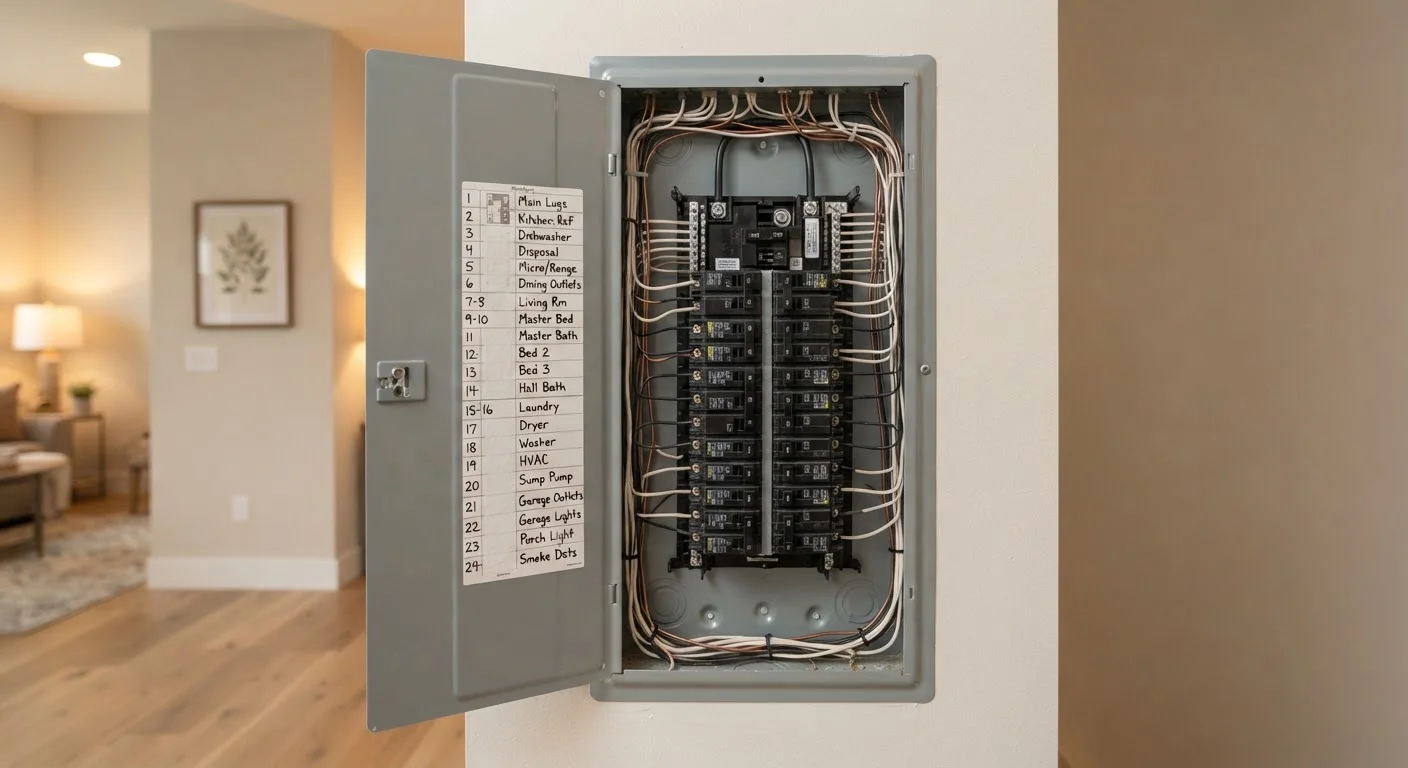
Your main panel (also called the breaker box or load center) is typically a gray metal cabinet mounted on a wall in a garage, utility room, or basement. Inside, a main breaker controls all power to the house; below it, individual breakers correspond to individual circuits.
Each breaker is rated for a maximum current - most residential breakers are 15 or 20 amps. When a circuit draws more current than its breaker allows, the breaker trips to the middle or OFF position, cutting power. To restore it, switch it fully to OFF first, then back to ON.
Map Your Panel Before You Need It
Taking 30 minutes to label every breaker now pays off the next time something trips or you need to cut power for a repair. Plug a lamp into each outlet, switch off breakers one at a time, and note what goes dark. Write your findings on the panel's directory card.
The panel door usually has - or should have - a directory listing what each breaker controls. If yours is unlabeled or inaccurate, mapping it yourself takes about 30 minutes and pays off every time something trips or you need to cut power for a repair.
Common Circuit Types in a Typical Home
Not all circuits are the same. Here's a breakdown of what you're likely to find:
- General lighting and outlet circuits: Usually 15-amp circuits wired with 14-gauge wire. These serve bedrooms, hallways, and living areas where loads are modest.
- Kitchen and bath circuits: Typically 20-amp circuits using 12-gauge wire, because these areas run more devices. Kitchens are required to have at least two dedicated countertop circuits by most building codes.
- Dedicated appliance circuits: Refrigerators, dishwashers, microwaves, and washing machines each typically require their own circuit so they don't compete for current. Large appliances like electric dryers and ranges run on 240-volt circuits, which use two breaker slots.
- AFCI and GFCI protected circuits: Modern codes require arc-fault circuit interrupter (AFCI) protection in bedrooms and living spaces, and ground-fault circuit interrupter (GFCI) protection near water. Older homes may lack these - a gap worth noting.
If your home runs a lot of electronics, understanding circuit capacity can also help you prevent the kind of nuisance outages covered in our first-time household electronics guide.
What You Can Safely Do Yourself
Homeowners can handle a small but meaningful set of electrical tasks without professional help:
- Resetting a tripped breaker: Straightforward and safe. If it trips again immediately, stop and call an electrician.
- Replacing an outlet or switch: With the breaker off and the correct replacement part, swapping a like-for-like outlet is manageable for most adults comfortable with basic tools. Always verify the circuit is de-energized with a non-contact voltage tester before touching any wires.
- Installing GFCI outlets: GFCI outlets come with clear wiring instructions and are a worthwhile safety upgrade in older homes.
- Labeling the panel: No tools required, genuinely useful.
Always Verify Power Is Off Before Working
Switching off a breaker is not enough on its own - use a non-contact voltage tester to confirm a circuit is de-energized before touching any wires. These testers cost under $20 at any hardware store and are essential for any hands-on electrical task. Do not rely solely on the breaker label.
If you're troubleshooting a device that seems fine but keeps losing power, it may be a circuit issue rather than a device fault - our electronics troubleshooting checklist can help you rule out the device before calling anyone.
When to Call a Licensed Electrician
Many electrical tasks go beyond what a homeowner should attempt. Always hire a licensed electrician for:
- Running new wiring or adding circuits to the panel
- Upgrading your panel's capacity
- Any work on 240-volt circuits (dryers, ranges, EV chargers)
- Repeated breaker trips with no obvious cause
- Flickering lights, burning smells, or scorch marks near outlets
- Any project requiring a permit - which most new circuit work does
Permits exist to ensure work is inspected and meets current safety codes. Unpermitted electrical work can create hazards and complicate home sales. When in doubt about whether your project requires one, contact your local building department before starting.
Building a basic understanding of your home's electrical system doesn't mean you should tackle it alone - it means you can describe problems accurately, ask informed questions, and recognize when the scope of work warrants professional expertise.
This article provides general educational information about residential electrical systems. It is not a substitute for advice from a licensed electrician. Always follow local electrical codes and obtain required permits for any electrical work in your home.