

Key Takeaways
Option A
Envelope Budgeting
The tactile, cash-first method for deliberate spenders.
Best for: People who overspend in variable categories and want physical spending limits that are impossible to ignore.
Option B
Spreadsheet Budgeting
The flexible, data-driven system for detail-oriented planners.
Best for: People who prefer tracking every dollar digitally and want full visibility into trends over time.
If you consistently overspend on groceries, dining, or entertainment
Envelope Budgeting
Physical cash creates a firm, visible boundary that digital numbers rarely replicate. When the envelope is empty, spending stops — no willpower required.
If you have irregular income or multiple income streams
Spreadsheet Budgeting
Spreadsheets can be updated instantly to reflect income changes, making them far more adaptable than fixed cash allocations divided at the start of a pay period.
If you want to analyze spending patterns month over month
Spreadsheet Budgeting
Spreadsheets store historical data so you can spot trends, adjust allocations, and track progress toward savings goals with precision.
If you find budgeting abstract or hard to stick with
Envelope Budgeting
Physically handling money makes spending feel more concrete, which research consistently links to more mindful purchasing decisions.
If you share finances with a partner and need a shared tracking system
Spreadsheet Budgeting
A shared cloud-based spreadsheet gives both partners real-time visibility into the budget without requiring coordination around physical cash.
How Each Method Works
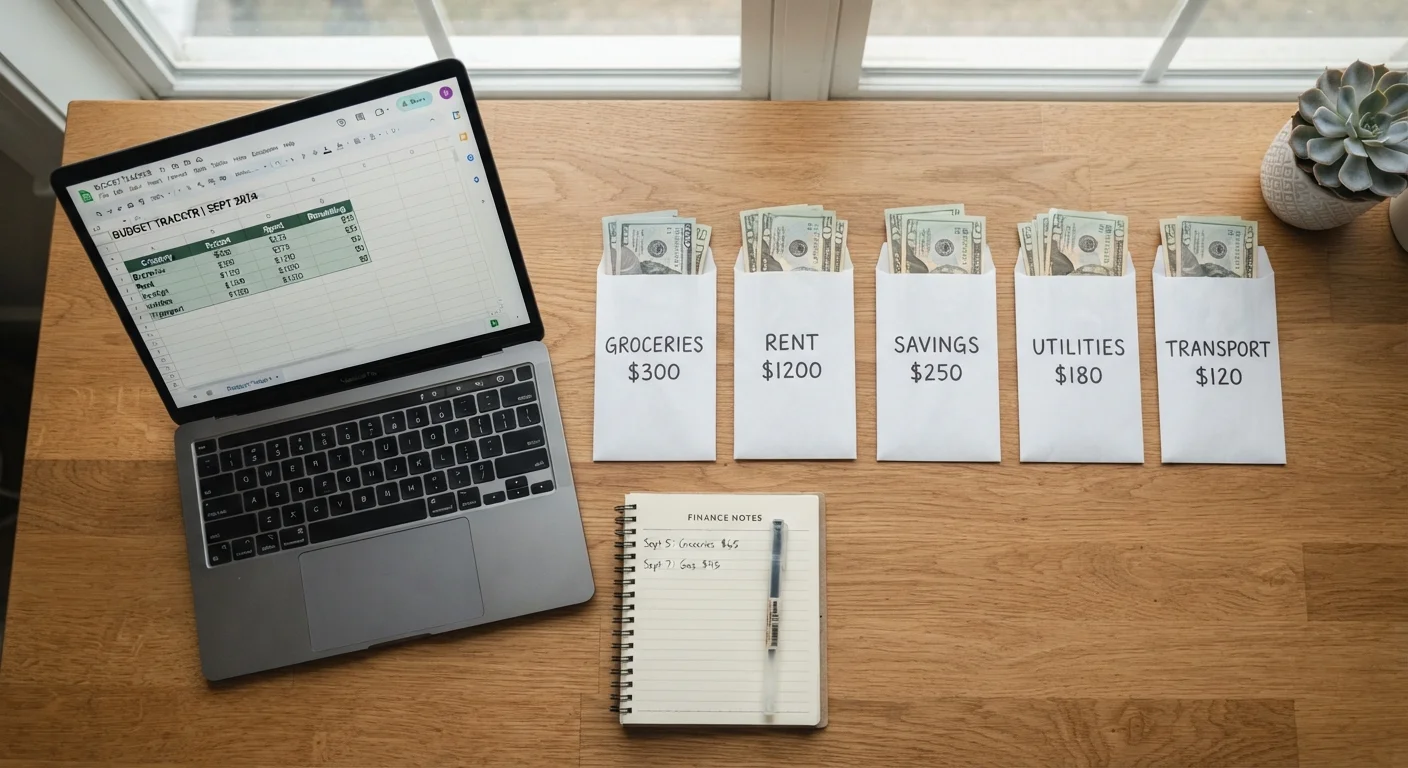
Envelope budgeting is one of the oldest personal finance systems still in active use. At its core, you withdraw cash at the start of each pay period and divide it into labeled envelopes — one for groceries, one for gas, one for dining out, and so on. Spending in each category is limited to what's in the envelope. Once it's empty, you either stop spending in that category or consciously move money from another envelope, making any trade-off visible and deliberate.
Spreadsheet budgeting replaces physical cash with a digital ledger. You build a template — whether in a tool like Google Sheets, Microsoft Excel, or a similar program — that lists your income, your spending categories, and your targets. As you spend, you log transactions manually or import them from bank statements. The spreadsheet calculates totals, shows variances, and can be expanded to include savings goals, debt payoff schedules, or net worth tracking.
Neither system requires expensive software or a financial background. Both are rooted in the same foundational principle: assigning every dollar a purpose before it gets spent.
| Criterion | Envelope Budgeting | Spreadsheet Budgeting |
|---|---|---|
| Core mechanism | Physical cash in labeled envelopes | Digital ledger with logged transactions |
| Spending limit enforcement | Hard stop when envelope is empty | Relies on self-monitoring and discipline |
| Setup time | Low — withdraw cash, divide it | Moderate — build or adapt a template |
| Ongoing maintenance | Minimal — no logging required | Regular — transactions must be entered |
| Works with digital payments | Limited — cash-only by design | Yes — tracks any payment method |
| Historical trend analysis | None unless you record it separately | Strong — data persists across months |
| Adaptability to income changes | Low — requires re-dividing cash | High — update figures instantly |
| Cost | Free | Free (with standard tools) |
Where Envelope Budgeting Has a Clear Edge
The envelope method's greatest strength is behavioral. Paying with cash is psychologically different from swiping a card — studies in consumer behavior have found that people tend to spend less when using physical currency because the loss feels more immediate. For anyone who struggles with overspending in variable categories like food, clothing, or entertainment, that friction can be the difference between staying on budget and blowing it.
The method is also low-maintenance in the sense that it requires no logging. You don't enter transactions or reconcile statements — the envelope balance tells you exactly where you stand at any moment. This makes it appealing for people who find data entry tedious or who have tried spreadsheet budgeting and abandoned it within a few weeks.
Understanding which of your expenses are genuinely variable versus fixed is key to setting envelope amounts that work. Our guide to fixed vs. variable expenses explains why that distinction matters so much for any budgeting system.
~33%
Americans with a written monthly budget
Gallup polling has consistently found that fewer than half of American adults maintain a detailed household budget, underscoring how much room exists for any structured system.
~18%
Reduction in spending using cash vs. cards
Multiple consumer behavior studies, including research published in the Journal of Consumer Research, have found that paying with cash reduces spending compared to card-based payments.
Where Spreadsheet Budgeting Has a Clear Edge
Spreadsheets offer something envelopes fundamentally cannot: a complete, searchable record. Every transaction you log becomes data you can review — by month, by category, or over an entire year. This makes it straightforward to notice patterns, like consistently underestimating your utility bills each winter or gradually increasing restaurant spending over six months.
Flexibility is the other major advantage. Envelopes work best when income and expenses are predictable. Spreadsheets adapt easily when a freelance payment comes in late, a subscription renews unexpectedly, or you need to redirect funds mid-month. You can restructure the entire budget in minutes without physically moving cash between locations.
Spreadsheets also integrate naturally with savings planning. You can build tabs for an emergency fund, a vacation fund, or a debt payoff tracker alongside your monthly spending columns. For readers looking to expand beyond month-to-month budgeting into longer-term wealth building, this structural flexibility connects naturally with saving and growing your money over time.
The tradeoff is effort. A spreadsheet budget only reflects reality if you update it consistently. Building the habit of consistent tracking is often the hardest part of making a spreadsheet system work long-term.
Common Failure Points — and How to Avoid Them
Envelope budgeting breaks down when spending increasingly moves online. Subscriptions, e-commerce, and digital bill pay don't fit neatly into a cash system. Many people use a hybrid approach — cash envelopes for high-risk discretionary categories, while fixed bills like rent and utilities are handled electronically and simply tracked on paper or a notes app.
Spreadsheet budgeting most often fails due to abandonment. People set up a detailed template in the first week of January, log transactions faithfully for two weeks, then quietly stop. The gap between a budget that looks right on paper and one that holds up day-to-day is almost always a habit problem, not a math problem. Scheduling a weekly 10-minute review session dramatically improves follow-through.
Both systems also require honest category amounts. Underestimating what you actually spend on groceries or gas — whether in an envelope or a spreadsheet cell — means you'll hit the limit before the month ends and scramble to cover the gap. Start with a month of honest tracking before setting targets, regardless of which method you choose.
You Don't Have to Choose Just One
Many people find that a hybrid approach works well in practice: cash envelopes for two or three high-risk discretionary categories, paired with a simple spreadsheet to track fixed bills and savings progress. There is no rule that requires you to commit to a single system. If your current method isn't working, consider borrowing elements from the other — the goal is a system you'll actually use. You might also explore other budgeting approaches to find a fit that matches your lifestyle.
This article is for general informational and educational purposes only. It does not constitute personalized financial advice. Readers are encouraged to consult a qualified financial professional for guidance specific to their situation.