

Key Takeaways
Option A
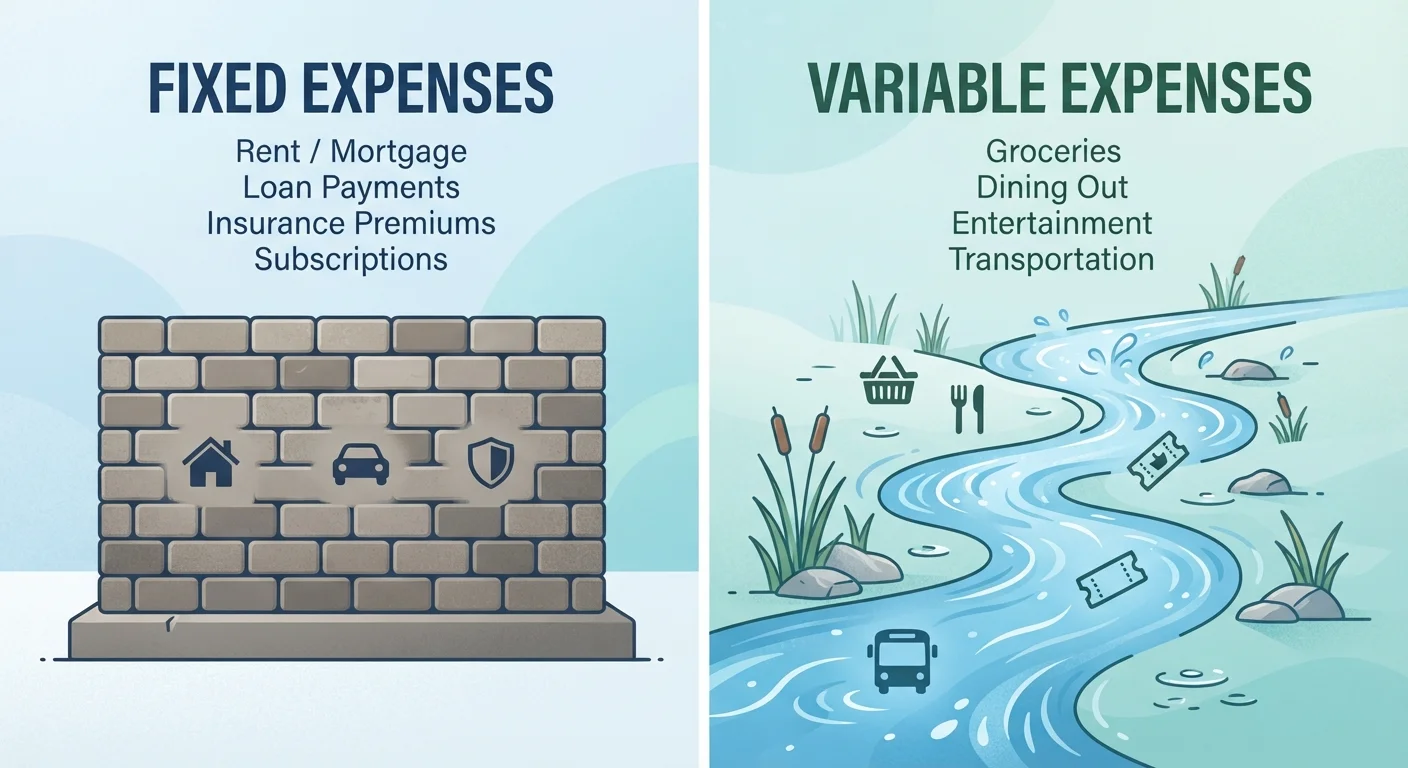
Fixed Expenses
The predictable, non-negotiable foundation of your budget.
Best for: Establishing a reliable spending baseline so you always know your minimum monthly financial obligations.
Option B
Variable Expenses
The flexible, adjustable layer that shifts with your habits and life.
Best for: Identifying where spending flexibility exists and where targeted cuts can free up cash each month.
If you want to establish a reliable monthly spending baseline
Fixed Expenses
Cataloguing your fixed expenses first gives you an immovable floor to build every budget around, preventing the common mistake of spending money already committed elsewhere.
If you need to find quick savings or free up cash this month
Variable Expenses
Variable costs are where spending behaviour is most adjustable. Pulling back on dining, subscriptions, or entertainment can produce immediate results without breaking contracts.
If you are building a long-term budget for the first time
Fixed Expenses
Start by listing every fixed obligation so you understand your non-negotiable monthly commitment before allocating anything to discretionary or savings goals.
If you want to improve your budgeting accuracy over time
Variable Expenses
Averaging three to six months of variable spending data smooths out irregular costs and produces far more realistic budget projections than single-month snapshots.
What Makes an Expense Fixed or Variable
Every dollar leaving your household falls into one of two behavioral categories. A fixed expense is a cost that remains the same amount each billing period, regardless of how much you use a service or how your month unfolds. Rent or mortgage payments, car loan installments, insurance premiums, and fixed-rate loan payments are classic examples. You owe the same figure whether the month has 28 days or 31, whether you drove the car daily or barely touched it.
A variable expense, by contrast, shifts from month to month based on consumption, behavior, or circumstances. Groceries, gasoline, utility bills, dining out, clothing, and entertainment spending all fall here. Some variable costs — like electricity — vary because of usage. Others — like restaurant spending — vary because of choices. Both share the defining trait that their amounts are not pre-determined.
A third, often overlooked group sits between these two: periodic or irregular expenses. Annual car registration fees, quarterly insurance premiums paid in lump sums, and holiday gifts are neither monthly fixed costs nor weekly variable ones. Many budgets collapse because these expenses are invisible until they arrive. Treating them as variable costs and setting aside a monthly fraction in a sinking fund is one practical way to handle them. See our reference glossary for household spending for a fuller breakdown of how these groups are commonly organized.
| Criterion | Fixed Expenses | Variable Expenses |
|---|---|---|
| Amount each month | Consistent, predetermined | Fluctuates with use or choice |
| Examples | Rent, loan payments, insurance | Groceries, gas, dining, utilities |
| Ease of reducing | Requires contract or lifestyle change | Adjustable through daily behavior |
| Budget role | Sets the non-negotiable spending floor | Determines remaining flexibility |
| Planning horizon | Long-range decisions (months or years) | Short-range decisions (weekly or daily) |
| Risk if underestimated | Missed payments, penalties, debt | Overspending, end-of-month shortfall |
Why the Distinction Matters for Every Budget Decision
When people budget without distinguishing expense types, they typically underestimate monthly obligations and overestimate flexibility. Someone might see $800 left after fixed bills and assume it is freely spendable — only to find groceries, gas, and a utility spike consume most of it before the month ends. This is one of the primary reasons a budget looks balanced on paper but falls apart mid-month.
The practical value of the fixed-versus-variable split is that it assigns different decision frameworks to each category. Fixed expenses require long-range decisions: signing or exiting a lease, refinancing a loan, switching insurance providers. Variable expenses require short-range decisions: what goes in the grocery cart this week, whether to cook at home on Friday. Conflating those two decision timescales leads to either over-restricting daily spending or ignoring the slow accumulation of recurring commitments.
~33%
Americans with no monthly budget
Survey data from the National Foundation for Credit Counseling consistently finds roughly one in three U.S. adults does not follow a formal household budget.
~$1,500
Average monthly variable spending gap
Consumer Expenditure Survey data from the U.S. Bureau of Labor Statistics shows significant variation in discretionary spending categories across income levels, illustrating how variable costs drive budget unpredictability.
For anyone working on managing debt, the distinction becomes especially important. Fixed debt payments (minimum loan payments, required installments) must be met to avoid penalties. Variable spending is where behavior changes can accelerate debt payoff. Separating the two makes that strategy coherent rather than vague.
How to Budget Each Type Effectively
The most reliable method for fixed expenses is direct allocation at the start of the month. Before any other spending decision is made, total all fixed obligations and subtract them from your take-home income. What remains is genuinely available — and only then should variable spending be allocated. This sequence prevents the common error of spending variable dollars that are already claimed by fixed commitments.
For variable expenses, a different approach works better: category caps based on historical averages. Pull three to six months of bank or credit card statements and calculate what you actually spend in each variable category — groceries, fuel, utilities, dining, entertainment. Use those averages as your monthly targets rather than aspirational guesses. Budgets built on real behavior are far more durable than budgets built on optimism.
Choosing the right tracking system matters too. Whether you prefer cash envelopes or a digital spreadsheet, the structural logic should reflect the fixed-versus-variable split — fixed costs tracked as locked line items, variable categories as flexible caps. Our comparison of envelope budgeting versus spreadsheet budgeting walks through which method suits different organizational styles.
When 'Fixed' Is More Flexible Than It Seems
Some expenses feel immovable but are actually negotiable. Insurance premiums can often be reduced by adjusting coverage levels or shopping providers at renewal. Subscription services branded as monthly commitments can be paused or cancelled. Even certain loan rates can be renegotiated through refinancing. Reviewing your fixed expense list annually — not just your variable spending — can uncover meaningful savings that aren't visible in day-to-day budget tracking.
Finally, don't assume every fixed expense is permanent. Renters can negotiate lease terms or consider month-to-month versus fixed-term lease trade-offs. Homeowners can evaluate whether refinancing changes their monthly floor. For many households, what feels like a fixed obligation is actually a renegotiable one — which means even your fixed expense list deserves periodic review, not just your variable spending habits.
Understanding how discretionary spending fits within your variable costs is also worth exploring. See our article on what discretionary spending actually means for a closer look at that layer of the budget.
This article is for general informational and educational purposes only and does not constitute personalized financial advice. Consult a qualified financial professional for guidance specific to your situation.