

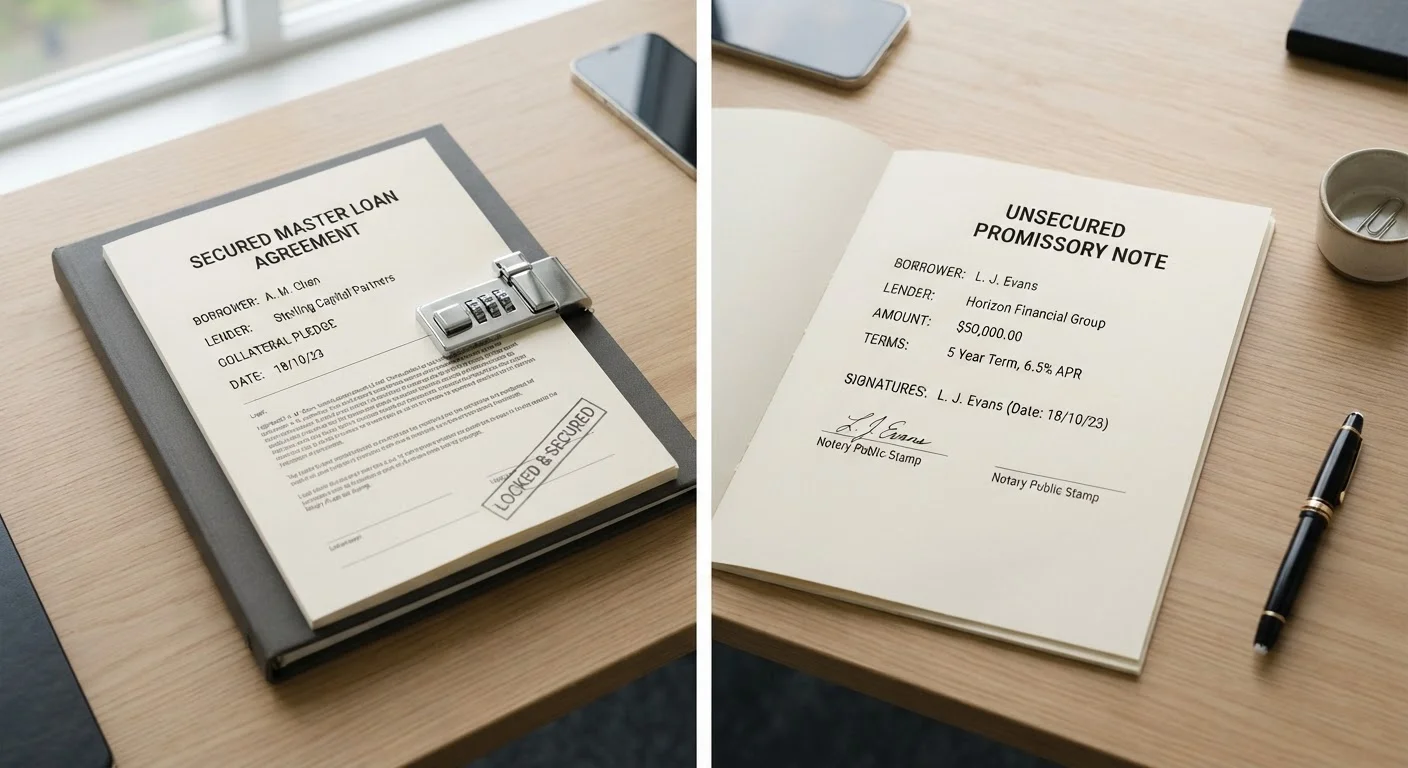
Key Takeaways
Option A
Secured Debt
Collateral-backed borrowing with lower rates and higher stakes.
Best for: Borrowers financing large purchases — such as a home or vehicle — who can accept that the asset may be repossessed if payments stop.
Option B
Unsecured Debt
Credit extended on creditworthiness alone, with no asset on the line.
Best for: Borrowers who need flexible credit for everyday expenses or emergencies and do not want to pledge a specific asset as collateral.
If you are financing a home purchase
Secured Debt
Mortgages are secured loans, which is why they typically carry lower interest rates than unsecured alternatives. The property itself serves as collateral for the lender.
If you need flexible borrowing for everyday or emergency expenses
Unsecured Debt
Credit cards and personal loans don't require pledging an asset, making them more accessible for short-term or variable needs — though the trade-off is usually a higher interest rate.
If you are concerned about protecting specific assets in the event of financial hardship
Unsecured Debt
Because no collateral is involved, a default on unsecured debt does not trigger direct repossession of property — though it still seriously damages your credit and can lead to legal collection action.
If you have strong credit and want the lowest possible borrowing cost on a large sum
Secured Debt
The presence of collateral reduces lender risk, which generally translates to lower interest rates compared to unsecured borrowing of comparable size.
The Core Difference: What Collateral Actually Means
At its most basic, debt falls into two categories based on whether an asset backs the loan. If you are new to these concepts, our foundation guide to debt and credit walks through the core mechanics of borrowing before diving into the distinctions here.
Secured debt requires the borrower to pledge a specific asset — called collateral — against the loan. The lender holds a legal claim on that asset. If the borrower stops making payments, the lender has the right to seize and sell the collateral to recover what is owed. Mortgages and auto loans are the most common examples: the home or vehicle serves as the collateral.
Unsecured debt involves no such pledge. The lender extends credit based on the borrower's creditworthiness — primarily their credit history and income — rather than a specific asset. Credit cards, personal loans, and student loans are typically unsecured. If a borrower defaults, the lender cannot directly repossess property; instead, they may pursue collection efforts or sue for repayment.
| Criterion | Secured Debt | Unsecured Debt |
|---|---|---|
| Collateral required | Yes — specific asset pledged | No — creditworthiness only |
| Typical interest rates | Generally lower | Generally higher |
| Common examples | Mortgage, auto loan | Credit card, personal loan |
| Consequence of default | Repossession or foreclosure | Collections, credit damage, potential lawsuit |
| Credit score impact at default | Severe | Severe |
| Approval emphasis | Asset value + creditworthiness | Credit score + income |
| Loan amounts | Often larger (tied to asset value) | Often smaller or variable |
How Collateral Affects Interest Rates and Approval
The presence or absence of collateral is one of the most significant factors shaping the cost of borrowing. Because secured debt gives lenders a concrete fallback — the collateral itself — they face less financial risk. That reduced risk generally translates to lower interest rates for the borrower.
6–7%
Typical 30-year fixed mortgage rate range
Federal Reserve data shows secured mortgage rates remain substantially below average unsecured personal loan rates, which often exceed 10–12% for well-qualified borrowers.
~21%
Average credit card APR (unsecured)
The Federal Reserve's Consumer Credit report tracks average credit card interest rates, which have historically been several times higher than secured mortgage rates.
35%
Payment history share of FICO score
FICO score methodology weights payment history most heavily — meaning defaults on both secured and unsecured debt carry serious, lasting credit score consequences.
Unsecured debt offers lenders no such safety net, so they typically charge higher rates to compensate for the elevated risk of non-repayment. This is why credit card annual percentage rates (APRs) are often substantially higher than mortgage rates, even for borrowers with excellent credit.
Approval criteria also differ. Secured loans may be accessible to borrowers with less-than-perfect credit, because the collateral partially offsets credit risk. Unsecured credit decisions lean more heavily on your credit score and debt-to-income ratio. Understanding how lenders check your credit — including the difference between hard and soft inquiries — is useful context when applying for either type.
Consequences of Default: What You Stand to Lose
The stakes of missed payments differ significantly depending on the debt type.
With secured debt, default can lead to the direct loss of the asset tied to the loan. A mortgage lender may initiate foreclosure on your home; an auto lender may repossess your vehicle. These processes vary by state and lender, but the core consequence is losing the collateral. Credit damage accompanies these events as well. For context on how auto loans interact with insurance coverage, our article on comprehensive vs. collision coverage covers some adjacent considerations for vehicle ownership.
With unsecured debt, default triggers a different set of consequences: the account goes to collections, your credit score takes a serious hit, and the lender may eventually pursue a civil lawsuit to obtain a court judgment. A judgment can lead to wage garnishment in many states. While you won't lose a specific asset through repossession, the financial and legal fallout is still significant.
Debt default of any kind has ripple effects beyond monthly payments. Our piece on lesser-known ways debt shapes everyday life covers impacts on housing applications and employment screenings that many borrowers overlook.
When Secured Debt Becomes Unsecured
In some bankruptcy proceedings, a court may determine that a secured debt exceeds the value of its collateral — the portion above that value may be treated as unsecured. This is a complex legal area known as 'lien stripping' or 'cramdown,' and the rules vary by debt type and bankruptcy chapter. Anyone considering bankruptcy should consult a qualified bankruptcy attorney before proceeding.
This article is for general informational purposes only and does not constitute personalized financial or legal advice. Consult a licensed financial professional or attorney for guidance specific to your situation.