

Key Takeaways
Why Automation Changes the Savings Equation
Most people understand they should save regularly. The challenge isn't knowledge — it's execution. Saving manually requires a decision every pay period: how much to set aside, when to transfer it, and resisting the temptation to spend it first. Behavioral research consistently shows that humans are prone to present bias, meaning immediate spending feels more rewarding than future security.
Automation sidesteps that psychological friction entirely. When saving happens without active effort — triggered by a schedule, a paycheck, or a transaction — it shifts from a recurring decision to a background process. The result is consistency that manual saving rarely achieves.
This isn't just a productivity hack. It's a structural change to how money moves. As explored in our end-to-end savings guide, the habits surrounding saving matter as much as the amounts involved.
“The secret to getting ahead is getting started. The secret to getting started is breaking your complex, overwhelming tasks into small manageable tasks, and then starting on the first one.”
— Mark Twain, American author and humorist
Three Core Automation Methods — and How They Work
Understanding the mechanics behind each approach helps you choose the right fit for your situation.
Use payroll direct deposit splits to save before money reaches your checking account.
When savings are diverted before you see the funds, the psychological effect of 'missing' money disappears. This mirrors the pay-yourself-first philosophy, which research suggests produces stronger saving outcomes than saving what remains after spending. It also eliminates the transfer step entirely.
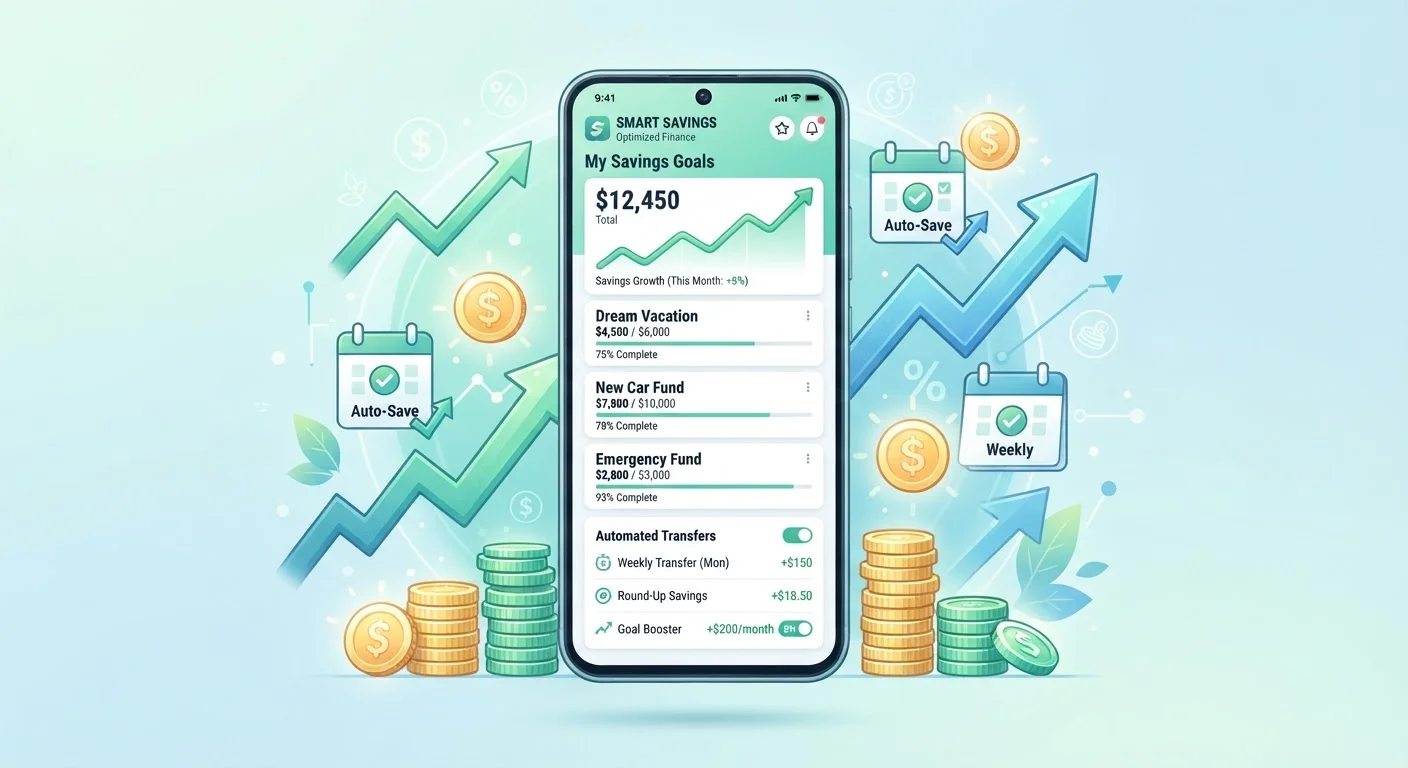
Schedule recurring automatic transfers on a fixed date each month.
Scheduled transfers give you precise control over the amount and timing without relying on willpower. Aligning the transfer date with your pay date — shortly after income arrives — reduces the risk of the money being spent before the transfer occurs.
Activate round-up savings tools to convert spare change into consistent contributions.
Round-up features, offered by many financial apps and some banks, automatically round each debit card purchase to the nearest dollar and transfer the difference to a savings account. While individual amounts are small, the cumulative effect over hundreds of monthly transactions is meaningful — and entirely passive.
Create separate named savings accounts tied to specific goals.
Behavioral economics research suggests that earmarking funds — assigning money a specific purpose — reduces the likelihood of spending it impulsively. Named accounts (e.g., 'Emergency Fund,' 'Car Repair') make the goal tangible and help you monitor progress clearly. Automation deposits into these accounts reinforce the habit.
Automate increases to your savings rate after income changes.
Lifestyle inflation — spending more as income grows — is one of the most common barriers to building wealth over time. Setting a rule to automatically increase savings contributions whenever your income rises captures the additional cash flow before spending habits adjust to it.
Whichever method you use, pairing it with the right account matters. A savings vehicle matched to your goal's timeline prevents money from sitting in an account that doesn't serve its purpose.
Getting Started Without Overcomplicating It
One common mistake is treating automation as an all-or-nothing setup. You don't need to automate everything at once or start with large amounts. Starting small and building gradually is often more effective than an aggressive initial commitment that gets reversed when cash flow tightens.
It's also worth noting that automation doesn't eliminate the need for a budget — it complements one. If you're still developing a spending plan, core budgeting strategies can help you identify how much is realistically available to redirect before setting any transfer amounts.
One important caveat: review your automated amounts at least twice a year. Income changes, new expenses, and shifting goals all affect how much you can sustainably set aside. An amount that made sense six months ago may need adjusting — up or down. Automation handles the execution, but you still own the strategy.
This article is for general informational and educational purposes only and does not constitute personalized financial advice. Consult a qualified financial professional for guidance specific to your situation.