

Key Takeaways
Our Verdict
Neither short-term nor long-term savings strategies are universally superior — they serve fundamentally different purposes. Most households need both running simultaneously. Matching the right vehicle to the right timeline prevents common mistakes like keeping retirement savings in a low-interest account or locking up an emergency fund where it's inaccessible.
| Best for | Recommended |
|---|---|
| Goals you'll reach within one to three years | Short-Term Strategy |
| Retirement, education funding, or decade-long wealth building | Long-Term Strategy |
| Readers who need both stability and growth simultaneously | Parallel Goal Framework |
What Separates Short-Term from Long-Term Goals
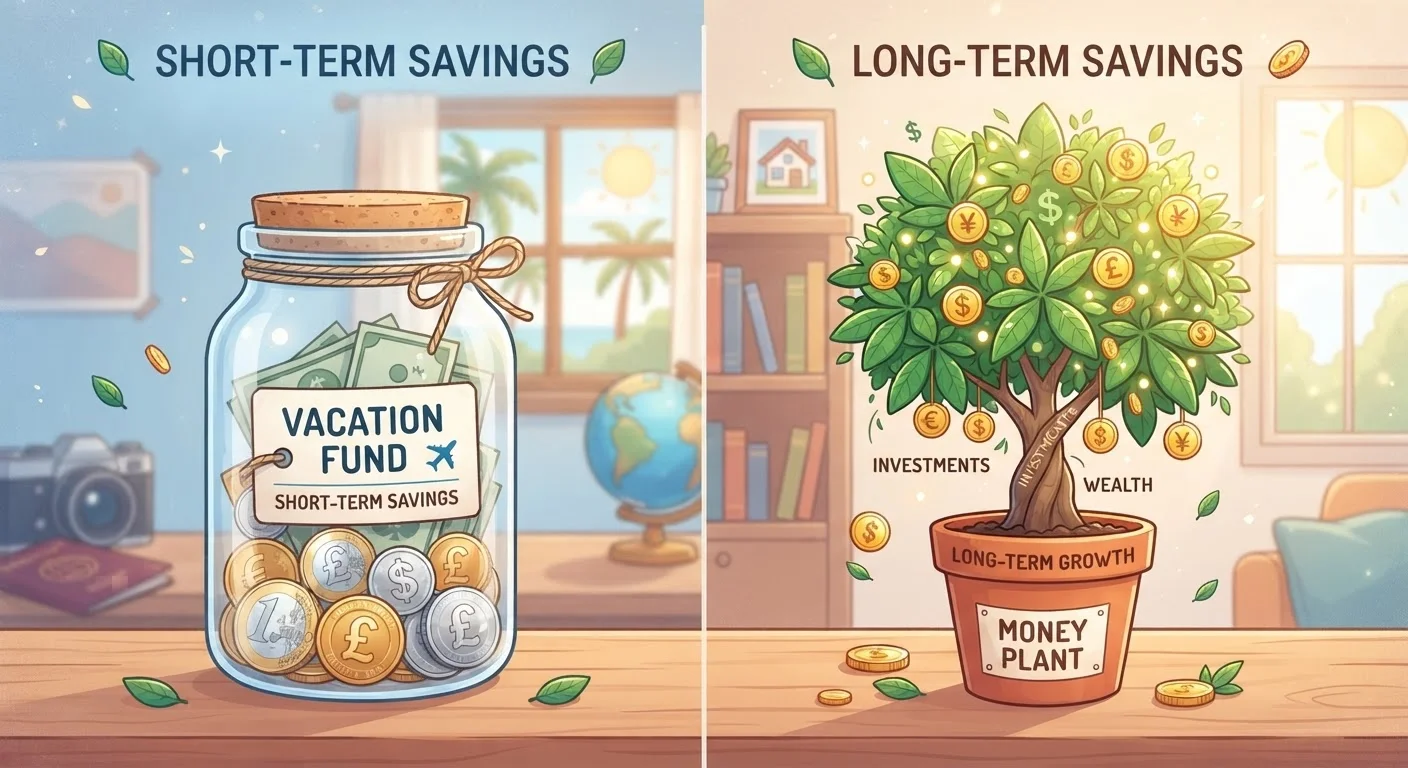
The most useful distinction between savings goals isn't the dollar amount — it's the timeline. A short-term goal generally has a horizon of one to three years: building an emergency fund, saving for a vacation, covering a home repair, or preparing for a vehicle purchase. A long-term goal typically extends five years or more, often stretching across decades, and includes retirement savings, a child's college education, or a first home down payment.
Why does timeline matter so much? Because it determines how much risk you can tolerate, which account types make sense, and how much compounding can work in your favor. A short-term goal demands stability and access — you can't afford a 20% market dip the month before you need the money. A long-term goal, by contrast, can absorb short-term volatility in exchange for meaningfully higher growth over time.
Understanding this difference is foundational. For a broader framework, see The Full Picture on Saving and Growing Money Over Time, which ties emergency funds, savings accounts, and investing habits together in one end-to-end guide.
Short-Term Savings: Vehicles and Best Practices
For goals within a one-to-three-year window, the priority is capital preservation and liquidity. Common vehicles include:
- High-yield savings accounts (HYSAs): These typically offer substantially higher interest rates than traditional savings accounts while keeping funds fully accessible. They're well-suited for emergency funds and near-term goals. See how they compare in our side-by-side look at high-yield vs. traditional savings accounts.
- Money market accounts: Similar in structure to HYSAs but sometimes offering check-writing or debit access. Our money market vs. high-yield savings comparison covers the distinctions in detail.
- Certificates of deposit (CDs): Fixed-term deposits that typically pay higher rates in exchange for locking funds away for a set period. These work well when you know precisely when you'll need the money and want to earn more in the interim.
The key risk with short-term savings isn't market loss — it's inflation quietly eroding purchasing power if rates are too low, and over-commitment to instruments with withdrawal penalties.
Label Your Accounts by Goal
Naming savings accounts after their purpose — 'Emergency Fund,' 'Vacation 2026,' 'Down Payment' — creates psychological clarity and reduces the temptation to redirect money. Many financial institutions allow custom account nicknames at no cost. This simple practice is one of the most effective ways to stay consistent across multiple goals simultaneously.
One structural habit that strengthens short-term saving is keeping each goal in a separate, labeled account. Visibility into progress reduces the temptation to redirect funds.
Long-Term Savings: Vehicles and Best Practices
When a goal is five or more years away, time becomes your most powerful asset. Compound growth — earning returns on prior returns — has the greatest effect over long time horizons. Vehicles commonly used for long-term goals include:
- Tax-advantaged retirement accounts (401(k), IRA, Roth IRA): Designed specifically for retirement, these accounts offer tax benefits that materially improve long-term outcomes. Contribution limits and rules vary by account type.
- 529 education savings plans: State-sponsored plans that allow tax-free growth when funds are used for qualifying education expenses.
- Brokerage accounts: For long-term goals that fall outside retirement or education, a taxable brokerage account allows investment in diversified assets without contribution limits, though without the same tax advantages.
| Short-Term Savings | Long-Term Savings | |
|---|---|---|
| Typical timeline | 1–3 years | 5+ years |
| Primary priority | Liquidity and stability | Growth and compounding |
| Common vehicles | HYSAs, money market, CDs | 401(k), IRA, 529, brokerage |
| Risk tolerance | Very low | Moderate to high |
| Inflation sensitivity | Higher (less time to recover) | Lower (time absorbs volatility) |
| Tax advantages | Generally none | Often significant |
| Access to funds | Generally unrestricted | Often restricted before milestones |
It's worth noting that keeping too much of your long-term wealth in a low-interest savings account carries its own risk. Our article on why saving more doesn't always mean growing wealth faster explains how excess cash on the sidelines can quietly lose purchasing power to inflation over time.
This article is for general informational and educational purposes only and does not constitute personalized financial, investment, tax, or legal advice. Consult a qualified financial professional before making decisions about your specific situation.
Running Both Strategies at Once
Most households need short-term and long-term savings running in parallel — not sequentially. Waiting until an emergency fund is fully built before contributing to a retirement account, for example, can mean years of missed compounding. A more practical approach is to fund each goal proportionally based on urgency and impact.
Building this habit consistently often comes down to how your savings system is structured. Automation — scheduled transfers, payroll splits, or round-up tools — removes the friction from saving and reduces the likelihood of skipping a contribution. The role of automation in consistent saving article details exactly how these tools work in practice.
It's also worth reviewing your budgeting philosophy. Whether you save before spending or allocate what's left over makes a measurable difference in long-term outcomes. The pay-yourself-first vs. traditional budgeting comparison explores both approaches. And regardless of how well-structured your plan is, common missteps can stall progress — the savings traps that quietly undermine progress is worth reading alongside this one.