

Key Takeaways
Start here
Why Cats Can Be Trained (And Why Many Owners Doubt It)
Build your foundation
The Science Behind Cat Learning
Get practical
Choosing the Right Rewards
Begin training
Timing, Cues, and Your First Sessions
Refine your approach
Common Mistakes and How to Avoid Them
Why Cats Can Be Trained (And Why Many Owners Doubt It)
The idea that cats are untrainable is one of the most persistent myths in pet ownership. It stems from a real difference — not a deficiency. Cats were not domesticated as working partners in the way dogs were, so they do not share the same instinct to seek human direction. That does not mean learning is beyond them. It means the approach has to match how cats actually think and what genuinely motivates them.
Behavioral research confirms that cats learn through the same basic mechanisms as other mammals: association, consequence, and repetition. Cats in laboratory and applied settings have been shown to learn cued behaviors, solve problems, and retain what they have learned over time. Many cat owners have already observed this without realizing it — a cat who runs to the kitchen at the sound of a can opener has made a learned association just as deliberate as any trained cue.
For a broader look at how cats and dogs differ as companions — including how those differences affect day-to-day ownership — see our side-by-side comparison.
Observe Before You Train
Spend a few days noticing when your cat is naturally alert, curious, and approachable — usually in the morning or after a nap. These windows of mild arousal are your best training opportunities. Attempting to train a sleeping or overstimulated cat wastes the session.
The Science Behind Cat Learning
Cat training is grounded in operant conditioning — a learning process in which behavior is shaped by its consequences. When a behavior produces something the cat values (a treat, a toy, attention), the cat is more likely to repeat it. When a behavior produces nothing, it tends to fade. This is why positive reinforcement — adding something desirable after the desired behavior — is the standard approach recommended by veterinary behaviorists.
Positive reinforcement
Adding something the animal wants (like a treat) immediately after a desired behavior to make that behavior more likely to happen again.
Operant conditioning
A learning process in which an animal's behavior is shaped by the consequences that follow it — rewarding outcomes increase the behavior, while neutral outcomes cause it to fade.
Marker
A precise signal — typically a click or a short word — used to tell the animal the exact moment it performed the correct behavior, just before the reward is delivered.
Cue
A signal (word, hand gesture, or sound) that tells the animal which behavior to perform. A cue is only meaningful after the animal has learned to associate it with a specific action.
Luring
Using a treat or toy to physically guide an animal into a desired position or behavior during the early stages of training, before a cue is added.
Punishment-based methods are counterproductive with cats. Unlike dogs, cats have a lower tolerance for frustration and a stronger withdrawal response. Aversive experiences during training do not teach the cat what you want — they teach the cat to avoid you. For a comprehensive overview of learning theory as it applies across species, our complete pet training reference covers the full framework.
Choosing the Right Rewards
Motivation is the engine of cat training, and finding what genuinely motivates your cat is more important than any technique. Most cats are primarily food-motivated, making small, soft, high-value treats the most practical reward. The treat should be small enough to eat in one second — anything larger slows the session and fills your cat up too quickly.
Not every cat responds equally to food. Some cats are more motivated by a brief play session with a wand toy or by gentle physical contact. Experimenting matters: offer several options during relaxed moments and note which produces the most enthusiastic response. That is your training currency.
- Food rewards: Small, soft, strongly scented treats are typically most effective. Reserve them exclusively for training to maintain their value.
- Play rewards: A one- to two-second burst with a preferred toy can work well for cats who are highly play-driven.
- Social rewards: Some cats respond to brief, specific praise or petting — but verify your cat actually enjoys this rather than assuming.
Before beginning any session, confirm your cat is in a mildly hungry state — not just fed, but not distressed. A cat who has just eaten a full meal has little incentive to work for food.
Timing, Cues, and Your First Sessions
Timing is the most technically demanding part of cat training. The reward must follow the desired behavior within one to two seconds for the cat to connect the two. Delays break the association. This is precisely why many trainers use a marker — a distinct sound (a click or a short verbal cue like "yes") that signals the exact moment the correct behavior occurred, buying a second or two to deliver the treat. For a full comparison of clicker and verbal marker methods, see our guide to clicker training vs. verbal markers.
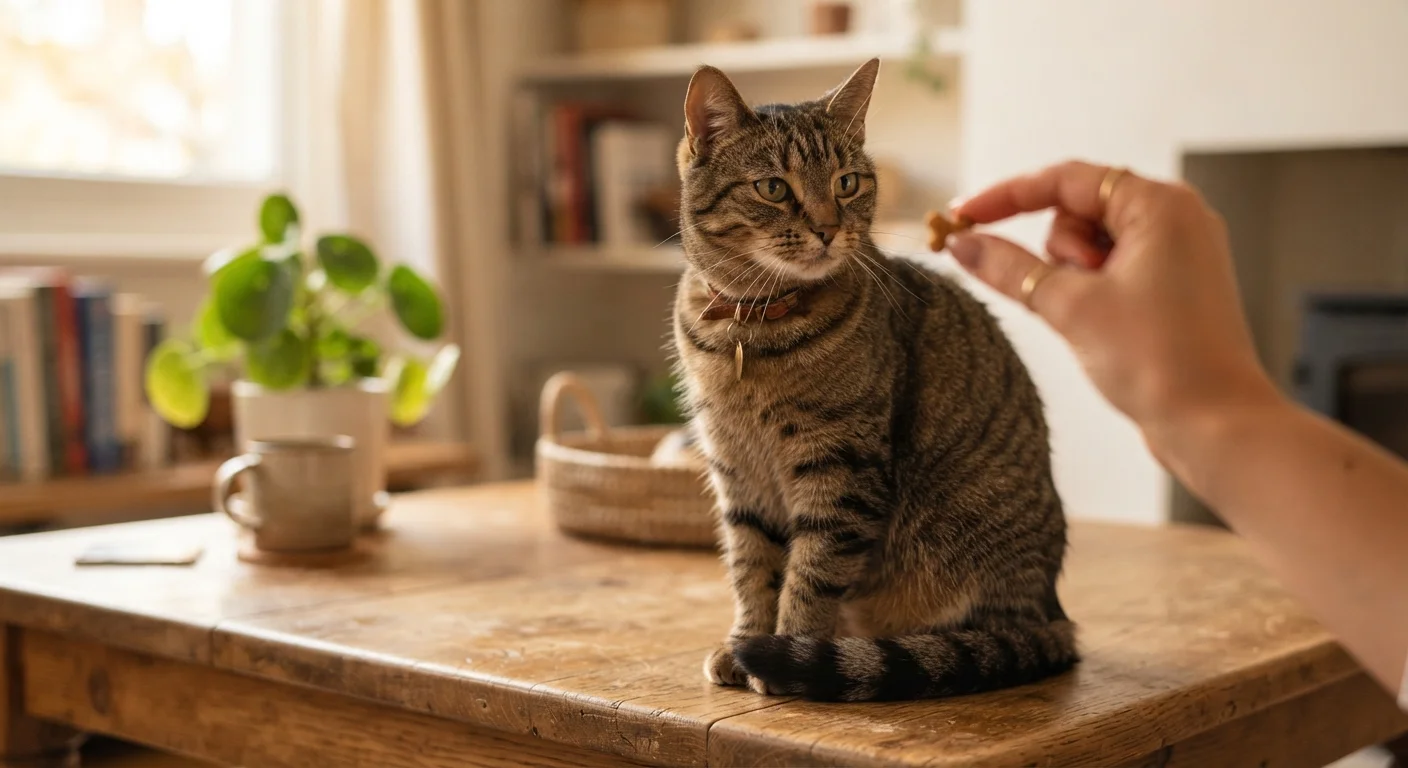
A practical starting cue for most cats is "sit." Here is the basic process:
- Hold a small treat just above and slightly behind your cat's nose so the head naturally tilts up and the hindquarters lower.
- The moment the rear touches the ground, mark (click or say "yes") and immediately deliver the treat.
- Release your cat and reset. Repeat no more than five to eight times per session.
Keep sessions to two to five minutes. End before your cat loses interest, not after. Consistency across multiple short sessions each day builds skills faster than occasional long ones. For a structured pre-session checklist covering environment, energy level, and reward selection, review our session setup guide before you begin.
One Behavior at a Time
When you are starting out, focus on a single behavior until your cat responds reliably in your training space — typically 80% of attempts over several sessions. Adding new cues too quickly before the first is solid creates confusion and slows overall progress. Patience with one behavior pays dividends when you move to the next.
Common Mistakes and How to Avoid Them
Most early training failures trace back to a small set of predictable errors. Recognizing them in advance saves significant frustration.
- Sessions that are too long
- Cats disengage quickly. Two to five minutes is the ceiling for productive work. If your cat walks away, the session is over — following and attempting to re-engage typically increases avoidance.
- Repeating cues without a response
- Saying "sit, sit, sit" while the cat ignores you trains the cat to ignore the cue. Say it once. If there is no response, reset and try again with better luring.
- Inconsistent markers or rewards
- Switching between "yes," "good," and "nice" confuses the association. Pick one marker and use it every time, exclusively for training moments.
- Training when the cat is stressed or overstimulated
- A cat who is reactive, pacing, or showing flattened ears or a lashing tail is not in a state to learn. Wait for a calmer moment.
- Skipping the foundation of trust
- If your cat is not comfortable approaching you voluntarily, formal training is premature. Spend time simply being present, offering treats without expectation, and building positive associations first.
Cat training is ultimately a relationship skill. The goal is not a perfectly obedient animal but a cat who engages willingly and a household dynamic that works for both of you. Explore our pet health and care hub for guidance on the broader picture of feline wellbeing.
Avoid Aversive Corrections
Spray bottles, loud noises, and physical corrections may stop a behavior in the moment but consistently damage the trust your cat has in you and in the training environment. Cats subjected to aversive training are more likely to avoid interaction altogether, making any future training significantly harder. If a behavior is unwanted, focus on rewarding an incompatible alternative instead.