

Key Takeaways
Our Verdict
Neither group classes nor private instruction is universally superior — each format serves different dogs, owners, and goals. Group classes excel for socialization and foundational skills, while private sessions are better suited for behavior challenges, reactive dogs, or highly specific training needs. Many owners find value in combining both approaches over time.
| Best for | Recommended |
|---|---|
| Puppies and dogs needing socialization alongside basic obedience | Group Classes |
| Dogs with reactivity, fear, or complex behavioral issues | Private Instruction |
| Owners with flexible schedules and tighter budgets | Group Classes |
| Owners needing training adapted to their home environment or routine | Private Instruction |
What Each Format Actually Offers
Understanding what you're signing up for — beyond the marketing language — helps you set realistic expectations from the start.
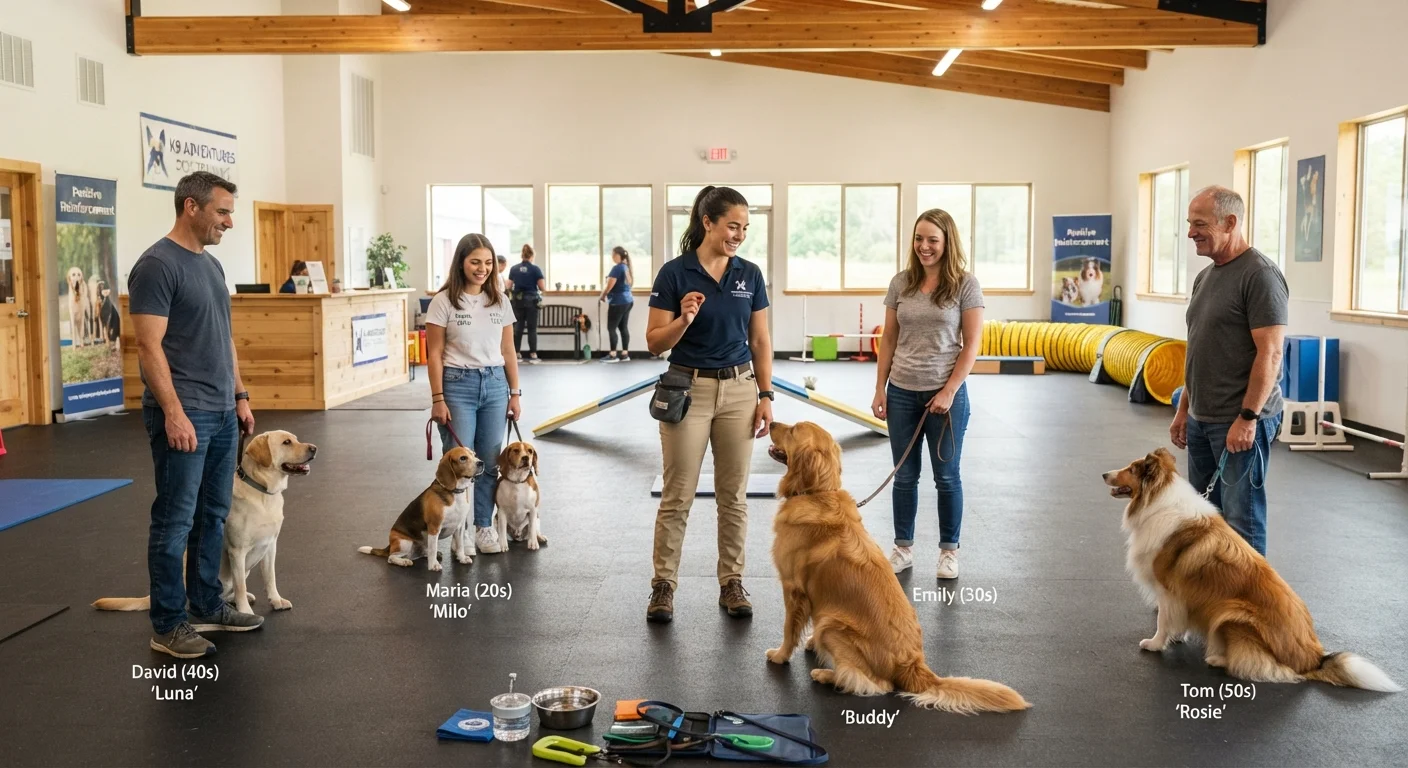
Group classes typically gather four to ten dogs and their owners for structured, instructor-led sessions lasting six to eight weeks. A skilled instructor teaches cues and skills to the whole class, with brief individual attention when needed. The environment is intentionally busy, which is part of the point: dogs practice focusing despite real-world distractions. This format naturally builds impulse control and teaches dogs to pay attention to their owners even when other dogs are nearby.
Private instruction means one-on-one time between a trainer, your dog, and you — usually in your home, a training facility, or a location relevant to the problem you're solving. Sessions can be tailored entirely to your dog's history, triggers, and current skill level. There's no waiting for other dogs to take their turns, and the trainer can observe your dog's behavior in its natural context. For a deeper look at how environment shapes every training session, see our guide to setting up successful sessions.
How Group Classes and Private Sessions Compare
The differences go beyond price and scheduling. Consider how each format stacks up across the criteria that matter most to dog owners.
| Group Classes | Private Instruction | |
|---|---|---|
| Typical cost per session | Lower — shared across participants | Higher — one-on-one time |
| Socialization opportunity | High — built into the format | Low — requires separate arrangement |
| Individual attention | Limited — shared with class | Full — entirely focused on your dog |
| Best for reactive dogs | Generally not recommended | Strongly preferred |
| Schedule flexibility | Fixed weekly sessions | Often more flexible scheduling |
| Distraction training | Naturally built in | Must be deliberately structured |
| Home behavior issues | Difficult to address directly | Can be assessed in your environment |
Cost varies considerably by region and trainer experience. Group classes at training facilities typically run less per session than private instruction, though package pricing and session length affect the total investment significantly.
When Group Classes Are the Right Call
Group classes tend to be an excellent fit when your primary goals include socialization, foundational obedience, and building a working partnership in the presence of distractions. Puppies between 8 and 16 weeks gain enormous benefit from structured exposure to other dogs and people during this critical developmental window — provided the class is well-managed and positive in approach.
Adult dogs that are friendly, curious, and easily motivated also thrive in group settings. The peer-learning dynamic can be surprisingly effective: watching other dogs succeed at a cue often sparks a dog's engagement. Owners benefit too, observing how others navigate the same challenges and gaining community support.
Ask to Observe Before You Enroll
Many reputable training facilities will allow prospective students to watch a class session before signing up. Use this opportunity to assess how the instructor manages the group, how dogs respond to the environment, and whether the pace and style feel like a good fit for your dog's personality. A few minutes of observation can save weeks of mismatched effort.
Group classes work less well for dogs who are reactive to other dogs or people, easily overwhelmed, or dealing with fear-based behavior. Placing a highly anxious dog in a busy class environment can reinforce stress rather than reduce it. This is a situation where the format can actively work against your goals.
This parallels a broader principle covered in our complete owner's reference on training and behavior: matching the learning environment to the learner's current capacity matters as much as the curriculum itself.
When Private Instruction Makes More Sense
Private instruction becomes the clearer choice when your dog has specific behavioral challenges that need careful, individualized management. Leash reactivity, resource guarding, separation anxiety, fearfulness, and aggression all require a trainer who can observe the behavior directly and adapt in real time — something a group setting cannot safely or effectively provide.
Private sessions are also valuable for owners who want to work on skills specific to their lifestyle: navigating apartment elevators, greeting delivery workers calmly, or riding in a car without distress. A trainer working in your environment can spot triggers and management gaps you might not notice yourself.
Don't Wait Too Long on Problem Behaviors
Behavioral issues like growling, snapping, or persistent fear responses tend to become more entrenched over time without structured intervention. If your dog is displaying these signs, seeking private instruction from a certified professional sooner rather than later gives you a better foundation to work from. Delaying help is rarely neutral — it often allows patterns to deepen.
New owners who feel overwhelmed or uncertain about their technique often gain more from private instruction initially. Having a trainer watch you handle your dog and give immediate, specific feedback builds owner confidence faster than a group class where your turns are brief. Once fundamentals are solid, transitioning to a group class for socialization and distraction practice is a natural next step.
For dogs with significant physical needs alongside behavioral ones, pairing training with a structured daily routine helps reinforce progress between sessions.
Choosing a Trainer: What to Look For in Either Format
The format matters less than the person running it. A skilled trainer using evidence-based, positive reinforcement methods will produce better outcomes in a group setting than a poorly qualified trainer offering private sessions — and vice versa.
When evaluating any trainer or program, look for:
- Credentials from recognized organizations such as the Certification Council for Professional Dog Trainers (CCPDT) or the International Association of Animal Behavior Consultants (IAABC)
- Clear use of positive reinforcement and humane, science-based methods
- Willingness to explain their approach and answer your questions
- A class or session structure you can observe before committing
Avoid trainers who rely heavily on aversive tools, punishment-based techniques, or who cannot clearly explain why they use a given method. For guidance on specific training tools and techniques, our article on clicker training vs. verbal markers explores how different marking methods work in practice.
This article is for general informational purposes only. Every dog is an individual; consult a certified professional trainer or veterinary behaviorist for guidance specific to your dog's needs, especially when dealing with fear, aggression, or anxiety-related behaviors.