

Key Takeaways
Option A
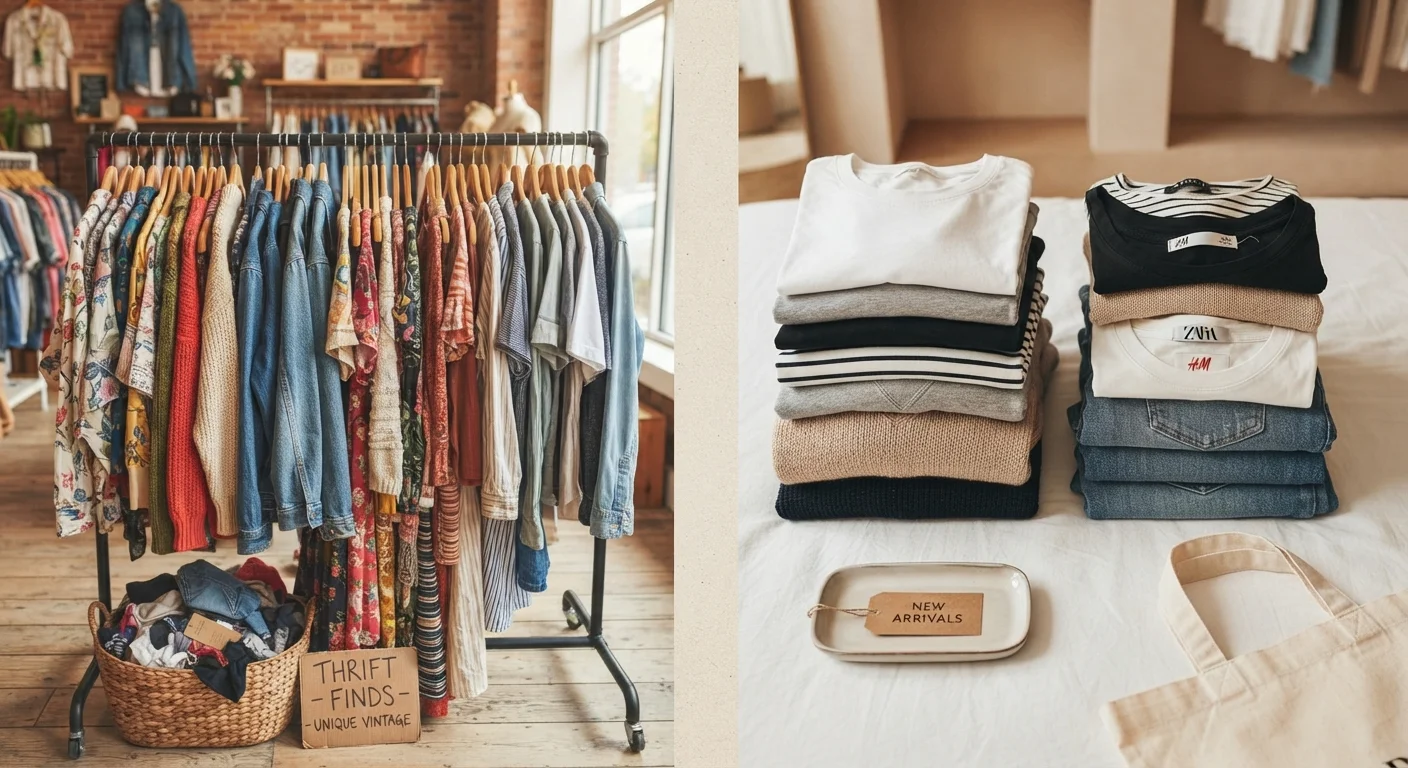
Thrift Store Shopping
The sustainable, hunt-and-discover approach to fashion.
Best for: Budget-conscious shoppers who enjoy the search, value uniqueness, and want to reduce clothing waste.
Option B
Fast Fashion
The convenient, on-trend option for quick wardrobe refreshes.
Best for: Shoppers who prioritize immediate availability, consistent sizing, and keeping up with current trends affordably.
If you're building a wardrobe on a tight budget
Thrift Store Shopping
Per-item prices at thrift stores are consistently lower, and you can find quality fabrics and construction that would cost far more new. See our guide to building a work wardrobe on a budget for strategic tips.
If you need a specific item quickly and reliably
Fast Fashion
Fast fashion retailers stock predictable sizing and styles year-round, so you can find exactly what you need without an unpredictable hunt.
If reducing environmental impact matters to you
Thrift Store Shopping
Buying secondhand extends the life of existing garments and reduces demand for new manufacturing, lowering associated resource consumption.
If you need to follow specific dress codes or uniform requirements
Fast Fashion
Consistent stock, standardized sizing, and current-season options make it easier to meet precise dress code requirements reliably.
If you want a unique, personal style that stands out
Thrift Store Shopping
Thrift stores surface one-of-a-kind pieces and vintage styles that can't be replicated by mass-produced seasonal collections.
The Real Cost Comparison
Price is usually the first reason people consider thrifting — and the numbers are genuinely compelling. A garment that retails for $40–$80 new might surface at a thrift store for $3–$15. But cost-per-item only tells part of the story.
Fast fashion's low sticker prices are real too, and its consistency is a genuine advantage: you can find a $12 T-shirt in your exact size on any given Tuesday. Thrift stores require time investment. You may visit three times before finding something worth buying. If your time has high opportunity cost, that changes the math.
Durability also affects true cost. A secondhand garment made from heavier cotton or quality construction may outlast a cheaper new equivalent by years. Paying $8 for something that lasts five years versus $15 for something you replace after one season shifts the long-term calculation significantly. The smart shopping tips hub has more frameworks for evaluating real versus sticker value.
| Criterion | Thrift Store Shopping | Fast Fashion |
|---|---|---|
| Average item cost | Low ($3–$15 typical) | Variable ($5–$50+ typical) |
| Time investment | High — requires browsing | Low — consistent availability |
| Sizing consistency | Inconsistent across eras | Standardized and predictable |
| Environmental footprint | Lower (reuses existing item) | Higher (new production) |
| Garment durability | Often higher (older construction) | Often lower (cost-optimized) |
| Style uniqueness | High — one-of-a-kind finds | Low — mass-produced designs |
| Return policies | Rarely offered | Commonly available |
| Trend currency | Unpredictable | Current season, on-trend |
Environmental and Ethical Trade-Offs
The fashion industry is frequently cited as a significant contributor to textile waste, water use, and carbon emissions — though precise figures vary widely by methodology and supply chain. What's broadly agreed upon: producing a new garment uses energy, water, and raw materials. Buying secondhand reuses an existing item, sidestepping that production cycle entirely.
Fast fashion's business model — frequent trend cycles, large production runs, low prices — is designed to encourage high turnover. That creates real downstream waste when garments are discarded after a season or two. Research from environmental organizations suggests a meaningful share of donated fast fashion eventually ends up in landfills anyway, complicating the picture.
~92M tons
Textile waste generated globally per year
The Ellen MacArthur Foundation has cited figures in this range when describing the global scale of fashion industry waste.
~2,700 L
Water to produce one cotton T-shirt
The World Wildlife Fund estimates this figure, roughly equivalent to what one person drinks over 2.5 years.
~60%
Increase in garments purchased globally since 2000
McKinsey & Company research on fashion consumption trends has highlighted this approximate doubling of purchase volume per capita.
Ethical labor conditions in garment manufacturing are another dimension many shoppers weigh. Production standards vary significantly by country and supplier, and verifying them as a consumer is genuinely difficult. Secondhand shopping sidesteps this concern somewhat — though it doesn't address the conditions under which the original garment was made.
Neither path is perfectly clean, but secondhand shopping generally carries a measurably lighter immediate footprint for the individual purchase.
Practicality: Fit, Availability, and the Thrill of the Hunt
Practicality is where fast fashion has a real edge. Need a blazer in a size 14 by Friday? A fast fashion retailer is more likely to have it in stock, in predictable sizing, with a straightforward return policy. For specific needs — work wear, athletic gear, standardized basics — that reliability matters.
Thrift shopping is genuinely unpredictable. Sizing is inconsistent because vintage and older garments were cut differently, and items aren't organized by size at many stores. Finding something that fits well requires patience and a willingness to try things on. That unpredictability can also be the appeal: the hunt itself is part of the experience for many dedicated thrifters.
Before buying clothes online, especially from secondhand platforms, it's worth knowing how to read fabric descriptions and assess condition ratings — the same critical eye that serves you in a physical thrift store.
Rotating your wardrobe efficiently matters regardless of where your clothes come from. Our piece on seasonal wardrobe transitions can help you manage a mixed-source closet without it becoming overwhelming.
A Note on Secondhand Online Platforms
Peer-to-peer resale apps and online thrift platforms have expanded what secondhand shopping looks like. They offer more convenience and searchability than physical stores, though condition descriptions and photos vary in reliability. It's worth reading platform policies on returns and disputes before making a purchase, especially for higher-value items.
Building a Smarter Wardrobe With Both
The most practical approach for most shoppers isn't an either/or commitment — it's a deliberate mix. Thrift stores tend to reward patience on classics: structured blazers, quality denim, wool coats, leather belts, and other durable items where construction quality matters. These are exactly the pieces worth hunting for.
Fast fashion can make sense for items that are inherently short-lived by design — a trend-driven accessory, a specific color you need for one occasion, or basics so inexpensive that durability is less relevant. Understanding classic versus trendy pieces helps you decide which category a purchase falls into before you buy.
The goal isn't wardrobe purity — it's building a closet that serves your real life without unnecessary waste of money or resources. Knowing what you're trading off in each transaction puts that choice clearly in your hands.
This article provides general consumer information for educational purposes. It does not constitute financial, environmental, or professional advice.