

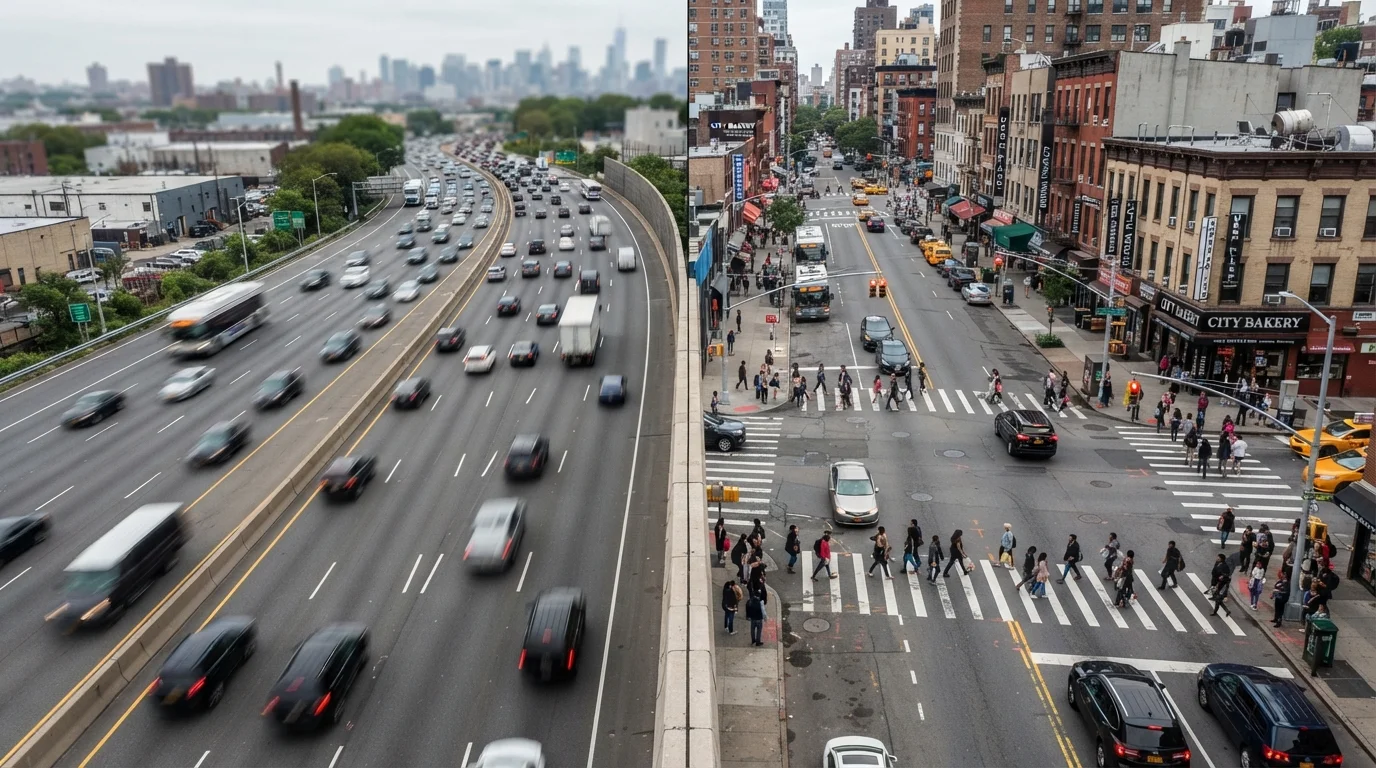
Key Takeaways
Option A
Highway Driving
High-speed, sustained-focus travel with fewer decision points.
Best for: Drivers covering long distances, commuting between cities, or navigating interstates at consistent speeds.
Option B
City Driving
Constant, rapid decision-making in a dense, unpredictable environment.
Best for: Urban commuters and drivers navigating stop-and-go traffic, pedestrians, cyclists, and frequent turns.
If you're a newer driver building confidence
City Driving (practice first)
Lower speeds give you more time to correct mistakes, though the complexity is high. Mastering city navigation builds foundational hazard recognition before tackling highway speeds.
If fatigue or sustained focus is your challenge
Highway Driving (requires active countermeasures)
Highway monotony can cause attention drift; plan regular breaks and use lane discipline tools like cruise control carefully to stay alert on long trips.
If you're coaching a teen or new driver
Highway Driving (introduce it deliberately)
Freeway driving has a steep learning curve around merging and speed judgment. A structured introduction, as outlined in our freeway driving guide, reduces risk significantly.
The Core Difference: Decision Frequency vs. Decision Consequence
At its heart, the highway versus city divide comes down to two variables: how often you must make a critical decision, and how severe the consequences are when something goes wrong.
City driving is a high-frequency decision environment. In a single mile of urban travel, a driver may encounter a dozen traffic lights, multiple crosswalks, turning vehicles, cyclists in bike lanes, and pedestrians stepping into the road. Each demands rapid assessment and response - often in under a second. The speed is lower, but the cognitive load is relentless.
Highway driving is lower in decision frequency but higher in consequence per decision. Traveling at 65-75 mph, the margin for error shrinks dramatically. A lane change executed poorly, or a following distance that's too short, can produce a chain-reaction collision with little time to intervene. Drivers who underestimate how much space they need at speed are a consistent source of rear-end crashes on interstates.
Understanding this distinction helps drivers calibrate their mental state before they even pull onto the road. See also the broader framework in our Safe Driving in America overview for how these environments fit into the full picture of road safety.
Highway-Specific Skills: Speed Management and Spatial Awareness
Highway driving rewards smoothness. Abrupt braking, sudden lane changes, and erratic speed adjustments are amplified by the velocity of surrounding traffic. The skills that matter most include:
- Merging at speed: Entering a highway requires matching the flow of traffic - not stopping at the end of a ramp. Drivers must judge gaps accurately and accelerate to highway speeds before merging. Our introduction to freeway driving covers this in detail for those new to interstates.
- Following distance: At 65 mph, a vehicle travels roughly 95 feet per second. The widely accepted guideline of a three-second gap between vehicles gives drivers meaningful reaction time - though many drivers maintain far less.
- Lane discipline: Keeping right except to pass reduces conflict and keeps traffic flowing. Lingering in the left lane contributes to road rage and dangerous passing maneuvers.
- Vigilance against fatigue: Highway monotony is a genuine hazard. Reduced visual stimulation can cause attention to drift - or, in severe cases, microsleep. Night driving amplifies this risk considerably.
| Criterion | Highway Driving | City Driving |
|---|---|---|
| Typical speed range | 55-75 mph | 15-45 mph |
| Decision frequency | Low but sustained | High and constant |
| Primary hazard type | Speed differential, fatigue | Pedestrians, intersections |
| Key skill | Smooth merging, spacing | Hazard scanning, anticipation |
| Fatigue risk | Higher (monotony-induced) | Lower, but mentally taxing |
| Lane change complexity | High consequence at speed | More frequent, lower speed |
| Stopping distance required | Much longer | Shorter, but sudden stops common |
City-Specific Skills: Hazard Scanning and Anticipation
Urban driving is fundamentally about anticipation. The most experienced city drivers are always processing what might happen - not just what is happening. Key city-driving skills include:
- Intersection scanning: Even on a green light, experienced drivers scan cross-traffic before entering. Red-light runners are a real and documented hazard in U.S. cities.
- Pedestrian and cyclist awareness: Urban environments mix vulnerable road users with vehicles constantly. Scanning sidewalks and bike lanes - especially before right turns - is non-negotiable.
- Managing blind spots at low speed: Parallel-parked cars can conceal pedestrians stepping out between vehicles. Slowing near parked cars is a habit many drivers skip until it matters. Our article on common lane-change errors addresses blind spot management in more depth.
- Reading driver behavior: City drivers learn to watch wheels - not just turn signals - to predict what another vehicle will do. A car's front wheels turning toward the lane line is a stronger signal than a blinker that was forgotten.
~40%
Urban share of U.S. traffic fatalities
According to NHTSA data, a significant share of fatal crashes occur in urban areas, where pedestrian and intersection conflicts are concentrated.
3 seconds
Recommended minimum following gap at highway speed
Traffic safety organizations broadly recommend a minimum three-second following distance on highways, increasing in adverse weather or reduced visibility.
95 ft/sec
Distance covered per second at 65 mph
At 65 mph, a vehicle covers approximately 95 feet every second, illustrating how quickly the margin for error disappears at highway speeds.
The habits new drivers are never formally taught are especially relevant in city environments, where instincts and pattern recognition matter as much as knowledge of the rules.
Transitioning Between Environments
One of the least discussed driving challenges is the mental gear-shift required when moving from one environment to the other. Drivers leaving a highway and entering city streets often carry residual highway-speed perception - a phenomenon sometimes called highway hypnosis carryover - where 35 mph feels unnaturally slow after sustained high-speed travel. This can cause drivers to unconsciously drift above posted city speed limits.
Conversely, drivers accustomed to city stop-and-go who suddenly enter a freeway may underestimate how quickly space closes at highway speeds, or hesitate during merge windows. Building awareness of these transitions - and consciously resetting your mental state - is a practical safety habit that formal driver training rarely emphasizes.
This article is for general informational and educational purposes. Driving conditions, regulations, and best practices vary by state and locality. Always follow posted signage and applicable traffic laws in your area.