

Key Takeaways
Why Roundabouts Confuse American Drivers
The United States has historically relied on traffic signals and stop signs, so many drivers reach adulthood without ever formally learning roundabout rules. Yet the number of roundabouts in the U.S. has grown sharply over recent decades - the Federal Highway Administration has documented consistent safety benefits, including reductions in fatal crashes of roughly 90 percent and injury crashes of around 75 percent compared to conventional intersections.
The confusion is understandable. Roundabouts require drivers to make quick decisions about yielding, lane selection, and signaling - often without prior instruction. According to the Insurance Institute for Highway Safety, the U.S. still has far fewer roundabouts per capita than countries like the United Kingdom or France, meaning most American drivers simply have less practice. This guide closes that gap.
For a broader look at the driving habits that licensing tests often overlook, see our guide to road safety habits new drivers are never formally taught.
What you will need
How to Navigate a Roundabout Safely
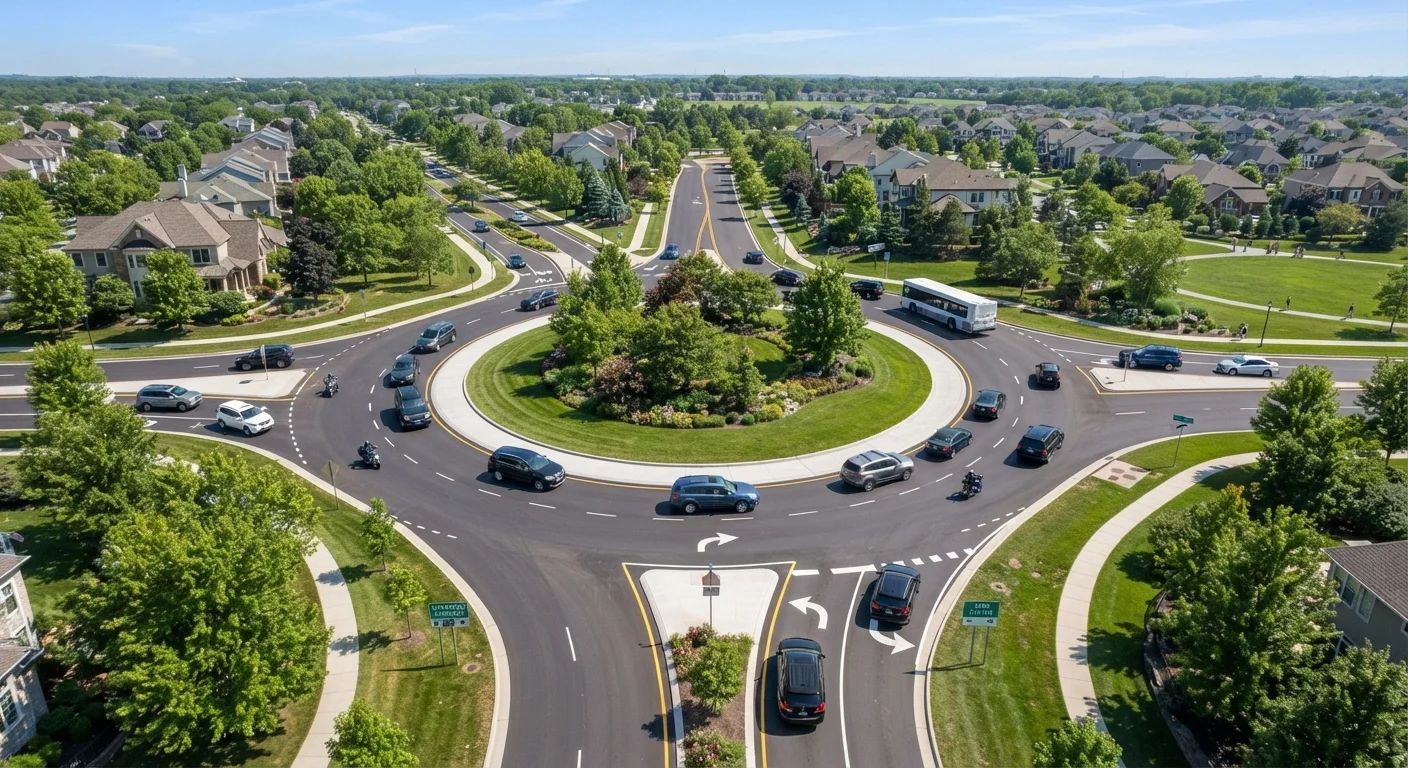
Follow these steps every time you approach a roundabout - whether it is a compact single-lane circle or a larger multi-lane intersection.
Slow down well before the yield line
Begin decelerating as soon as you see the roundabout warning sign - a yellow diamond with a circular arrow. The posted advisory speed inside most U.S. roundabouts ranges from 15 to 25 mph. Slowing early gives you time to read lane markings, signs, and traffic already in the circle.
Choose your lane before you enter
At a single-lane roundabout, there is only one choice. At a multi-lane roundabout, read approach signs and pavement markings to select the correct lane for your intended exit before you reach the yield line. Changing lanes once inside the circle is unsafe and, in many jurisdictions, prohibited.
Yield to circulating traffic - not the other way around
The fundamental rule: traffic already inside the roundabout has the right of way. Wait at the yield line until there is a safe gap in the circulating flow, then enter smoothly. Do not stop unless necessary - but never force your way in. A common mistake is treating the roundabout like a four-way stop and waiting for drivers inside to wave you through; that creates unpredictable hesitation for everyone.
Maintain your lane and speed through the circle
Once inside, keep a steady, controlled speed. Stay in your chosen lane, keep a safe following distance from the vehicle ahead, and resist the urge to brake sharply. Scan continuously for pedestrians and cyclists, who may be crossing at splitter islands between the circulatory roadway and exits.
Signal your exit, then leave
Activate your right turn signal as you pass the exit before the one you intend to take. This tells drivers waiting at the yield line that you are leaving - helping them judge when it is safe to enter. Exit at a controlled speed, watching for any pedestrians in the crosswalk at the exit.
Practice in Low-Traffic Conditions First
If roundabouts are new to you, seek out a quiet single-lane roundabout during off-peak hours to build comfort with the yield-and-enter rhythm. Confidence with the basics makes multi-lane roundabouts significantly easier to handle. Familiarity with road signs at the approach also helps - our road signs reference guide covers roundabout-specific warning signs.
Multi-Lane Roundabouts: Special Considerations
Multi-lane roundabouts follow the same core rules but demand more planning. Entering the wrong lane is one of the most common errors - and it can force a driver to cut across lanes inside the circle, which is dangerous.
- Use the right lane if you are turning right or going straight (typically the first or second exit).
- Use the left lane if you are going straight through or making a left turn (typically the third exit or beyond, including a U-turn).
- Lane markings and overhead signs at the approach will indicate which lane leads to which exit. Read them early - last-second lane changes inside a roundabout are a leading cause of sideswipe crashes.
Proper lane discipline in roundabouts is closely related to the broader challenge of lane changing. Our article on what drivers consistently get wrong when changing lanes covers the habits that reduce sideswipe risk in any environment.
Never Stop Inside a Circulating Roundabout
Stopping abruptly within the roundabout - unless to avoid a collision - can cause rear-end crashes from vehicles behind you. If you are unsure of your exit, complete another loop rather than stopping or reversing. Reversing inside a roundabout is dangerous and illegal in most U.S. states.
For a comprehensive look at safe driving across all road types, visit our complete overview of safe driving in America.