

Key Takeaways
Unit Pricing
Unit pricing is the cost of a product broken down into a standard measurement — such as per ounce, per pound, per count, or per fluid ounce. It appears as a small number on a shelf tag, separate from the total price. Unit pricing lets you compare two differently sized packages on an apples-to-apples basis, regardless of package size or promotional packaging.
Unit price is calculated by dividing the total retail price by the number of units (ounces, count, etc.). Retailers are legally required to display unit pricing in many U.S. states, though the specific rules and measurement standards vary by state.
The Number Most Shoppers Ignore
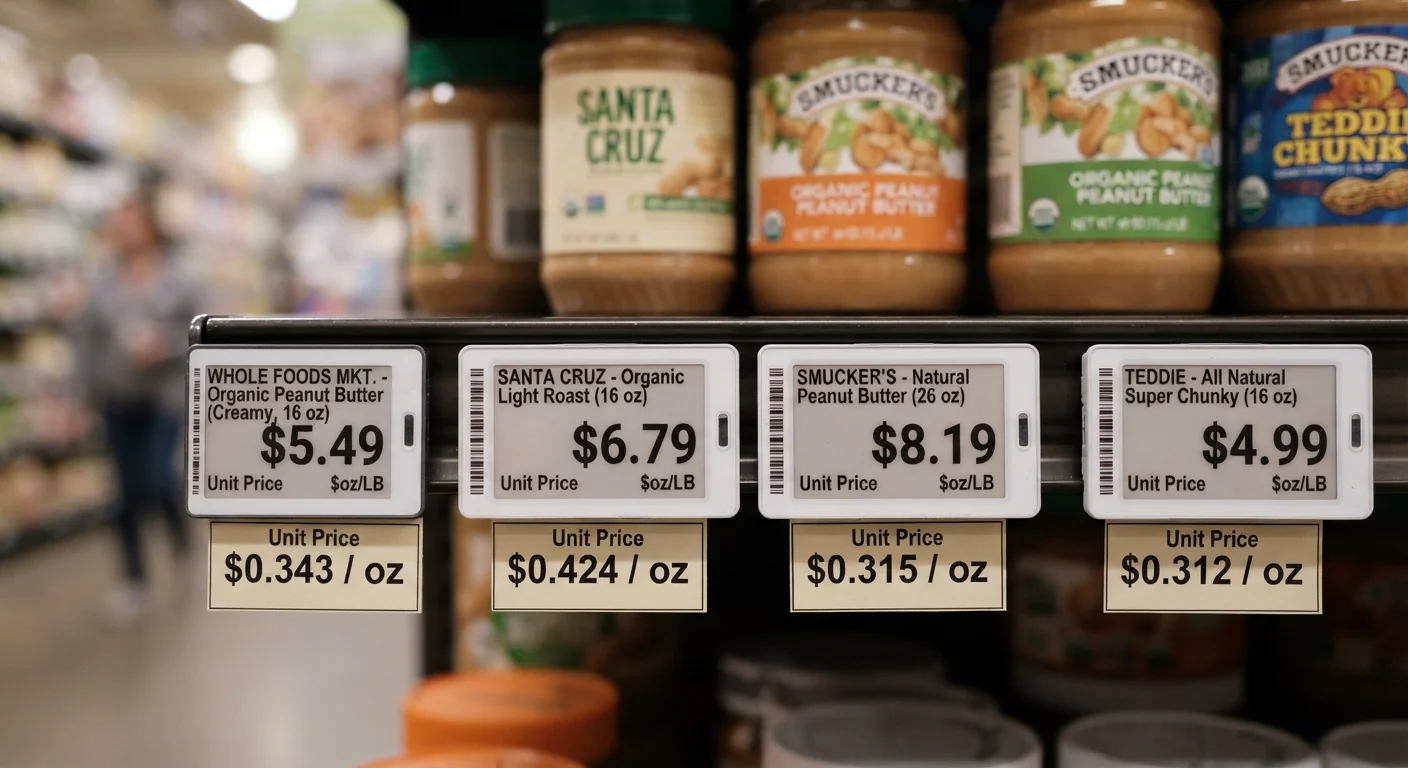
When you grab a product off a shelf, your eye goes straight to the big price on the tag — $4.99, $8.49, whatever it is. That number tells you what you'll hand over at checkout. But it tells you almost nothing about whether you're getting value for your money.
The unit price — that smaller, quieter number — is the one that actually does the work. It standardizes cost across different package sizes so you can make a real comparison. Without it, you're essentially guessing which size or brand is the better deal based on packaging and gut instinct, neither of which is particularly reliable.
Retailers are required to display unit pricing in many states, and most major grocery chains do so voluntarily. Yet consumer research consistently shows that shoppers overlook it. Part of the reason is layout: shelf tags cram a lot of information into a small space, and the total price is always the most prominent figure. Training yourself to find and read the unit price takes about thirty seconds to learn and pays off every time you shop.
~35%
Shoppers who regularly use unit prices
Consumer surveys have found that a minority of grocery shoppers actively consult unit pricing when making purchase decisions, despite near-universal availability in major chains.
Up to 30%
Potential cost variation within one product category
Studies on grocery pricing have found per-unit costs for the same product type can vary by 20–30% across package sizes and brands on the same shelf.
How to Read It — and What Can Trip You Up
Unit prices are straightforward in concept, but a few quirks can catch you off guard.
- The unit of measure matters. Paper towels might be priced per sheet or per 100 sheets. Laundry detergent might be per fluid ounce or per load. Before comparing two tags, confirm they're using the same unit — otherwise the comparison is meaningless.
- Bigger isn't automatically cheaper. The assumption that warehouse sizes or family packs always win on unit price is widespread but often wrong. Specialty flavors, limited editions, or promotional sizes sometimes carry a higher unit cost than the standard package.
- Sale tags can obscure the math. A bright red "on sale" banner draws attention to the total price discount, not the unit price. The sale item may still be more expensive per ounce than a non-sale alternative right next to it. See our article on how sale pricing tactics work for a deeper look at this dynamic.
Quick Trick When Tags Are Confusing
If two tags use different units of measure, pull out your phone's calculator. Divide each product's total price by its package quantity to get your own unit price. It takes under a minute and removes any ambiguity. Some grocery store apps also display unit prices in their product listings, which can help when shopping online or comparing before you leave home.
Unit pricing also pairs well with label literacy. Once you know the cost per ounce, you can cross-reference it with what you're actually getting in the package — something our guide on reading nutrition labels covers in detail for food products.
Where Unit Pricing Changes the Game
The most practical application of unit pricing is comparing store brands against name brands. The quality gap between the two varies significantly by product category, but the price gap is always visible in the unit price. Store brand comparisons become far more useful when you can see exactly how much more — or less — you're paying per unit.
Beyond brand comparisons, unit pricing is useful when evaluating bulk purchases, subscription quantities, and multipack deals. If a subscription delivery promises savings, the unit price gives you an objective benchmark to verify that claim rather than take it on faith.
The discipline is simple: before you put a product in the cart, glance at the unit price. It takes seconds and removes guesswork from one of the most repetitive financial decisions you make — grocery shopping.