

Key Takeaways
The Saving vs. Investing Confusion
Most people learn early that saving money is virtuous. And it is — up to a point. The problem arises when savers treat their savings account as the finish line rather than the starting block. Saving and investing are not interchangeable strategies; they serve different financial functions, operate on different timelines, and carry different risks.
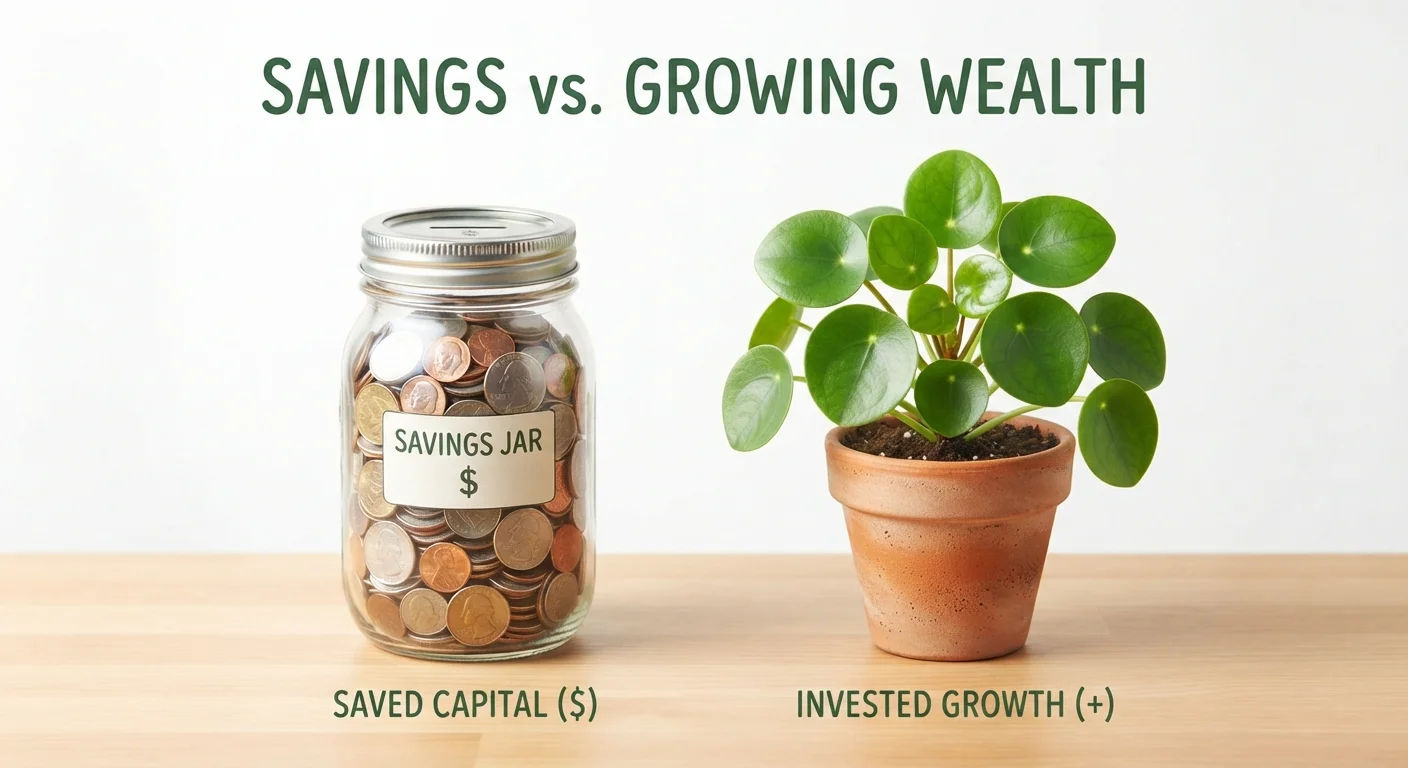
Saving typically means setting money aside in a liquid, low-risk account — a checking account, traditional savings account, or money market account. The priority is access and preservation. Investing, by contrast, means putting money to work in assets — such as stocks, bonds, or index funds — with the expectation of growth over time, accepting some degree of risk in exchange for higher potential returns.
When every spare dollar goes into a savings account indefinitely, the money is protected but not growing meaningfully. Understanding the distinction is foundational to any wealth-building plan. For a broader look at how these pieces connect, see the full picture on saving and growing money over time.
Myth
If I save more money each month, I'm automatically building wealth faster.
Fact
Saving more increases your financial cushion, but wealth growth depends on where that money is placed and how it earns returns over time.
Depositing more into a traditional savings account improves your liquidity and security — both important goals. However, if that account earns an interest rate below the inflation rate, your real wealth is not growing; it may actually be declining in purchasing power. Wealth accumulation requires assets that appreciate or generate returns above inflation, which savings accounts alone rarely accomplish over the long term.
Myth
Keeping all my money in savings is the safest financial strategy.
Fact
Holding excess cash beyond your emergency fund in low-yield accounts exposes you to inflation risk, which quietly reduces what your money can actually buy.
The concept of 'safe' varies depending on the time horizon. For short-term needs, savings accounts are appropriate — they're stable, insured, and accessible. But for money you won't need for five or more years, the greater risk is often doing nothing. Inflation steadily reduces purchasing power, and a strategy that avoids all market risk may accept a different kind of risk: the near-certain erosion of real value over time.
Myth
You need a large lump sum before you can start investing.
Fact
Many investment vehicles are accessible with small, regular contributions, and starting early with modest amounts can outperform delayed large deposits.
The belief that investing requires significant upfront capital keeps many people on the sidelines longer than necessary. In practice, employer-sponsored retirement accounts, index funds, and other vehicles often accept small recurring contributions. Thanks to compounding — where returns generate their own returns — the time your money is invested frequently matters more than the initial amount. Waiting to accumulate a 'sufficient' sum can forfeit years of compounding growth.
Myth
Saving and investing are essentially the same thing.
Fact
Saving preserves money with minimal risk; investing grows money by accepting measured risk in exchange for higher potential returns.
These two activities have distinct roles in a financial plan. Savings accounts are for goals with short timelines or needs requiring immediate access — an emergency fund, a car purchase next year, a vacation fund. Investments are for goals that are years or decades away, where riding out market fluctuations is feasible. Treating these as interchangeable leads to either unnecessary risk on short-term goals or missed growth on long-term ones.
Why Inflation Makes 'Safe' Savings Risky
There is a widely held assumption that keeping money in savings is the safest financial move. But safety has a hidden cost. When the interest rate on a savings account is lower than the prevailing rate of inflation, every dollar parked there is losing real purchasing power — slowly, invisibly, and continuously.
Consider a simple example: if your savings account earns 1% annually but inflation runs at 3%, your money's real value shrinks by roughly 2% each year. Over a decade, that erosion compounds into a meaningful loss of purchasing power, even though your account balance technically grew.
~3%
Average U.S. inflation rate over the past decade
The Federal Reserve targets 2% annual inflation as a long-run benchmark, and actual rates have varied — sometimes significantly — above that level in recent years.
< 1%
Average traditional savings account APY
According to the FDIC, the national average interest rate on traditional savings accounts has historically remained well below the rate of inflation for extended periods.
This is not an argument against keeping savings — emergency funds and short-term goal savings absolutely belong in accessible, stable accounts. The question is whether excess cash, beyond what you need for near-term goals, should remain idle. For most people building long-term wealth, the answer involves putting that surplus to work. Exploring how compound interest works clarifies why time in the market can matter as much as the amount invested.
Don't Confuse Liquidity With Growth
A fully funded emergency account is a financial necessity — but money held beyond that threshold in a low-yield account is not a neutral choice. It is a decision to accept inflation risk. Periodically reviewing whether your cash holdings align with your actual short-term needs can prevent inadvertent wealth erosion. Review your overall savings structure at least once a year.
Building Habits That Bridge Both Worlds
The practical solution is not to choose between saving and investing — it's to build a system that does both deliberately. Financial educators commonly recommend maintaining three to six months of essential living expenses in a liquid savings account before directing surplus income toward investments. This emergency fund acts as a financial buffer that prevents you from liquidating investments at an inopportune time.
Once that foundation is in place, consistent investing — even in modest amounts — tends to outperform sporadic large deposits. This is partly because of dollar-cost averaging, a strategy in which you invest a fixed amount regularly regardless of market conditions, reducing the impact of short-term volatility over time.
For those just establishing these habits, saving in your 20s offers a practical starting point. And if you're sorting out which savings vehicle matches your timeline and goal, matching savings vehicles to your goals is a useful guide. Be mindful of common savings traps that can quietly offset your progress even when your habits look solid on the surface.
This article is for general informational and educational purposes only and does not constitute personalized financial, investment, tax, or legal advice. Consult a qualified financial professional before making decisions specific to your financial situation.