

Key Takeaways
Mortgage
A mortgage is a loan used to purchase real estate, where the property itself serves as collateral. The borrower agrees to repay the loan — plus interest — over a set period, typically 15 or 30 years, through regular monthly payments. If the borrower stops making payments, the lender has the legal right to take ownership of the property through a process called foreclosure.
Mortgages are governed by both federal law (including the Truth in Lending Act) and state-level regulations, which determine disclosure requirements, foreclosure procedures, and borrower protections.
The Basic Structure of a Mortgage Payment
Every month, homeowners send a payment to their lender — but that payment is doing more than one job simultaneously. A standard mortgage payment consists of four components, often abbreviated as PITI: principal, interest, taxes, and insurance.
Principal is the portion that directly reduces what you owe on the loan. Interest is the lender's fee for extending you credit. Taxes and insurance are typically collected in an escrow account held by the servicer and disbursed on your behalf to local tax authorities and your homeowner's insurer.
The principal and interest portions are determined at closing and remain fixed for the life of a fixed-rate loan. The tax and insurance portions fluctuate as those costs change. For a full breakdown of what you pay at closing and beyond, see our guide on mortgage points, origination fees, and closing costs.
30 years
Most common US mortgage term
According to the Consumer Financial Protection Bureau, the 30-year fixed-rate mortgage remains the dominant loan product among American homebuyers.
~$100K+
Additional interest on a typical 30-year loan vs. 15-year
General amortization modeling shows that a $300,000 loan at comparable rates can cost well over $100,000 more in total interest over 30 years versus 15 years.
First 5 years
When interest dominates each payment most heavily
On a standard 30-year amortizing mortgage, interest accounts for the majority of each monthly payment throughout the earliest years of the loan.
How Amortization Works — and Why It Matters
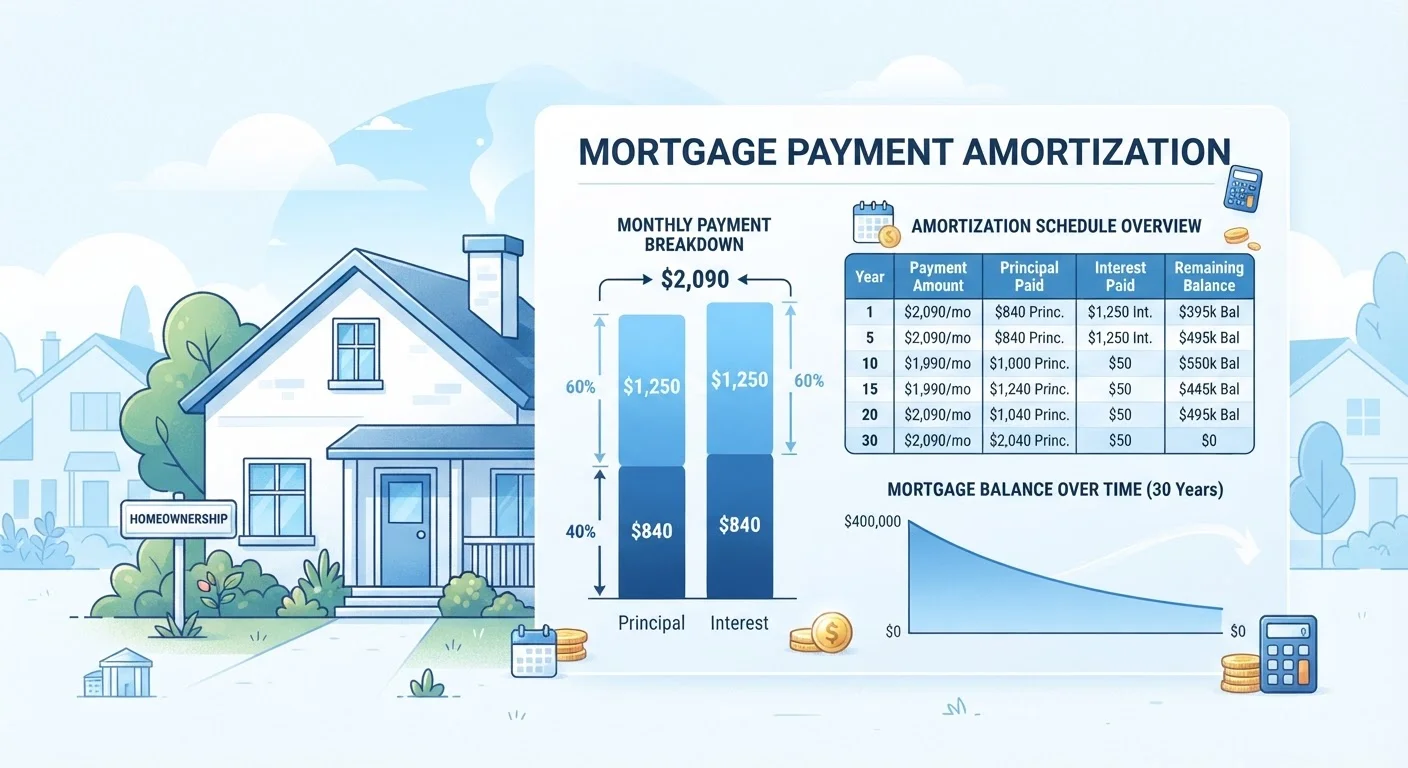
Amortization is the mathematical process that converts your loan balance into equal monthly payments spread over the loan term. The key insight most borrowers miss: even though your payment amount stays constant, the composition of each payment shifts dramatically over time.
On a 30-year fixed-rate mortgage, the first payment you make directs the large majority toward interest, with only a small slice reducing the principal. By the final years of the loan, the ratio flips — nearly all of each payment chips away at the remaining balance.
This happens because interest is calculated on the outstanding balance. In month one, the balance is at its peak, so interest charges are at their highest. Each payment reduces the balance slightly, which reduces the next month's interest charge, which allows a slightly larger slice to go toward principal. This compounding effect accelerates slowly at first, then more noticeably in the loan's second half.
Make Extra Payments Count
When making an additional payment, explicitly instruct your loan servicer to apply it to the principal balance — not toward future payments. Some servicers default to applying extra funds as prepaid scheduled payments, which does not reduce your balance as quickly. A written or online instruction ensures the payment works the way you intend.
You can request an amortization schedule from your lender at any time. It shows, payment by payment, exactly how much goes to principal and interest over the life of the loan — useful for evaluating extra-payment strategies. Unfamiliar with some of the terms on that document? Our home financing glossary explains common mortgage terminology in plain language.
The Long Game: Total Cost Over the Life of the Loan
The sticker price of a home and the total cost of buying it with a mortgage are two very different numbers. On a 30-year loan, the cumulative interest paid can add up to a substantial sum — sometimes exceeding the original loan balance itself, depending on the interest rate.
Loan term plays a decisive role. A 15-year mortgage carries a higher monthly payment than a 30-year mortgage at the same rate, but the total interest paid over the life of the loan is dramatically lower — both because the rate is typically lower on shorter-term loans and because interest has far fewer years to compound.
Interest rate, even in fractions of a percentage point, also has outsized long-term consequences. A difference of half a percentage point on a $350,000 loan translates to thousands of dollars over 30 years.
For homeowners who already have a mortgage, understanding these mechanics is also the foundation for evaluating whether refinancing makes sense. Our article on mortgage refinancing walks through when the math favors that decision. And if you want to understand the rate structure of your loan itself, see our explainer on fixed-rate vs. adjustable-rate mortgages.
This article is for general informational and educational purposes only. It does not constitute personalized financial, legal, or mortgage advice. Consult a qualified financial adviser or licensed mortgage professional before making decisions about your own home financing.