

Key Takeaways
Mortgage Closing Costs
Closing costs are the fees and charges you pay to finalize a home purchase or refinance — on top of your down payment. They typically include lender fees, third-party service charges, prepaid expenses, and optional discount points. These costs are due at the closing table and generally range from 2% to 5% of the loan amount.
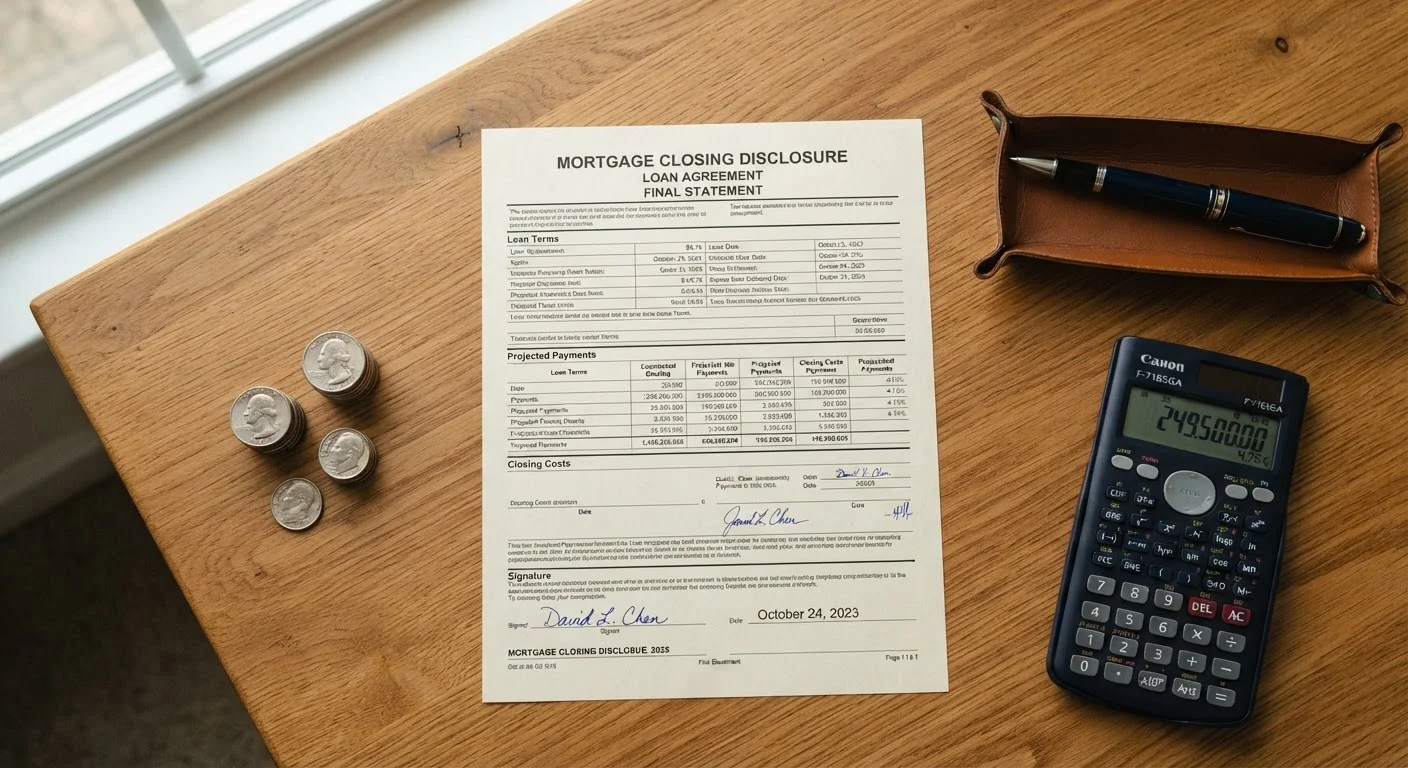
Closing costs are itemized on two federally mandated disclosures: the Loan Estimate (issued within three business days of application) and the Closing Disclosure (issued at least three business days before closing). Comparing these two documents line by line is one of the most effective ways to catch unexpected fee increases.
The Three Layers of Upfront Mortgage Costs
When you close on a home loan, three distinct categories of costs converge: discount points, lender origination fees, and third-party closing costs. Conflating them leads to confusion — and sometimes to overpaying without realizing it.
Lenders are required under the federal RESPA (Real Estate Settlement Procedures Act) and TRID rules to disclose all costs on a standardized Loan Estimate. The Loan Estimate and Closing Disclosure are your primary tools for understanding — and challenging — what you're being charged. Reviewing both documents side by side before signing is essential.
For a broader look at how all your upfront homebuying cash is allocated, see where your earnest money, down payment, and closing costs actually go.
2%–5%
Typical closing cost range as a share of loan amount
According to the Consumer Financial Protection Bureau (CFPB), closing costs commonly fall in this range, varying by loan size, state, and lender.
$6,000–$12,000
Estimated average closing costs on a $300,000 home
Based on the 2%–4% range commonly cited by federal housing resources; actual amounts vary significantly by location and loan terms.
0.25%
Approximate rate reduction per discount point
This is a commonly cited general estimate; the actual rate reduction per point varies by lender, loan type, and current market conditions.
Discount Points: Buying Down Your Interest Rate
A mortgage discount point is a form of prepaid interest. You pay an upfront lump sum to reduce your loan's interest rate — typically, one point costs 1% of the loan amount and reduces the rate by roughly 0.25%, though the exact reduction varies by lender and market conditions.
Whether points make financial sense depends on one calculation: the break-even period. If one point on a $400,000 loan costs $4,000 and saves you $60 per month, you break even in about 67 months — just over five and a half years. If you sell or refinance before that point, the prepayment was a net loss.
Run a Break-Even Calculation Before Buying Points
Before agreeing to pay discount points, ask your lender for the exact monthly payment difference between the two rate options. Divide the upfront point cost by that monthly savings to find your break-even month. Only consider points if your expected ownership period clearly exceeds that threshold — and remember that a future refinance resets the clock.
Points appear on Section A of your Loan Estimate under "Origination Charges." They may be listed as "Discount Points" or as a percentage. Confirm with your lender exactly how many basis points of rate reduction you're receiving per point paid, since this ratio varies.
For context on how your rate interacts with your total loan cost over time, see how a mortgage's principal and interest work over its full term.
Origination Fees: What the Lender Charges to Make the Loan
Origination fees cover the lender's cost of processing, underwriting, and funding your loan. They may appear as a single line item — often 0.5% to 1% of the loan amount — or broken into sub-charges like application fees, underwriting fees, or processing fees. Regardless of the label, they represent compensation to the lender.
Unlike third-party costs, origination fees are set by the lender and are therefore negotiable, particularly for borrowers with strong credit profiles or significant assets. Lenders competing for your business may reduce or waive certain fees. Comparing Loan Estimates from multiple lenders is the most reliable way to benchmark whether a fee is competitive.
Lender Credits Work in the Opposite Direction
A lender credit is essentially a negative point — the lender pays some of your closing costs in exchange for a higher interest rate. This reduces your cash due at closing but increases your ongoing monthly payment and total interest paid. It can be a useful tool for buyers who are cash-constrained at closing but plan to refinance or sell within a few years. Always model the long-term cost before accepting a lender credit.
One important distinction: a lender offering a "no-origination-fee" loan may compensate through a higher interest rate or by charging points. Always evaluate the full cost picture — rate, points, and fees together — rather than optimizing for a single line item.
Third-Party Closing Costs: The Rest of What You Owe
Beyond lender fees, closing costs include charges from third parties involved in the transaction. Common items include:
- Title search and title insurance — verifies ownership history and protects against undisclosed claims
- Appraisal fee — paid to the appraiser who determines the property's market value for the lender
- Attorney or settlement agent fee — varies by state; some states require attorney presence at closing
- Government recording fees — charged by the local government to record the deed and mortgage
- Prepaid items — homeowners insurance premium, prepaid mortgage interest, and initial escrow deposits for taxes and insurance
Prepaid items are not strictly fees — they're funds collected in advance for ongoing obligations. They still require cash at closing and must be factored into your total out-of-pocket calculation. The homebuying process involves coordinating these costs across multiple service providers, which is why reviewing your Closing Disclosure carefully before settlement day matters.
These costs also appear in refinance transactions. For a look at how closing costs factor into a refinance decision, see when refinancing makes financial sense.
What's Negotiable and What Isn't
A common misconception is that closing costs are fixed. In practice, two categories apply: lender-controlled fees, which have negotiating room, and third-party and government fees, which generally do not.
Lender-controlled items — origination charges, rate lock fees, and sometimes application fees — can often be reduced by negotiation or by choosing a lender with a more competitive fee structure. You also have the right under RESPA to shop for your own title company and settlement agent in most states, which can affect those costs.
Government recording fees, transfer taxes, and mandated insurance products are set by law or regulation and are not negotiable. Understanding which category each fee falls into lets you focus your energy where it can actually make a difference.
Decisions made here affect your loan's long-term cost in ways that compound. For more on how choices at origination shape what you pay over time, see why borrowers often pay more than expected on their mortgage.
This article is for general informational and educational purposes only and does not constitute financial, legal, or lending advice. Mortgage costs, fees, and regulations vary by lender, loan type, and state. Consult a licensed mortgage professional, HUD-approved housing counselor, or qualified financial adviser for guidance specific to your situation.