

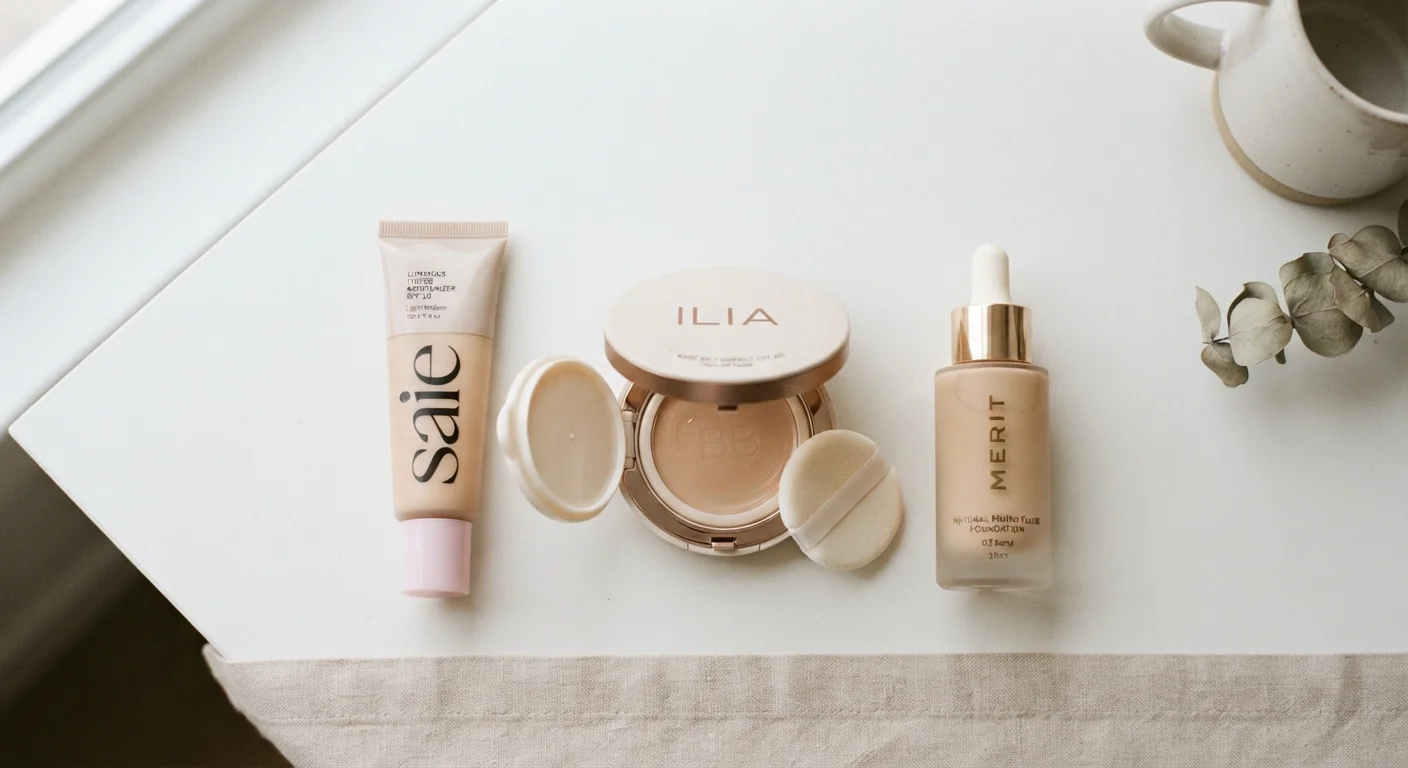
Key Takeaways
Our Verdict
Tinted moisturizer, BB cream, and foundation each solve a slightly different problem. If you want a quick, skin-first look with minimal steps, tinted moisturizer or BB cream will likely serve you better. If coverage, longevity, and finish control are priorities, foundation earns its place in the lineup. Understanding what each product is actually designed to do makes it much easier to choose — or mix — with confidence.
| Best for | Recommended |
|---|---|
| Minimal-step routines or dry skin needing hydration | Tinted Moisturizer |
| Multitaskers who want skin-care benefits plus coverage | BB Cream |
| Those who want precise coverage and finish control | Foundation |
| Beginners building a simple, adaptable base routine | BB Cream or Tinted Moisturizer |
What Each Product Is Actually Doing
At a glance, tinted moisturizer, BB cream, and foundation all seem to do the same job: add a little color and even out your complexion. But the similarities end there. Each product has a different primary function, and knowing that changes how you evaluate them.
Tinted moisturizer is essentially a hydrating moisturizer with pigment mixed in. The coverage is sheer — it takes the edge off redness or uneven tone without masking your skin. It's designed to feel weightless and nourishing, which makes it a natural fit for anyone already happy with their skin and looking for a little polish. If you want to understand how moisturizer works in a broader routine, our everyday skincare routine guide lays out the basics clearly.
BB cream (short for beauty balm or blemish balm) is more of a hybrid. It typically bundles moisturizer, a little coverage, and often SPF into one formula. Coverage is light to medium, and many BB creams include skin-care actives like niacinamide or hyaluronic acid. Think of it as a multitasker with more to offer than a tinted moisturizer but less customization than a foundation.
Foundation is the most versatile of the three. It comes in sheer, medium, and full-coverage formulas across a wide range of finishes — matte, satin, dewy, skin-like. Its job is to create a base that you can layer other products on top of, and the range of shades is generally far broader. The tradeoff is more product, more steps, and more attention needed to blend it well.
| Tinted Moisturizer | BB Cream | Foundation | |
|---|---|---|---|
| Coverage Level | Sheer | Light to medium | Light to full |
| Typical Finish | Natural, dewy | Natural to satin | Varies widely by formula |
| Skin-Care Benefits | Hydration focused | Hydration, SPF, actives | Minimal, formula-dependent |
| Shade Range | Often limited | Moderate | Generally broadest |
| Best Skin Types | Dry, normal, sensitive | Most skin types | All, with right formula |
| Routine Complexity | Minimal | Low to moderate | Moderate to involved |
| Wear Duration | Shorter | Moderate | Longer with setting |
How Skin Type Shapes the Decision
Your skin type is one of the most useful filters when choosing between these three options — and it often clarifies things quickly. For a deep dive into what your skin type actually means for product choices, see our article on understanding your skin type.
Dry or dehydrated skin typically responds well to tinted moisturizer, since the added hydration works with the skin rather than sitting on top of it. Many BB creams are also a good fit here, especially those formulated with emollient or humectant ingredients. Heavy, matte foundations can emphasize dry patches if your skin isn't thoroughly prepped first.
Oily or combination skin often gets more mileage from a foundation — specifically one formulated with oil control or a matte finish. Tinted moisturizers can slide or look shiny on oilier skin types. Some BB creams address this with oil-absorbing ingredients, so formula matters as much as product category.
Sensitive skin tends to benefit from fewer ingredients, which often points toward a straightforward tinted moisturizer with a short, gentle ingredient list. Some BB creams contain fragrance or active ingredients that may not suit sensitive skin — checking the label carefully is always worthwhile.
Try Before You Fully Commit
If you're unsure which formula suits your skin, many beauty counters and stores offer samples or testers. Apply a small amount along your jaw — not your wrist — to see how the color, texture, and finish actually perform on your face. Give it an hour before judging the final result, since many formulas shift slightly as they oxidize or set on the skin.
Coverage, Finish, and Longevity at a Glance
Beyond skin type, three practical factors usually drive the final call: how much coverage you want, what finish you're going for, and how long the product needs to last.
Coverage runs sheerest to fullest in this order: tinted moisturizer → BB cream → foundation. If you're comfortable with your skin texture and just want color correction, tinted moisturizer is plenty. If you're covering more visible unevenness or blemishes, foundation (or a concealer paired with a lighter base) gives you the most control.
Finish is harder to generalize by product category, since it varies by formula. That said, tinted moisturizers almost universally deliver a natural or dewy finish. BB creams tend toward natural to satin. Foundations span the full range — you can find a dewy skin-tint foundation or a full-coverage matte formula depending on what you're after.
Longevity generally increases with coverage weight. A tinted moisturizer worn alone may need a touch-up by midday in humid weather. Foundation, especially when set with powder, tends to last longer. A setting spray can extend the wear of any base product significantly.
For those newer to building a base routine, our beginner's makeup guide walks through product order and application techniques without the overwhelm.
~60%
Of base makeup users prefer lighter coverage for daily wear
Consumer surveys from the cosmetics industry consistently show lighter-coverage formats trending upward for everyday use over the past several years.
SPF 15–30
Typical SPF range in BB creams
Many BB creams include broad-spectrum SPF, though dermatologists note that typical application amounts may deliver less protection than the labeled value.
Mixing, Layering, and Making It Work for You
One of the most freeing things to know is that these products don't have to compete with each other — they can work together. Blending a drop of tinted moisturizer into your foundation sheers it out for a more skin-like finish. Applying a BB cream as a base and dabbing foundation only where you want more coverage is a common technique for a natural-but-polished look.
Layering works best when you think about the order of product application — lighter, more fluid textures typically go on before heavier ones. Your moisturizer (or skincare base) goes on first, then your tinted moisturizer, BB cream, or foundation. Concealer, if you use it, usually goes on after your base product.
If you're relying on your BB cream for SPF, apply it as the last step in your skincare routine and first step in your makeup routine — and make sure you're applying enough to get the sun protection on the label. A thin swipe rarely delivers the full SPF value.
Ultimately, the right base product is the one that fits your skin, your schedule, and the look you actually want to walk out the door with. None of these options is more legitimate or more advanced than the others — they're just different tools. Try one, adjust, and don't overthink it.