

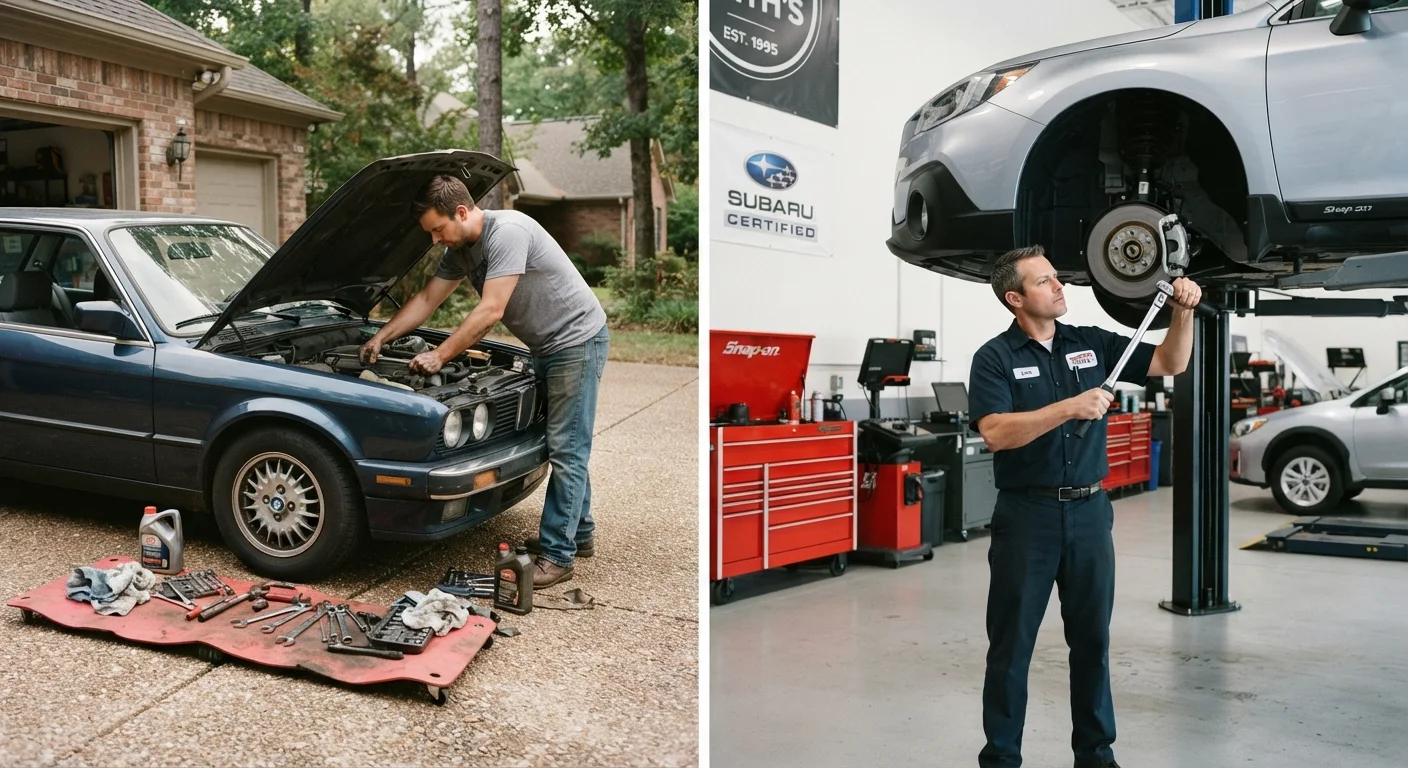
Key Takeaways
Reduces labor costs on routine tasks
Labor charges often represent 50% or more of a shop invoice. Handling simple services yourself - oil changes, filter swaps, fluid top-offs - can meaningfully lower your annual maintenance spend.
Builds firsthand knowledge of your vehicle
Regular hands-on maintenance helps you notice early warning signs - unusual wear, fluid discoloration, loose connections - before they become expensive problems.
Flexible scheduling on your own timeline
You're not waiting for an appointment or leaving your car overnight. Simple tasks can often be completed in under an hour on a weekend.
Control over parts and product quality
You choose exactly which oil, filter, or fluid goes into your vehicle, and you can verify it meets manufacturer specifications rather than relying on shop inventory choices.
Higher risk on complex or safety-critical systems
Mistakes on brakes, steering, or suspension components can create serious safety hazards. These systems have zero margin for error and typically require specialized tools to service correctly.
Upfront tool investment can be significant
A basic socket set, oil drain pan, floor jack, and jack stands represent a real upfront cost. Specialty tools for specific repairs can add up quickly and may only be needed once.
Risk of voiding or complicating warranty claims
While U.S. law generally protects your right to DIY maintenance, you must document the work carefully. Incomplete records or unapproved materials can complicate a warranty dispute.
Missed diagnostic opportunities
Professional technicians often spot unrelated issues during a routine service. A home mechanic focused on a single task may overlook developing problems elsewhere on the vehicle.
Improper disposal and environmental responsibility
Used motor oil, coolant, and batteries require proper disposal at designated facilities. Improper disposal is both environmentally harmful and potentially illegal.
Our Verdict
DIY maintenance is a genuine money-saver for routine, straightforward tasks - but only when done correctly with the right tools and knowledge. For anything involving safety-critical systems, emissions equipment, or advanced diagnostics, a qualified mechanic is the safer, smarter call. Most drivers benefit from a blend of both approaches.
Best for mechanically confident drivers who want to handle routine upkeep themselves while knowing where to draw the line and hand off to a professional.
What Counts as DIY-Friendly Maintenance
Not every service on your vehicle's schedule requires a lift, specialized tools, or years of training. Several routine tasks fall squarely within reach for a careful, motivated driver. These typically include engine air filter replacements, cabin air filter swaps, windshield wiper blade changes, battery terminal cleaning, checking and topping off fluids, and in many vehicles, basic oil and filter changes.
The common thread is low complexity and low risk: these jobs don't put safety-critical systems in jeopardy if done imperfectly, and instructions are widely available in your owner's manual or from reputable automotive sources. If you're unsure which services apply to your vehicle's current mileage, understanding your maintenance schedule is a logical first step before picking up a wrench.
Reduces labor costs on routine tasks
Labor charges often represent 50% or more of a shop invoice. Handling simple services yourself - oil changes, filter swaps, fluid top-offs - can meaningfully lower your annual maintenance spend.
Builds firsthand knowledge of your vehicle
Regular hands-on maintenance helps you notice early warning signs - unusual wear, fluid discoloration, loose connections - before they become expensive problems.
Flexible scheduling on your own timeline
You're not waiting for an appointment or leaving your car overnight. Simple tasks can often be completed in under an hour on a weekend.
Control over parts and product quality
You choose exactly which oil, filter, or fluid goes into your vehicle, and you can verify it meets manufacturer specifications rather than relying on shop inventory choices.
Where DIY Maintenance Falls Short
Modern vehicles are considerably more complex than those of a generation ago. Tightly packaged engine bays, electronic control modules, and torque-sensitive fasteners mean that even jobs that look simple can go sideways without the right equipment or experience. Brake system work, suspension components, timing belt or chain service, transmission fluid exchanges on sealed units, and anything touching airbag or advanced driver-assistance system (ADAS) sensors should generally be left to a qualified technician.
Beyond complexity, there's a warranty dimension. Many new-vehicle powertrain warranties require that maintenance be performed according to manufacturer specifications. While the Magnuson-Moss Warranty Act generally protects your right to perform your own maintenance without voiding a warranty, you'll need documented proof that the work was done correctly and with approved materials. Cutting corners on a repair that then causes a larger failure is also a real risk - and one that deferred or improper maintenance tends to amplify over time.
Higher risk on complex or safety-critical systems
Mistakes on brakes, steering, or suspension components can create serious safety hazards. These systems have zero margin for error and typically require specialized tools to service correctly.
Upfront tool investment can be significant
A basic socket set, oil drain pan, floor jack, and jack stands represent a real upfront cost. Specialty tools for specific repairs can add up quickly and may only be needed once.
Risk of voiding or complicating warranty claims
While U.S. law generally protects your right to DIY maintenance, you must document the work carefully. Incomplete records or unapproved materials can complicate a warranty dispute.
Missed diagnostic opportunities
Professional technicians often spot unrelated issues during a routine service. A home mechanic focused on a single task may overlook developing problems elsewhere on the vehicle.
Improper disposal and environmental responsibility
Used motor oil, coolant, and batteries require proper disposal at designated facilities. Improper disposal is both environmentally harmful and potentially illegal.
The Real Cost Comparison
Labor typically accounts for a substantial share of any shop invoice. For a basic oil change, you might pay $50-$100 at a shop, while doing it yourself could cost $25-$40 in materials - though you'll also need to factor in the cost of disposal, your time, and any tools you don't already own. For more involved services, the savings gap can widen considerably.
That said, the math isn't always straightforward. A professional technician may catch an unrelated issue during a service visit - worn brake pads, a leaking coolant hose, a low tire - that a home mechanic might miss. Small services skipped or done incorrectly can snowball into repair bills that dwarf any labor savings. The cost case for DIY is strongest when you already have the tools, you're confident in the procedure, and you're disciplined about following up on anything unusual you find.
~50%
Share of repair bill that is labor
Industry estimates consistently show that labor costs make up roughly half of a typical automotive repair invoice, making it the primary driver of shop cost differences versus DIY.
3 in 10
Drivers who perform some DIY maintenance
Consumer surveys from automotive research organizations suggest roughly 30% of U.S. drivers perform at least some routine maintenance tasks themselves, most commonly oil changes and filter replacements.
Making a Hybrid Approach Work for You
The most practical path for most drivers isn't a strict either/or choice. Handle the straightforward, low-risk tasks yourself to build familiarity with your vehicle and reduce routine costs. Bring in a professional for anything involving brakes, suspension, emissions systems, or electronic diagnostics - and for annual inspections that give a trained eye a full look at the vehicle's condition.
Whatever approach you choose, maintaining a thorough service log is essential. Record dates, mileage, what was done, and what products were used. This documentation supports your vehicle's resale value, helps mechanics work more efficiently, and keeps you honest about what's overdue. You can also use it to identify patterns - a vehicle that keeps consuming coolant or burning oil is telling you something, regardless of who performed the last service.
Know Your Vehicle's Specific Requirements
Owner's manuals vary significantly by make, model, and model year. Some vehicles use synthetic oil with extended change intervals; others have sealed transmissions that require dealer-level tools to service. Before attempting any maintenance task, consult your owner's manual and verify the correct specifications - don't rely solely on generic online guides. When in doubt, a quick call to a dealership's service department can clarify requirements at no cost.
This article provides general educational information about vehicle maintenance and is not a substitute for advice from a qualified mechanic. Safety-critical repairs should always be performed by a licensed professional.