

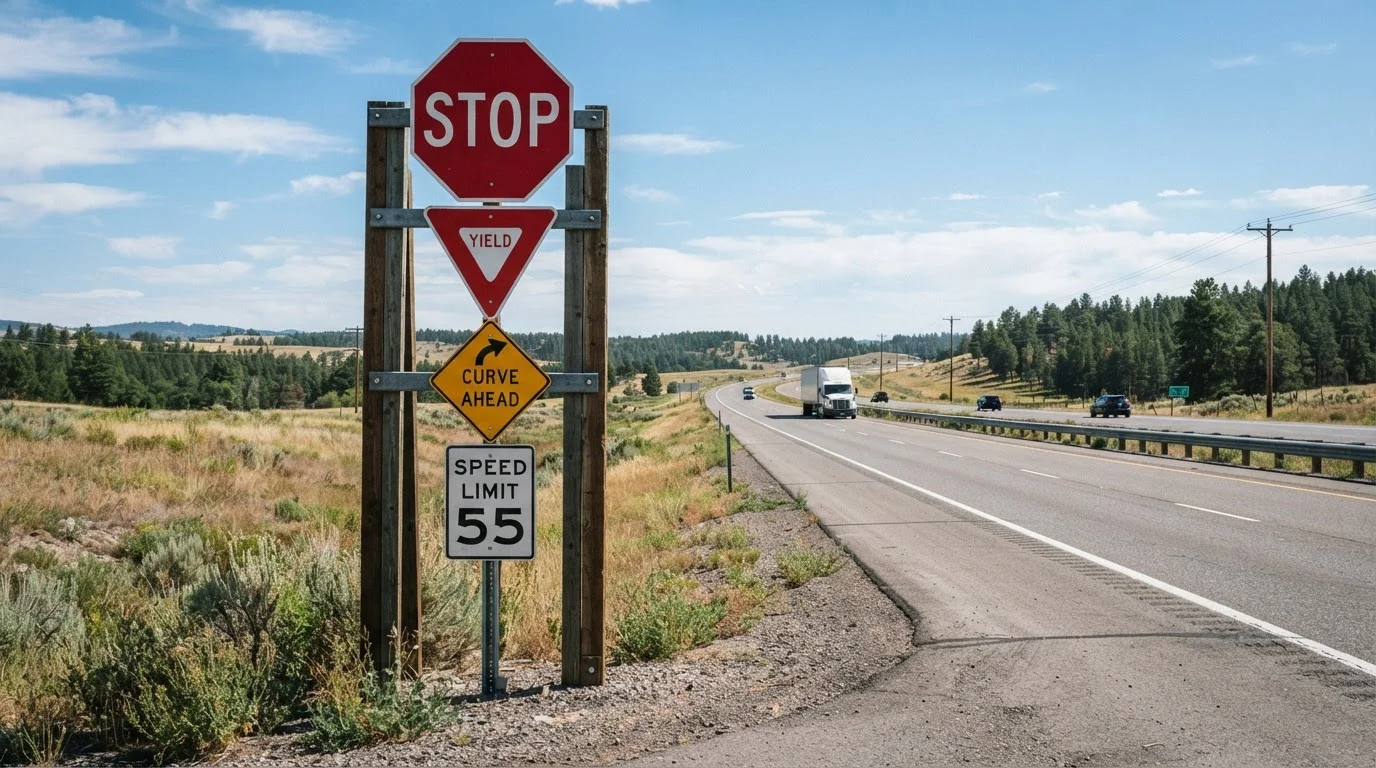
| Standard governing U.S. signs | MUTCD (Manual on Uniform Traffic Control Devices) (Federal Highway Administration) |
| Primary sign categories | Regulatory, Warning, Guide (MUTCD, current edition) |
| Shape: Regulatory stop | Octagon (red with white text) |
| Shape: Warning signs | Diamond (yellow or fluorescent yellow-green) |
| Shape: Yield sign | Downward-pointing equilateral triangle (MUTCD) |
| Color: Highway guide signs | Green with white text |
| Color: Traveler service signs | Blue with white text |
| Color: Recreational/cultural signs | Brown with white text |
The Three Categories Every Driver Must Understand
U.S. road signs are organized into three functional categories defined by the MUTCD, the federal standard that governs traffic control across the country. Recognizing which category a sign belongs to tells you instantly what kind of action it demands.
| Standard governing U.S. signs | MUTCD (Manual on Uniform Traffic Control Devices) (Federal Highway Administration) |
| Primary sign categories | Regulatory, Warning, Guide (MUTCD, current edition) |
| Shape: Regulatory stop | Octagon (red with white text) |
| Shape: Warning signs | Diamond (yellow or fluorescent yellow-green) |
| Shape: Yield sign | Downward-pointing equilateral triangle (MUTCD) |
| Color: Highway guide signs | Green with white text |
| Color: Traveler service signs | Blue with white text |
| Color: Recreational/cultural signs | Brown with white text |
Regulatory signs communicate laws. Running a stop sign, ignoring a one-way marker, or misreading a turn restriction aren't honest mistakes - they're traffic violations. These signs are typically white with red or black text and have standardized shapes (octagons, circles, vertical rectangles) that you should recognize before you can even read the words.
Warning signs alert drivers to hazards, changes in road conditions, or unexpected geometry ahead. They use a yellow or fluorescent yellow-green diamond shape and demand you adjust speed or attention. A chevron alignment sign on a curve, for example, is telling you the road bends more sharply than you might expect - not a suggestion to slow down, but a professional assessment that your current speed may be unsafe.
Guide signs - the green highway markers, blue service signs, and brown recreational signs - provide route and destination information. Misreading them rarely creates legal jeopardy, but missing an exit or confusing a route junction can lead to unsafe last-second lane changes. For a broader picture of how sign literacy fits into overall road safety, see the Safe Driving in America overview.
Regulatory Signs Drivers Most Frequently Misread
Several regulatory signs generate consistent confusion even among experienced drivers. Here are the ones worth reviewing carefully.
- Yield
- A downward-pointing red-and-white triangle. It means you must slow and give the right-of-way to traffic in the intersecting road or roundabout - and stop if necessary. It does not mean proceed cautiously without stopping. Roundabout yield rules are a particularly common source of driver error.
- Do Not Enter / Wrong Way
- These two signs are often paired but serve different purposes. "Do Not Enter" (white bar on red) faces drivers approaching a restricted entry point. "Wrong Way" (white on red, rectangular) faces drivers who have already entered a one-way road going the wrong direction. Both demand an immediate, safe stop and reversal of direction.
- No Turn on Red
- Unless this sign is posted, most states permit a right turn on red after a full stop. When the sign IS posted - often at complex intersections or near pedestrian crossings - that permission is revoked entirely. Many drivers treat it as advisory; it is not.
- Regulatory speed signs vs. advisory speed signs
- A white rectangular speed limit sign is a legal maximum. A yellow diamond-shaped speed sign (often posted at curves or ramps) is an advisory - an engineering recommendation for safe speed under normal conditions, not a legal limit. Confusing the two is more common than most drivers realize.
Misreading these signs accounts for a meaningful share of intersection crashes. For habits that go beyond sign knowledge, see road safety habits new drivers are never formally taught.
Warning Signs That Demand a Response, Not Just Awareness
Warning signs are passive-looking - yellow, informational - but several require active driver adjustment, not just mental noting.
MUTCD
The Manual on Uniform Traffic Control Devices - the federal standard published by the Federal Highway Administration that defines the design, placement, and meaning of all traffic signs, signals, and pavement markings in the United States.
Regulatory Sign
A sign that communicates a legally enforceable requirement or prohibition. Failing to comply is a traffic violation, not a judgment call.
Warning Sign
A diamond-shaped yellow or fluorescent yellow-green sign that alerts drivers to upcoming hazards, road geometry changes, or conditions requiring reduced speed or heightened attention.
Advisory Speed
A recommended - not legally mandated - speed for a specific road feature such as a curve or off-ramp, posted on a yellow diamond sign. It reflects engineering guidance for safe navigation under normal conditions.
Guide Sign
Signs providing route, destination, distance, or service information. Green for highway routes, blue for traveler services, and brown for recreational or cultural sites.
Right-of-Way
The legal priority one road user has to proceed before another. Regulatory signs such as Stop and Yield formally assign right-of-way at intersections and merge points.
- Slippery When Wet - A car with wavy skid lines. This sign marks roads with pavement surfaces that become dramatically more slippery in rain. On these stretches, the usual friction assumptions you carry into a curve or stop no longer apply. Reduce speed before reaching the hazard zone, not during. See also: driving in winter weather.
- Divided Highway Begins / Ends - Easily overlooked, but critical. "Divided Highway Ends" means oncoming traffic will now share your roadway with only a painted centerline as separation. Head-on collisions at these transitions are disproportionately fatal.
- Grade Crossing Advance Warning - The round yellow sign with an "X" and "RR" appears well before a railroad crossing. It is positioned specifically to give you enough stopping distance if a train is present. Do not accelerate past it.
- Low Clearance - Rectangular, yellow, posted before underpasses. If you drive a taller vehicle - a van, camper, or truck - you must know your vehicle's height and take this sign seriously every time.
Dashboard symbols are a related category of vehicle warnings that operate on similar logic - you can review what dashboard warning lights actually mean for that parallel reference.
~40%
Of fatal crashes occur at or near intersections
According to Federal Highway Administration data, a significant share of fatal road crashes involve intersection-related factors where sign compliance plays a direct role.
50 states
All adopt MUTCD standards
Every U.S. state is required to adopt sign and signal standards consistent with the MUTCD, ensuring nationwide uniformity in road sign design and meaning.