

Key Takeaways
Our Verdict
Pay-yourself-first tends to produce stronger savings outcomes for people who struggle to save consistently, because it removes the decision from the end of the month — where competing priorities often erode what's left. Traditional budgeting gives more control to those with variable income or complex expense structures who need to see the full picture before committing to savings. Neither method is inherently better; the most effective budget is the one you can sustain.
| Best for | Recommended |
|---|---|
| Consistent earners who want to build savings without constant willpower | Pay-Yourself-First |
| Those with irregular income or complex, changing monthly expenses | Traditional Budgeting |
| Anyone who wants maximum visibility and control over every spending category | Traditional Budgeting |
| People who have historically saved little and want a structural reset | Pay-Yourself-First |
The Core Difference: Where Savings Sits in the Sequence
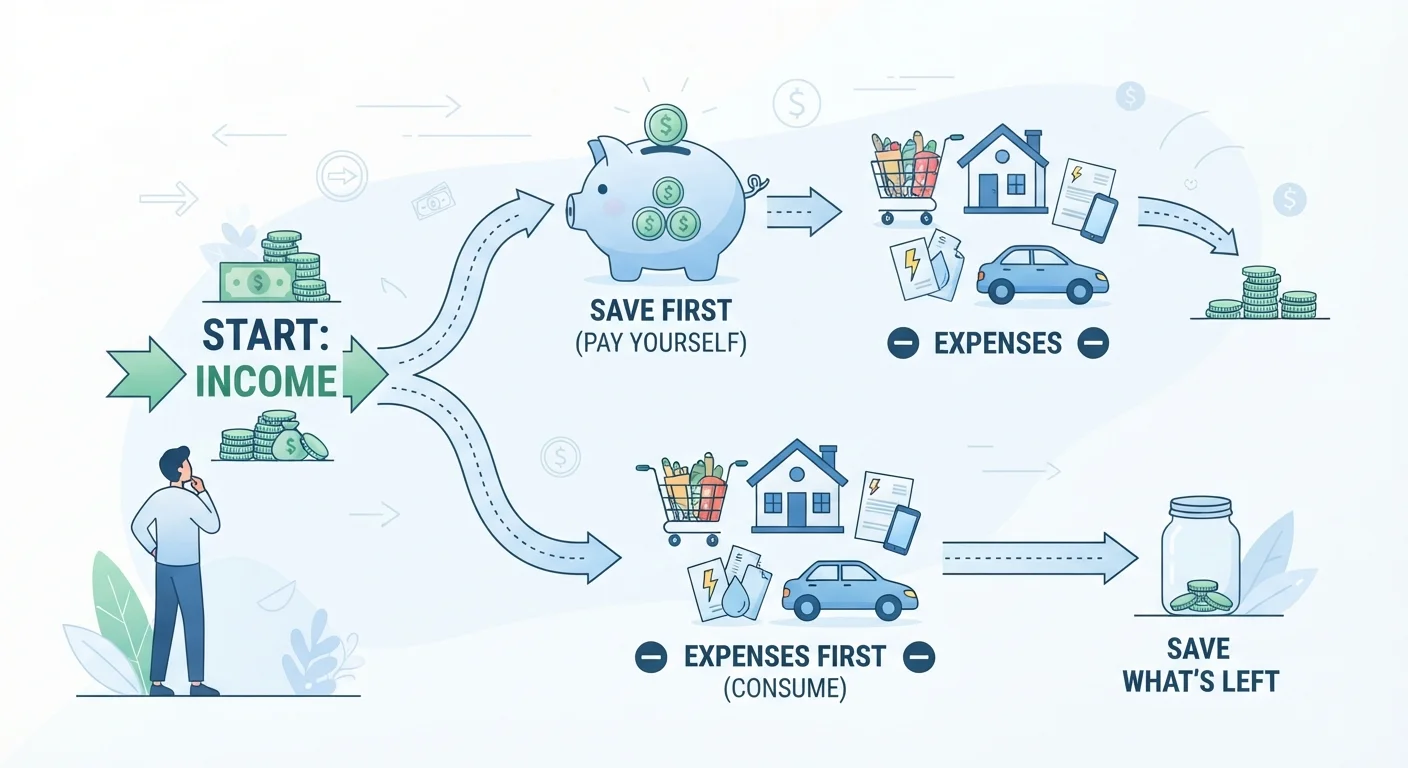
Most people save what's left over at the end of the month. That's the traditional approach in a single sentence. Pay-yourself-first flips that sequence entirely: you move a predetermined amount into savings the moment income arrives, then live on what remains.
This sequencing difference might seem minor, but it has significant behavioral consequences. Under traditional budgeting, savings competes with every other expense — groceries, rent, subscriptions, and discretionary spending all draw from the same pool before savings gets its share. Under pay-yourself-first, savings is non-negotiable and everything else adjusts around it.
If you're new to structuring a budget at all, the ground-up guide for first-time budgeters is a useful foundation before comparing methods.
| Pay-Yourself-First | Traditional Budgeting | |
|---|---|---|
| Starting point | Savings allocated first | Expenses mapped first |
| Savings consistency | High — built into the system | Variable — depends on surplus |
| Spending visibility | Lower — residual spending is flexible | High — every category tracked |
| Best income type | Steady, predictable income | Irregular or variable income |
| Effort required | Low once automated | Ongoing tracking required |
| Risk of undersaving | Low | Moderate to high |
| Flexibility for irregular expenses | Requires cash buffer | Easier to plan for |
How Pay-Yourself-First Works in Practice
The mechanics are straightforward. As soon as a paycheck clears, a set amount — whether a flat dollar figure or a percentage of gross income — transfers automatically to a savings account, retirement vehicle, or investment account. Only then does the remainder flow into everyday spending.
Automation is the backbone of this method. Setting up a recurring transfer or splitting a direct deposit means the decision is made once, not every month. Automating savings removes friction and reduces the risk that the money gets absorbed into spending before it can be set aside.
The method pairs naturally with tax-advantaged accounts. Workplace retirement plans funded by payroll deduction are essentially pay-yourself-first by design — the contribution happens before you see the money. For those exploring savings vehicles, understanding how accounts like IRAs work can help direct those automatic contributions effectively. See the comparison of Roth IRA vs. Traditional IRA for context on the structural differences.
Start Small With Pay-Yourself-First
If you're new to this method, begin with a savings transfer you won't miss — even 3% to 5% of take-home pay. The goal at the start is to establish the habit and prove to yourself the method works before increasing the amount. Most people find they adapt their spending within one to two months and can then raise the savings percentage gradually.
How Traditional Budgeting Works in Practice
Traditional budgeting starts with a full accounting of income and expenses. You map out what you earn, categorize every expected outgoing — rent, utilities, food, transportation, debt payments — and assign amounts to each. Savings enters the picture last, as a category funded by whatever surplus the math produces.
This approach rewards meticulous planners. Because you see all your expenses before committing to a savings number, it's easier to account for irregular costs: a car insurance premium due quarterly, a dental visit, seasonal utility spikes. Understanding your fixed versus variable expenses is especially important here, since the two behave differently and require different planning strategies.
Traditional budgeting also connects well with detailed tracking methods. If you're weighing how to actually record and monitor spending, a look at envelope versus spreadsheet budgeting covers two classic approaches that work alongside this philosophy.
Key Trade-Offs to Weigh
Pay-yourself-first excels at consistency and simplicity. Its primary risk is overcommitting to a savings amount that strains cash flow, forcing reliance on credit for unexpected expenses. Starting with a modest, manageable savings rate and adjusting upward gradually helps avoid this pitfall.
Traditional budgeting's strength is transparency. You understand exactly where every dollar goes. Its weakness is the savings gap: when months get expensive, the savings line item is often the first casualty. Many people who follow this method earnestly still find they save far less than intended.
For a broader view of how other structured methods compare — including zero-based budgeting and values-based approaches — the overview of eight budgeting methods maps out the full landscape. If you're currently using a framework like the 50/30/20 rule, it's worth understanding where that rule has real limitations before assuming it's the right fit.
57%
Americans with less than $1,000 saved
GOBankingRates surveys have consistently found that a majority of Americans hold minimal liquid savings, underscoring the challenge of saving what's left over.
3x
Higher saving rate with automatic transfers
Behavioral economics research, including work cited by the U.S. Consumer Financial Protection Bureau, indicates that automatic saving mechanisms significantly outperform manual saving intentions.
Choosing the Right Starting Point for Your Situation
Neither method produces results without follow-through. The honest question isn't which approach is theoretically superior — it's which one you'll actually stick with given your income pattern, spending habits, and financial goals.
If your income is steady and your biggest obstacle is that savings keeps disappearing before month-end, pay-yourself-first addresses that problem directly. If your expenses fluctuate significantly or you have irregular income, traditional budgeting's full-picture view may serve you better — provided you treat savings as a firm line item rather than an afterthought.
Whichever method you start with, aligning your savings behavior to specific goals strengthens motivation. Understanding how to match savings strategies to your timeline makes it easier to decide how much to set aside and where to put it. For ongoing ideas on building financial habits, the Saving & Growing hub covers practical strategies across a range of situations.
This article is for general informational and educational purposes only and does not constitute personalized financial advice. Consult a qualified financial professional for guidance specific to your circumstances.