

Key Takeaways
Why the Three D's Matter — and Why They Must Be Separated
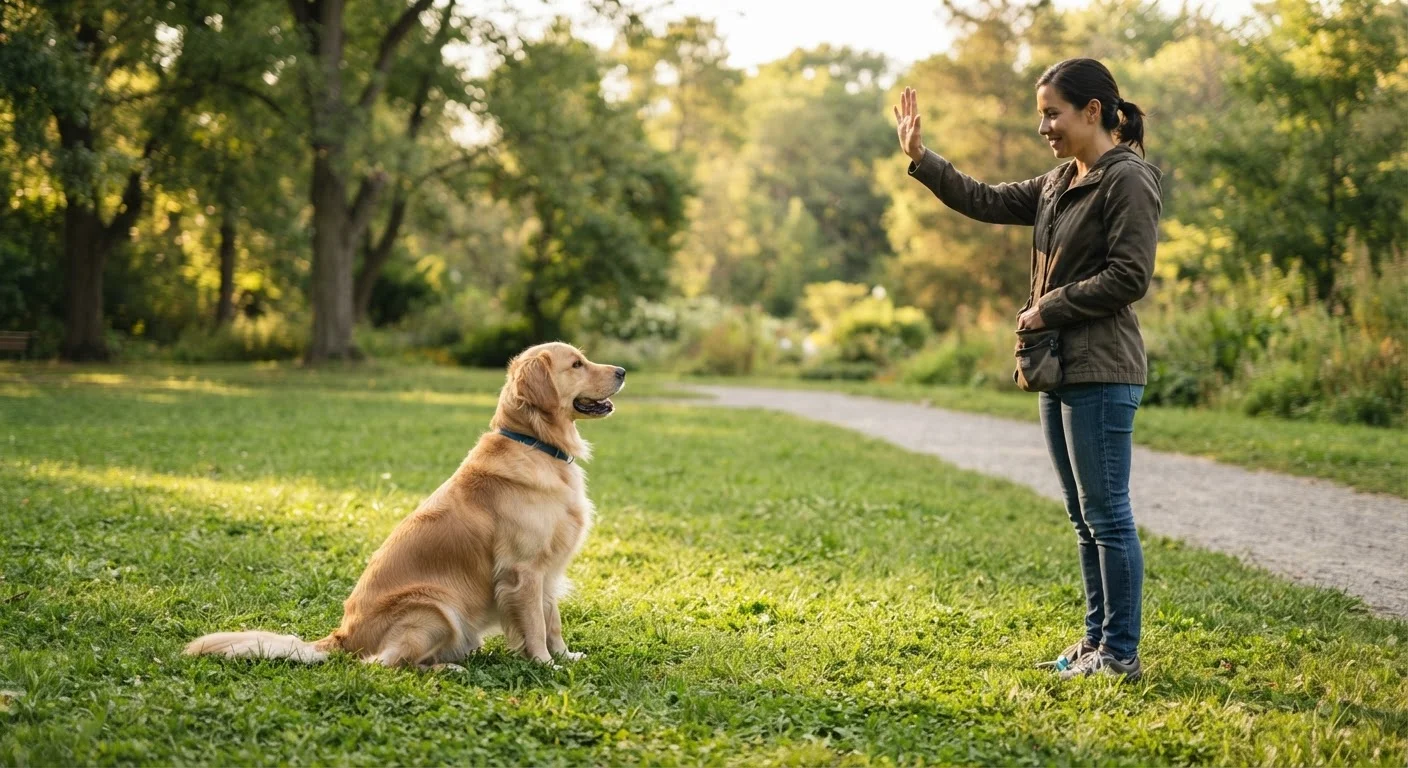
Dog trainers commonly refer to duration (how long the dog stays), distance (how far the handler moves away), and distraction (what is happening around the dog) as the "three D's" of stay training. These are not just vocabulary — they represent fundamentally different cognitive challenges for your dog.
The most common reason owners struggle to build a reliable stay is attempting to increase all three at once. If you step back, stay gone for 30 seconds, and a child runs past simultaneously, your dog is facing a compound problem with no clear path to success. By isolating each variable, you give your dog a genuine chance to understand and succeed at each one before the next layer is introduced. This approach also makes it easy to diagnose where a breakdown is coming from when errors occur.
For a broader framework on how dogs learn and how to structure training progressively, see the complete pet training and behavior reference.
What you will need
What You'll Need Before You Start
Gather your tools, set your environment, and confirm your dog already understands a basic position cue before beginning. A stay cannot be taught to a dog who doesn't yet have a solid sit or down — the position is the foundation the stay rests on.
High-value treats
Provide immediate positive reinforcement the moment your dog holds the stay position.
Marker (clicker or verbal)
Precisely marks the exact moment of correct behavior so your dog understands what earned the reward.
Treat pouch
Keeps treats accessible so reward delivery stays fast and seamless during training.
Long training leash (15–20 ft)
Provides safety when practicing distance stays in outdoor or semi-public environments.
If you're unsure whether to use a clicker or a verbal marker, our article on clicker training vs. verbal markers outlines the practical trade-offs of each approach so you can choose what fits your routine.
Step-by-Step: Teaching the Stay
Work through the steps below in order. Resist the urge to skip ahead — each step builds the neural foundation the next one requires. Most dogs can learn a solid 30-second stay with 5-foot distance within 2–3 weeks of consistent short sessions.
Set up a session for success
Before the first cue, give your dog a short play or sniff break to arrive focused but not over-stimulated. Choose a familiar indoor space with minimal foot traffic. Keep your treats pre-cut and your marker ready. Sessions should run no longer than 3–5 minutes — stop while your dog is still engaged. Review our article on setting up a training session for a full pre-session checklist.
Introduce the stay cue with zero duration
Ask your dog to sit or down. The instant they land in position, say "stay" once in a calm, clear voice, mark immediately, and deliver a treat — all within one to two seconds. You are not yet asking them to hold anything. You are simply pairing the word with the position. Repeat 5–8 times in a row. The goal here is a strong association between the word and being still, not an actual duration.
Build duration: add seconds one at a time
Once your dog holds position for 1–2 seconds reliably, begin stretching time. Ask for a stay, pause 3 seconds, mark, return to your dog, and reward. Gradually increase in small increments — 5 seconds, 8 seconds, 12 seconds — over multiple sessions. Use a variable schedule so the dog never knows exactly when the marker is coming. End every successful stay with your release word before asking for anything else.
Add distance: step away, then return
Only after your dog holds a 15–20 second stay reliably should you introduce distance. Reset duration back to just 2–3 seconds while you begin stepping away. Take one step back, pause, return to your dog, mark, and reward. Gradually build to multiple steps. Turn so your back is briefly to the dog, then return. Each new spatial variable requires duration to be temporarily reduced — this is normal and expected.
Introduce distractions gradually
Distractions are the hardest variable. Start mild: shuffle your feet, clap softly, or drop a low-value item nearby. Reward heavily for staying calm. Progressively increase distraction intensity — a bouncing ball, another person walking past, outdoor sounds. Each new distraction means you should temporarily reduce both duration and distance. Think of distractions as a separate axis you're climbing, not something to stack on top of advanced stays.
Proof the stay across environments
A stay your dog holds in the living room is not yet a stay your dog holds at the veterinarian's office. Dogs learn contextually, so familiar stays must be practiced in new locations. Each new environment effectively resets learning partway — expect a regression and rebuild duration and distance from a lower starting point. Consistent proofing across several weeks is what makes a stay genuinely reliable.
End Every Session on a Win
Finish each training session with a behavior your dog performs confidently — a simple sit, a known trick, or an easy one-second stay. This leaves both of you feeling successful and keeps your dog's association with training sessions positive. A dog who enjoys training shows up enthusiastic for the next session.
Enrichment between sessions also supports training progress. Mental stimulation — puzzle feeders, sniff games, and structured play — helps dogs arrive at training sessions calmer and more receptive. See our article on enrichment activities that support good behavior for ideas that complement your stay work.
Troubleshooting Common Stay Problems
Even with careful progression, most dogs will break the stay at some point. Here's how to interpret and respond to the most frequent issues:
- Dog breaks immediately: The position itself isn't solid enough. Return to reinforcing the sit or down heavily before layering any stay.
- Dog stays well alone but breaks when you move: Your movement is a distraction — treat it as such and add it to the distraction variable rather than the distance variable.
- Dog stays indoors but not outside: Normal context specificity. Rebuild in new environments starting from short, easy stays.
- Dog stays until the treat pouch appears: The pouch has become the cue. Try keeping treats in a nearby bowl instead, or practice with the pouch empty and reward from a separate pocket.
Never Use the Stay as a Timeout
Placing a dog in a prolonged, tense stay as a consequence for unwanted behavior can undermine the cue's positive associations and create anxiety around training. The stay should always be taught and maintained as a calm, rewarding experience. If you need to manage a difficult behavior in the moment, a simple sit and redirect is a better tool.
If you'd like additional structure or a professional perspective on your dog's specific challenges, consider comparing group classes to private instruction to find the format that fits your situation.